Why Is There Something Instead of Nothing?
A Piece of Wax and a Giant Question

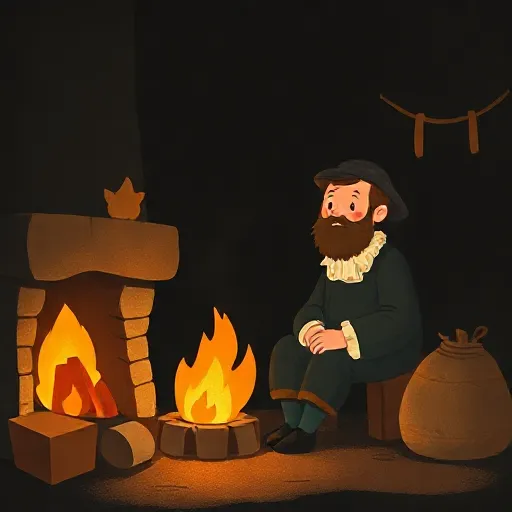
It’s a cold winter evening in 1641. A man sits alone in a room, holding a piece of wax fresh from the hive. It feels hard, smells of honey, and makes a crisp sound when he taps it. Then he moves it toward the fire. The wax softens, loses its shape, and turns into a warm puddle. Every sense tells him it’s a completely different thing. And yet he knows it’s the same wax. How? Not by his senses — they report only constant change. He grasps sameness with his mind alone.
That man was René Descartes (1596–1650), and he was chasing one of philosophy’s biggest questions: why is there something instead of nothing? The thinkers we now call rationalists argued that the answer can be found without any help from the senses. The key, they believed, is reason — the mind’s power to work out truths by thinking alone, much as you figure out that 2 + 2 = 4 without checking a pile of pebbles.
Many rationalists also believed in innate ideas: that the mind is born with certain knowledge already stamped into it, not merely with empty space waiting for experience to fill. If that is true, then the deepest truths about reality are already inside you, waiting to be uncovered. And the deepest of all, they thought, is that reality itself cannot possibly not exist. There is something, they argued, because there must be something. Nothingness is like a round square — impossible. That conviction shaped everything they wrote about substance, the stuff that exists in the most basic way, depending on nothing else.
Descartes’s Two Worlds: Mind and Matter

Descartes defined substance as a thing that exists so completely it doesn’t depend on anything else to be. In the strictest sense, he said, only God fits that definition — everything else depends on God’s power. Still, he allowed that created things, like your mind or a stone, could be called substances in a looser way, because they depend only on God and not on one another.
He ended up with two radically different kinds of created substance. Thinking substance makes up minds. Extended substance makes up bodies — anything that takes up space. Your mind, he argued, has no size, no shape, and you can conceive it existing without any body at all. A lump of wax, by contrast, is nothing but extension: length, breadth, and depth that can shift endlessly. This split is called dualism.
But dualism had a very practical problem — and it was one teenager who spotted it. Princess Elisabeth of Bohemia (1618–1680) read Descartes’s work and wrote to him with a sharp objection. If the mind has no size and no contact with anything, how can it make your arm move? In Descartes’s own physics, a material thing can be moved only by something that touches it. The immaterial mind violates that rule. Elisabeth couldn’t see how pure thought could push a muscle.
Descartes replied that the mind and body form a mysterious union, a composite we grasp not by thinking but by living — through “life and ordinary conversations.” Elisabeth was not satisfied. She eventually suggested that maybe part of the soul itself was extended, giving it something like a surface that could touch. That would solve the contact problem, but it also blurred the crisp dualism Descartes wanted. Their exchange exposed a crack that later rationalists felt they had to seal.
Spinoza and the Single Cosmic Substance

If Descartes saw two kinds of substance, Baruch Spinoza (1632–1677) saw exactly one. He took the idea of substance to its logical extreme. A substance, he argued, must be completely independent — it cannot be divided from another substance or limited by it. If two substances shared an attribute, they would limit each other and wouldn’t be truly independent. But Descartes had allowed many different minds and many different bodies. Spinoza thought that couldn’t stand.
He concluded that there is only one substance, which he called “God or Nature” — a single, infinite reality that contains everything. This substance has infinitely many attributes, even though we can only think about two of them: thought and extension. Everything we perceive as a separate thing — a person, a chair, a thought — is really a mode, a temporary wave in the one substance.
This solved the mind–body problem in a stunning way. For Spinoza, your mind and your body are not two things that need to interact. They are the very same mode, viewed through two different attributes. A change in your body simply is the physical side of what, under the attribute of thought, shows up as an idea in your mind. No magical push is needed, because there is no gap to cross.
Spinoza also drew a bold conclusion about freedom. Because everything follows logically from the nature of the one substance, every event — including your decision to read this sentence — is necessary. Nothing could have happened otherwise. At first that sounds grim, but Spinoza thought understanding this could bring a deep calm. When you grasp that everything that happens is part of the same unbroken chain, you stop thrashing against events and find a kind of peaceful clarity that he called “knowledge under the form of eternity.” The most rational life, he believed, is the good life.
Leibniz and the Windowless Souls
Gottfried Wilhelm Leibniz (1646–1716) admired Spinoza’s drive toward unity but refused to accept that individual things are just waves in one cosmic ocean. He wanted to keep both the logical purity of rationalism and a world of real, distinct individuals. His solution was the concept of the monad: a simple, partless substance that acts as a true atom of nature.
Monads have no windows, Leibniz said. Nothing enters or leaves them; they don’t bump into each other and they don’t exchange messages. Instead, every monad contains, from the moment God creates it, a built-in program — a complete concept — that dictates everything that will ever happen to it and everything it will ever perceive. A monad is like a script that takes the form of a soul, running through every scene of its story in perfect harmony with every other monad. Leibniz called this arrangement pre-established harmony. When you stub your toe, it feels like the world caused your pain, but really your body-monad and your soul-monad were both following their scripts, and they match.
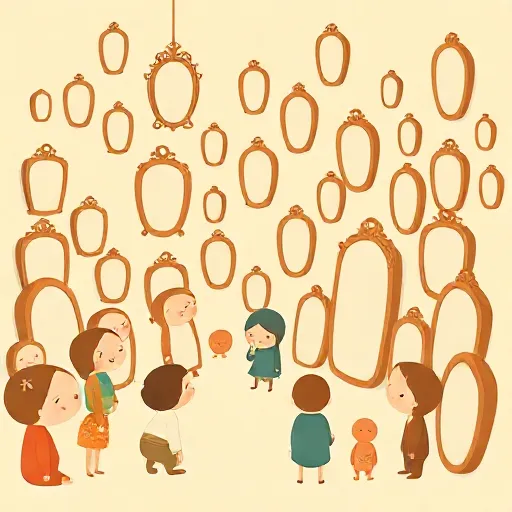
Each monad perceives the entire universe from its own unique perspective, though most perceive only dimly. Monads are like countless mirrors reflecting the same city. Because God selected the combination of monads that produces the richest variety without sacrificing order, this is the best of all possible worlds.
Leibniz gave his monads a complete concept that determines everything about them, but he still wanted to preserve human freedom. So he distinguished between absolute necessity (something whose opposite is a logical contradiction, like a triangle with four sides) and hypothetical necessity (something that must happen given a particular starting point, but which could have been otherwise in a different starting point). Caesar crossing the Rubicon was hypothetically necessary — it followed from Caesar’s complete concept — but there was no logical contradiction in imagining a world where he didn’t. Since God could have chosen a different world-script, the act remains free in a meaningful sense.
For Leibniz, this meant that all real knowledge is already inside us, buried like a lost melody. We don’t learn from the outside; we recall. Reason is the tool that brings the hidden music to the surface.
Why the Rationalist Dream Still Haunts Us

Descartes, Spinoza, and Leibniz disagreed fiercely, but they all shared a conviction: the world makes sense, and human reason — sitting in a chair, peering at wax — can uncover its deepest structure. They saw the universe as something more like a solved equation than a scrambled accident.
Their questions haven’t gone away. Today, cosmologists ask why there is a universe at all, and whether the laws of physics might be necessary in the way the rationalists imagined. Meanwhile, philosophers and scientists debate still whether human choices are fixed chains of cause and effect. Could a super-brain predict everything you’ll do next Tuesday? And if it could, would you still be responsible for your actions? Those debates trace a straight line back to the crackling fireplace where Descartes watched wax melt and tried to catch hold of a truth that would not melt with it.
The rationalists show that you can build gigantic, beautiful systems out of pure thought. Even when those systems don’t quite hold together, the attempt stretches our idea of what a single mind can do.
Think about it
- If every choice you make has a complete set of reasons that guarantee it, do you feel you are still free? Does the feeling matter more than the logic?
- Can the whole universe be like a domino chain where only one final pattern is possible? If so, how would that change the way you think about your future?
- If two people look at the same apple, and each one only ever knows their own idea of it, how can they be sure they are talking about the same thing?