
Is Space Real? The 300-Year Fight That Started with a Spinning Bucket
Newton’s Spinning Bucket: The Case for Absolute Space

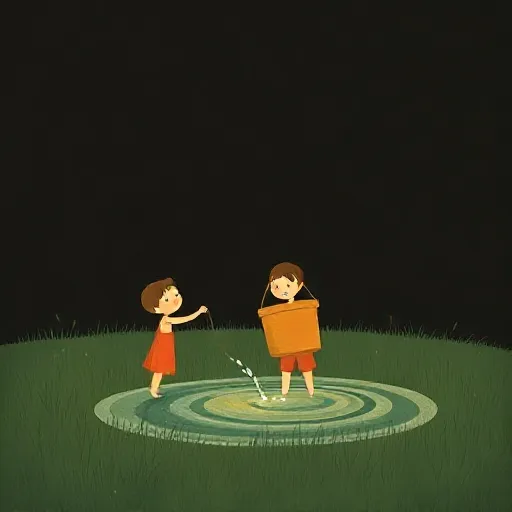
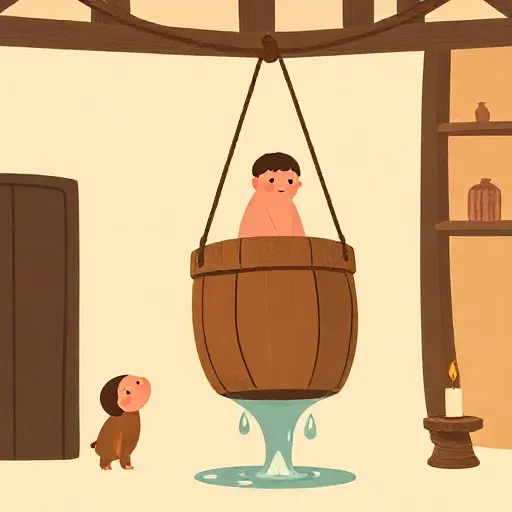
On a quiet evening in 1689, Isaac Newton (1643–1727) stood in his room and spun a bucket of water on a rope. The bucket turned, the water began to rotate with it, and its flat surface slowly curved — climbing the walls and dipping in the center. Newton had seen this a hundred times before. But that night, he saw it as a clue to the deepest nature of space itself.
Newton believed that the curving water proved something astonishing: space exists even where there is nothing. He called this invisible, everywhere-present thing absolute space. It was not made of matter, not a substance you could touch, but a silent container that stays still while everything else moves.
Why did a spinning bucket convince him? Look at the moment just after the bucket starts turning. The water is still flat and still relative to the bucket — it’s not sliding past the sides. Yet it soon begins to rise. Newton argued that this effect cannot be explained just by the water’s motion relative to the bucket. Something else must be the true anchor for its spinning. Absolute space, he concluded, is that anchor. Acceleration and rotation, he thought, are motions relative to absolute space itself — even in a universe completely empty except for the spinning thing. In a famous thought experiment, Newton imagined two globes tied by a cord in an otherwise empty cosmos; if the cord pulls tight, you know they are rotating around their common center, and you know that without looking at anything outside them. Absolute space, he thought, makes that possible.
Mach’s Reply: The Stars Tell You What’s Spinning

Nearly two centuries later, the physicist and philosopher Ernst Mach (1838–1916) read Newton’s argument and shook his head. Newton, Mach said, had jumped too far. All the bucket experiment really shows is that the water curves when it rotates relative to the Earth and the fixed stars. It does not, by itself, prove that an invisible absolute space must exist.
Mach offered two very different ways to drop absolute space. The first, which we might call Mach‑lite, is practical: keep Newton’s laws of motion, but use the distant stars — not absolute space — as the reference frame. That is what astronomers already did. Every time you say a rocket is moving at a certain speed or spinning, you compare its motion to the background of stars. Mach even rewrote Newton’s first law as an equation that sums up the effects of all the mass in the universe, so the fixed stars automatically play the role absolute space used to play. In worlds where the stars are reasonably still, the two pictures make exactly the same predictions.
The second, bolder idea — Mach‑heavy — insists that inertial effects, like the water climbing the bucket, must be caused by the relative motion of all the matter in the universe. Think of it as a kind of gravitational pull from the whole cosmos. Mach threw out a wild suggestion: if you made the bucket’s walls absurdly thick — several leagues of solid metal — maybe simply spinning those walls would tug the water outward, even before the water itself starts turning. That would mean rotation is not about absolute space at all; it’s about what everything else in the universe is doing. Mach‑heavy dreams of a law of gravity that works something like electromagnetic induction, where every bit of moving matter helps decide what counts as “spinning” locally.
Mach never quite separated these two views, and later thinkers would argue about which one, if either, could be made to work.
Einstein’s Rocket: Can You Make Acceleration Disappear?
Albert Einstein (1879–1955) read Mach and wanted to eliminate absolute motion completely. His special theory of relativity (1905) had already banished absolute velocity — you can never tell, by any experiment, whether you’re drifting through empty space at a constant speed or standing still. But special relativity still treated acceleration as absolute: fire a rocket engine and you can definitely feel the difference.
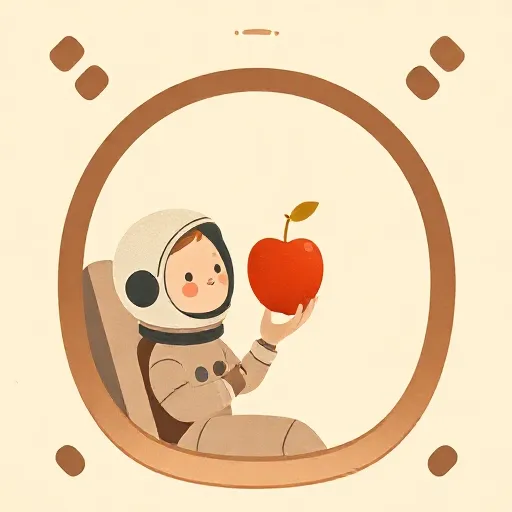
Then, in 1907, Einstein had a thought that struck him as the happiest thought of his life. Imagine you’re shut inside a windowless rocket far from any planet. If the rocket accelerates smoothly upward at exactly 9.81 meters per second squared, every object inside will feel a downward pull — just like gravity on Earth. Drop an apple? It falls to the floor. Stand on a scale? It shows your weight. Einstein saw that no experiment inside the cabin could tell you whether the rocket is accelerating in empty space or standing still on the surface of a planet. He called this the equivalence principle: uniform acceleration and a uniform gravitational field are physically identical.
If a bit of clever reinterpretation can turn acceleration into gravity, Einstein asked, why not go further? Why couldn’t all forms of supposedly absolute motion — even rotation — be seen as different patterns of relative motion in a gravitational field? That question drove him to build the general theory of relativity (1915). In general relativity, the laws of physics are written in a way that is generally covariant — they take exactly the same form no matter what tangled, spinning, twisting path your reference frame follows. Einstein hoped this would at last make motion entirely relative, just as Mach had envisioned.
Did Einstein Kill Absolute Motion? Not Quite

General relativity is a stunningly successful theory, and it contains genuinely Machian effects. There is something called frame‑dragging: if you could build Mach’s thick‑walled bucket and spin it, the rotating mass would gently tug nearby water into motion, as if the bucket’s spin were contagious. Even so, most physicists today agree that general relativity did not fully get rid of absolute acceleration.
Why? First, the theory permits a completely empty universe with no matter at all — yet space, in that case, still has a shape and a structure. That is uncomfortably close to absolute space. Second, you can model a single rotating star in an otherwise matter‑free cosmos. The star’s rotation is still absolute with respect to the background spacetime; there is no cosmic matter to make it relative to. So rotation and acceleration stubbornly refuse to disappear.
Einstein himself, by 1918, admitted the theory did not satisfy Mach’s hope in every possible world. Yet, in our actual universe — with its cosmic web of galaxies — general relativity comes tantalizingly close: the distribution of matter may entirely fix which motions are “inertial,” just as Mach wanted. The same theory gives you both readings, and that is why the fight over absolute space refuses to end.
Why It Still Matters: What Is Space, Really?

Next time you swirl a bucket in the sink, ask yourself the question that started it all: what is the water really spinning in relation to? Is space an invisible stage that stays put while everything else dances, or is it just a shorthand for the distances and directions between all the stuff in the universe?
These aren’t just old‑time puzzles; they sit at the heart of how physicists today try to understand black holes, the expansion of the universe, and the search for a quantum theory of gravity. If space is a real thing, then it can ripple, expand, and perhaps even dissolve. If it is only a web of relationships, then the deepest rung of reality is not “where” things are, but “how” they are connected. Three hundred years after Newton’s bucket, the question “Is space real?” is still wide open.
Think about it
- If you were locked in a windowless rocket and felt heavy, could you ever prove whether you are parked on a planet or accelerating through empty space? What experiment would you try?
- If all motion is only relative, does that mean the Earth isn’t really spinning — and that day and night are just a change in how we relate to the sun?
- Which feels more natural to you: that space is a giant invisible container, or that space is nothing more than the distances between objects? What would make you change your mind?