
Are You Moving Right Now? The 300-Year Argument Over Absolute Space
A Spinning Bucket and a Curve in the Water

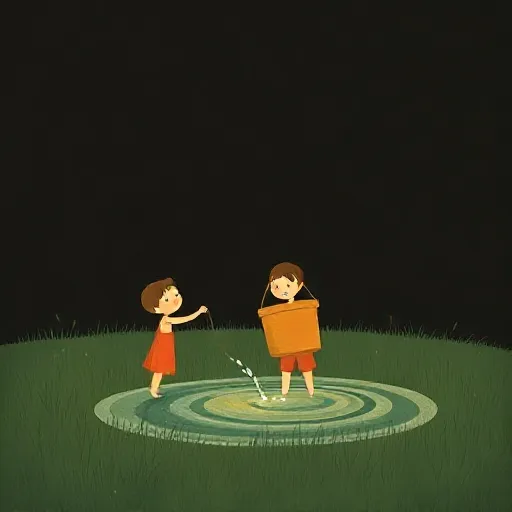
You tie a rope to a bucket of water, swing it around your head, and peer inside. The water no longer lies flat — it climbs up the sides of the bucket and forms a curved, bowl-like surface. Stop spinning, and the water flattens again. It feels obvious: the water is spinning, and that spinning does something to the water. But here’s the puzzle: spinning compared to what? If you say “the bucket,” that doesn’t always work — a moment after the bucket starts spinning, the water is still flat even though it’s moving relative to the bucket. And if the whole bucket of water was the only thing in the universe, would the water still climb the sides? Could you even say it’s spinning at all? This exact scenario, described by Isaac Newton (1643–1727) in 1687, launched a three‑hundred‑year argument about whether there is a true motion — a motion that is real all on its own, not just “real compared to that table or that planet.” It’s an argument about absolute space, and it starts with an ancient Greek.
Aristotle’s Universe: A Center That Pulls Everything Down
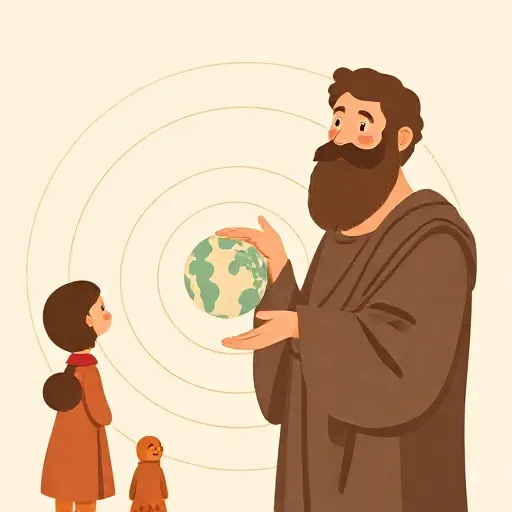
Long before buckets and spinning water, Aristotle (384–322 BCE) offered a simple theory of motion. Heavy things, like rocks, fall down; light things, like fire, rise up. For Aristotle, this wasn’t because of some invisible force pulling from the ground. It was part of the very nature of heavy and light objects. A rock wants to move toward the center of the universe; a flame wants to move away from it. That center, he insisted, wasn’t just the center of the Earth. It was a special point that the Earth happened to occupy. If the Earth were heavy, and it wasn’t already at the center, it would fall there. So up and down are not just directions relative to your feet — they are real, cosmic directions defined by that one ultimate point.
But what is that center? Aristotle sometimes suggested it was determined by the outer sphere of the fixed stars — a relation to a huge shell of bodies after all. He wasn’t wrestling with our question in a modern way, but already we see the problem: if you try to say that some motions are naturally up or down in an absolute sense, you have to say what makes that sense real. Does the center exist on its own, or is it just a way of talking about where the Earth happens to be?
Descartes’s Trick: Motion Is Only Relative — Kind Of
Two thousand years later, René Descartes (1596–1650) tried to banish mysterious invisible centers. He argued that space and matter are the same thing — the universe is jam-packed full of swirling bits, like a bucket of water and ice chunks stirred together. If space is matter, then when a body moves, the space it occupies moves right along with it. That sounds like nothing ever changes place — so how can anything move?
Descartes’s solution: all motion is just motion relative to something else. A boat moves relative to the shore; a person sitting on the boat is at rest relative to the deck. But he knew that ordinary talk isn’t just about any random comparison. He defined a special kind of proper motion: a body really moves only when it changes its immediate contiguous surroundings — the bodies it is directly touching. That, he thought, gave a unique, true sense of motion without needing an invisible absolute space.
Enter Newton. Place a bucket of water on a rope and give it a spin. At first the bucket spins but the water stays flat; in terms of Descartes’s proper motion, the water is moving (it slides past the bucket’s inner sides). Later, the water catches up and spins with the bucket, its surface curving into a bowl — even though now the water is touching the same bucket sides, so proper motion says it is at rest. Descartes’s special “true” motion says the water is moving when it looks still and still when it looks like it’s spinning. That can’t be the mechanically real sense of motion.
Newton’s Bold Idea: Absolute Space

Newton drew a dramatic conclusion. If the water’s curved surface shows that something real is happening, and it isn’t relative to the bucket sides, then the water must be rotating against something else — not a neighbor, but an invisible, unmoving backdrop that fills the entire universe. He called it absolute space: a rigid, eternal, three‑dimensional grid that bodies move through. True motion, for Newton, is simply motion relative to absolute space.
He gave another reason. The water climbs to a particular height on the bucket wall — spin faster and it climbs higher. That height tells you exactly how fast the water is rotating in the mechanically meaningful sense. But relative to any arbitrary object, a body has many different speeds at once (think of a passenger walking up a moving train: walking speed relative to the train, train‑plus‑walking speed relative to the ground, and so on). The fact that the bucket gives a single rate of true rotation means that the mechanically real sense of motion is not just any relative motion. There is one privileged, absolute sense.
Not everyone was convinced. Gottfried Wilhelm Leibniz (1646–1716) pointed out a big problem: while rotation (the curving water) seems absolute, what about plain forward speed without acceleration? According to Newton’s own laws, no experiment inside a smoothly sailing ship can tell you whether the ship is at rest or cruising at a constant speed. Absolute velocity is unmeasurable. If you cannot detect it, can you say that moving‑faster‑than‑absolute‑space is a real thing? And if that’s not real, why believe in the space it requires?
Leibniz Fights Back: Motion Is Force, Not Space

Leibniz had a radically different vision. Space, he said, is not a real substance like a cosmic box. It is something our minds construct — an ideal order we imagine when we compare where things are relative to one another. The universe consists of bodies and their relations, not bodies plus an invisible container.
But then what makes spinning water real, not just an illusion? Leibniz agreed with Newton that there is a true difference between rotating and not rotating. His answer was unexpected: true motion is not about changing location at all. It is about possessing a quantity he called vis viva — “living force.” For Leibniz, a moving body carries within it a certain amount of derivative active force, which appears in collisions as mass times speed squared (what we now call kinetic energy). A body isn’t “truly moving” because it sweeps through absolute space; it truly moves because a certain quantity of force belongs to it directly, as a primitive feature. When the bucket water spins, it gains vis viva — and that’s why the surface bends, not because it shifts against a hidden grid.
This also explains Leibniz’s puzzling reply to Newton’s bucket argument. He wrote, in effect, that there’s a difference between true motion and a mere relative change — but that doesn’t prove absolute space. For Leibniz, the bucket only proves that Descartes’s purely relational “proper motion” cannot be the whole story. It doesn’t force you to believe in an invisible, non‑material space; you can make sense of true rotation by appealing to the forces lodged inside bodies themselves.
Leibniz’s own collision laws fit surprisingly well with this picture. They are what we now call Galilean relativistic — they work the same way in any smoothly moving reference frame, but they don’t treat every arbitrary frame as equal. So he wasn’t saying that any relative motion is as good as any other (a view sometimes mistakenly pinned on him). He was saying that the real quantity is force, not position, and that space is merely a useful fiction we build from relations.
Still Spinning: What This Argument Means Today

The argument didn’t freeze in 1716. In the twentieth century, philosophers and physicists recast the puzzle using spacetime — a four‑dimensional union of space and time. A version called Galilean spacetime showed that you could have absolute acceleration (needed to explain the bucket) without absolute velocity (so Leibniz’s complaint about unmeasurable speed loses its force). Yet the deeper question remains: is that spacetime a real, substantial thing — a modern heir of Newton’s absolute space, a substantivalist picture — or is it just a mathematical way of talking about the relations between real bodies? And if space isn’t a thing, how can the universe make absolute acceleration real? Some contemporary thinkers try to explain rotation entirely by how a system relates to all the distant matter in the cosmos, while others argue that we must simply accept that there are primitive facts about which motions are “true.”
Newton also imagined two identical spheres tied together and spinning in an otherwise empty universe. The cord tying them would pull taut, even with nothing to spin relative to. For many, this thought experiment strongly suggests that rotational motion isn’t just a relation to other bodies — there’s something else, a geometric structure of the world itself, making the tension appear. Others reply that you don’t need a ghostly space if you take tiny cross‑time distance relations between bodies to be real, or if you treat the laws of physics as a concise summary of patterns in relative motions. The fight is very much alive.
Next time you spin a bucket of water — or just spin your own body around — ask yourself: are you rotating against an invisible cosmic grid, or is the world only a web of relations and a hidden current of force? The answer still isn’t settled, and it lives inside every GPS satellite, every particle accelerator, and every playground.
Think about it
- If you were floating in a completely empty universe with no stars or other objects, how could you tell whether you were spinning — and would that feel any different from standing still?
- Some people say that only things you can directly measure count as real. If you could never, even in principle, detect absolute velocity, is it still a real thing? Why might a scientist still want to keep the idea?
- Imagine you are playing a video game where characters move across a screen. Does the “space” they move in exist in the game’s world, or is it just a rule we use to describe where they are relative to each other? Could that be true of the real universe too?