The Spinning Bucket That Shook the Universe
The Bucket That Made Newton Think

Imagine spinning a bucket of water around your head. At first the water stays flat, even though the bucket is whirling around it. But after a few seconds the water starts to spin too — and its surface curves up the sides, like a bowl. Why does that happen? Isaac Newton (1643–1727) thought this simple experiment pointed to something huge: the difference between a motion that is only relative and a motion that is truly real. The question of what it means for anything to genuinely move, rather than just appear to move, set off a 300‑year fight among some of the sharpest minds in history. It’s a fight that, in a surprising way, still isn’t over.
Newton’s Two Worlds: Absolute and Relative
In 1687 Newton published a book that changed science forever: the Principia. Right near the beginning he dropped a short but explosive section called the Scholium. There he drew a sharp line between two kinds of space and time.
Absolute space, he said, is like a gigantic invisible container that stretches on forever. It never moves, never changes, and exists even if every single thing in the universe were gone. Absolute time flows steadily on its own — it doesn’t speed up or slow down depending on what clocks you use or what motions are happening. That’s the real, true, mathematical space and time.
But we don’t live inside those directly. In everyday life we use relative space and relative time — the distances and durations we measure by comparing objects and events around us. The space inside a train car, a whole day measured by the sun, a year counted by a calendar: all of those are relative. Newton didn’t think relatives were fake; he thought they were handy but imperfect copies of the absolute quantities.
For motion, he made the same split. True motion (he also called it absolute motion) is when a body changes its place in absolute space. Relative motion is just a change of position compared to some other object. The big, dangerous question was: can we explain true motion purely in terms of relative motion? Or does true motion need an invisible absolute space behind the scenes?
Descartes’ Countermove: Space Is Just Stuff

Newton’s greatest rival on this was René Descartes (1596–1650). Descartes believed that space and matter are exactly the same thing. If you stretch out your hand, the “empty” space between your fingers is really filled with some rarified substance — there can never be a true vacuum. For him, motion wasn’t about traveling through an invisible container; it was about changing which bodies you are snuggled up against.
He defined the true motion of an object as being carried away from the bodies that are touching it and brought near others, while treating those touching bodies as if they were still. So if you’re sitting in a chair in a moving carriage, do you have true motion? According to Descartes, no — because you aren’t switching places relative to the chair and the carriage walls. They’re at rest as far as you’re concerned. That definition avoided having to believe in absolute space. It also cleverly got around the idea, unpopular with the Church at the time, that the Earth really moves — Descartes could claim the Earth is at rest relative to its neighboring celestial fluid.
Newton thought this was a clever trick that fell apart when you looked closely.
Newton’s Attacks: Why True Motion Needs an Invisible Grid

One thing everyone agreed on: there is a real fact about whether a body is moving or still. The question was whether you could define what “truly moving” means using only relationships between bodies — or whether you had to appeal to absolute space.
Newton launched a barrage of arguments to show that any definition based on relative motion fails. They all boil down to the same idea: true motion has features that relative motion just doesn’t have.
The faraway‑place problem. Imagine there is an object somewhere in the universe that is absolutely at rest — say, a frozen star in a distant corner. If you only look at the things around you in your room, you can’t tell whether you are moving with respect to that star. So you can’t define what it means to be truly at rest just by how you line up with your nearby furniture. You need a reference that is fixed — and absolute space provides exactly that.
The part‑of‑a‑moving‑whole problem. If a whole thing is truly moving, then every piece inside it is truly moving too, even if that piece sits perfectly still within the whole. You, sitting calmly in a bus, are still racing down the highway — because the bus is. But if true motion were defined only by what’s immediately next to you, you’d seem to be at rest. Descartes’ definition misses the motion you share with your surroundings.
The moving‑places problem. When you walk from the front of a moving bus to the back, your total true motion is your walking plus the motion of the bus. If the bus itself is attached to a moving ferry, that motion adds in as well. To stop this chain you eventually need a place that isn’t moving at all — a stationary part of absolute space.
The force problem. Real motion changes only when a force pushes or pulls on an object. Relative motion, on the other hand, can change without any force acting on the object itself. Suppose you stand still and a dozen shopping carts around you all slide forward at once because someone pushed them. You now have a new relative motion — but no force ever touched you. So being truly in motion isn’t the same as having a certain sort of relative motion. In fact, if you apply the same force to a whole group of objects, their relative motions stay the same, even though each object’s true motion has changed.
Then came the splashy experiment.
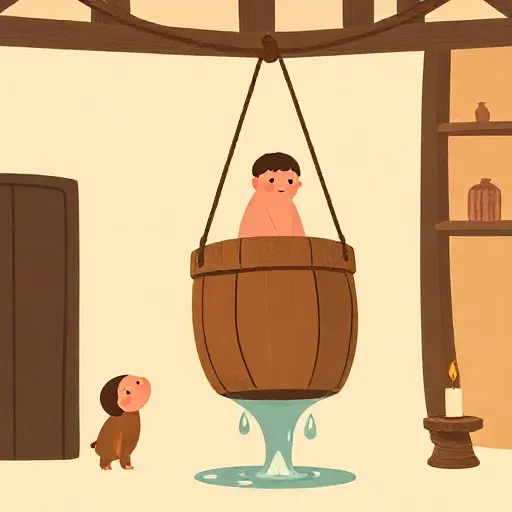
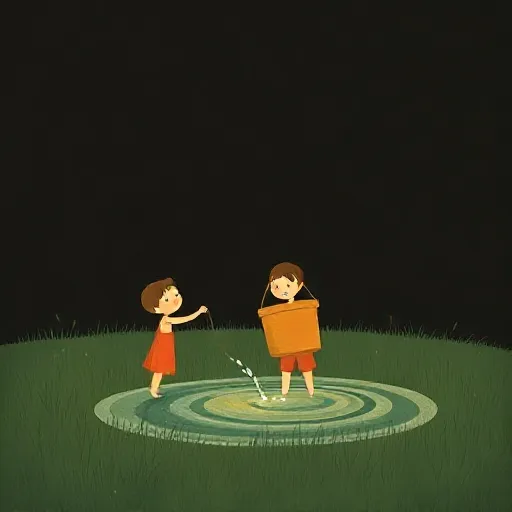
The spinning‑bucket argument. Newton took a bucket, hung it from a rope, and twisted the rope tight. He filled the bucket with water and let it go. The bucket spun rapidly. At first the water stayed flat and calm — it was spinning fast relative to the bucket, and its surface showed no sign of rising. After a while the water caught up and spun with the bucket. Now there was no relative motion between water and bucket. But the water’s surface was climbing the sides, showing a strong centrifugal force — the tendency of spinning stuff to fly outward. So the outward force didn’t match whether there was relative motion. Instead, it seemed to signal true, absolute spinning. Newton concluded that true circular motion cannot be defined as rotation relative to nearby bodies. It must be rotation with respect to absolute space.
Finding Absolute Motion in an Empty Universe

After all these arguments, Newton gave one last thought‑experiment to show that absolute motion isn’t just a philosophical fantasy — it has real, measurable effects. Picture two metal globes tied together by a cord, spinning in an otherwise completely empty universe. No stars, no walls, nothing to compare them to.
Even in that void, the cord would be pulled tight. The tension comes from the globes’ effort to fly away from the axis of spin. By measuring the tension, you could work out how fast they’re rotating. And if you pushed on opposite faces of the globes, you could even tell whether they were spinning clockwise or counterclockwise — all without a single other object in sight. Absolute space might be invisible, but its effects aren’t.
Why It Still Matters: From Newton to Your Spinning Chair

Newton’s absolute space and time ruled physics for two centuries. Then Albert Einstein came along. Special relativity showed that there is no single, universal “now” the way Newton imagined — so absolute time had to go. General relativity turned space into a dynamic, bendable fabric that warps around matter, not a rigid box. But the heart of the question didn’t vanish.
Even in modern physics, spinning motion seems to be absolute in a deep way. Einstein’s theory still has something called spacetime that can tell the difference between truly rotating and just coasting. And right now, inside your own ears, tiny fluid‑filled tubes detect whether your head is spinning — not relative to the wall, but absolutely. You can close your eyes and still feel yourself turning.
So the fight that started with a bucket of water in Newton’s hands hasn’t ended. Every time you spin in a chair and feel that strange outward push, you’re bumping into a mystery that still makes physicists and philosophers stay up at night: Is movement just a story we tell by comparing things, or is the universe’s invisible stage really there?
Think about it
- If you were alone in a completely empty universe, could you ever tell whether you were moving? Would it even make sense to say you “really” are?
- When you spin with your eyes shut, you feel yourself turning. Does that feeling prove you’re spinning absolutely, or is it just a trick your body plays because of how it’s built?
- Suppose every object in the whole cosmos shifted two feet to the left at the same moment. Would anything change? If not, does it matter whether we say something is “truly” still?