Why Do the Planets Move? Newton’s Answer Changed Everything
A Visitor with a Question
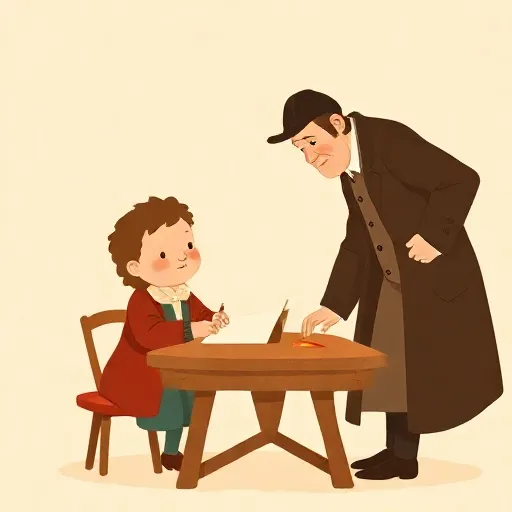
In the summer of 1684, Edmond Halley (1656–1742) traveled from London to Cambridge with a burning question. For years, astronomers had guessed that some force from the Sun keeps the planets in their paths. If that force grew weaker as you moved farther from the Sun — say, weaker by the square of the distance — what shape would a planet’s orbit have? Halley put the question to Isaac Newton (1643–1727). Without hesitating, Newton answered: an ellipse. He had worked it out years before but never published it.
That visit set off one of the most important books in history. Newton spent the next two years turning his answer into the Philosophiæ Naturalis Principia Mathematica — a gigantic work that did far more than solve Halley’s puzzle. The Principia offered a new kind of science, and it started a fight about what really counts as an explanation.
One Force for Heaven and Earth
Before Newton, nearly everyone followed the ancient idea that the sky and the Earth have completely different rules. Aristotle thought the heavens were perfect and unchanging, while down here things decayed and fell. Even by Newton’s time, many believed that planets were carried around by invisible whirlpools of fluid — what René Descartes (1596–1650) called vortices.
Newton shattered this picture. In the Principia he argued that a single centripetal force — a pull toward a center — keeps the Moon circling the Earth and the planets circling the Sun. That force is gravity, and it is the same force that makes an apple drop. What’s more, the strength of this pull follows a precise mathematical rule: it decreases with the square of the distance from the center (an inverse‑square law).
He backed this up with careful reasoning. Observations showed that planets sweep out equal areas in equal times around the Sun, which Newton proved is a sign that they are pulled only toward the Sun. If the pull were exactly inverse‑square, the orbits would be ellipses — which, to a close approximation, they are. Bit by bit, Newton connected the new physics of falling bodies with the motions of the sky.
The Cartesians’ Challenge: What Makes It Move?
Newton’s ideas did not win everyone over. Christiaan Huygens (1629–1695), the leading scientist in Europe, agreed that an inverse‑square gravity extends to the Moon. But he refused to accept that every tiny particle in the Earth pulls on every particle in the Moon. That, he said, was no better than magic. For Huygens and the Cartesians, a true explanation had to involve contact — something like the push of Descartes’ vortices.
The most clever challenge came from Gottfried Leibniz (1646–1716). Within a few years of the Principia, Leibniz published a new vortex theory that produced the exact same inverse‑square effect for planets. Here was a fully mechanical account that matched Newton’s mathematical result! So why prefer Newton’s invisible pull over Leibniz’s whirlpools?
Newton’s answer became famous — and controversial. He wrote in a later edition: “I have not as yet been able to deduce from phenomena the reason for these properties of gravity, and I do not feign hypotheses.” For him, guessing about the hidden cause of gravity when you could not test it was not true science. The job of physics was to find the mathematical laws that describe how the world works, and to predict new observations — not to invent a satisfying story for our minds.
Newton’s New Rules of Science

The Principia was not just a set of conclusions; it was a manual for a new way of doing science. Newton started with a “generic” mathematical theory of forces — what if the pull goes as the distance, or as the square of the distance, or as the cube? Then he compared the different possibilities with actual observations to see which one fit the real world. Only after that did he claim that an inverse‑square force actually existed.
Crucially, he never pretended that the real motions were perfect. The Moon’s orbit, for example, wobbles in complicated ways. Newton knew the simple ellipse was only approximate. So he developed quam proxime reasoning (Latin for “as nearly as possible”). If a planet almost sweeps out equal areas, the force pulling it must be almost purely toward the Sun. If its orbit barely shifts, the pull must be almost exactly inverse‑square.
This allowed him to make a bold move. He assumed the law of gravity was exactly true, then used it to show that the tiny wobbles of planets must come from their gravitational pulls on one another. Those wobbles had been seen but never explained. Over time, as later mathematicians worked out the effects of Jupiter pulling on Saturn, the theory was justified again and again. Newton’s fourth rule of reasoning summed up the attitude: take a result as true unless new observations force you to correct it. Science doesn’t need absolute certainty; it just keeps getting more exact.
Why It Still Matters: The Game of Approximation
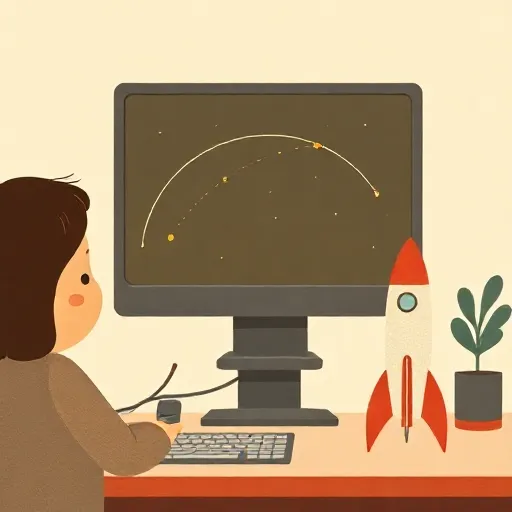
The Principia lost its status as the last word a century later when Einstein’s relativity showed that Newton’s model is only an extremely good approximation. But that, in a way, proves Newton’s point. Einstein’s theory didn’t throw out Newton’s; it showed where it holds perfectly as a limiting case — exactly as Newton had shown that Galileo’s physics of falling objects is a limiting case of his own.
Even more lasting is the method. When your phone shows a weather forecast or a spacecraft navigates to another planet, the calculations still follow the same pattern Newton laid down: start with the best laws you have, then correct them as finer data come in. And scientists still refuse to “feign hypotheses” about untestable deep causes if they can’t be measured.
The old debate about whether you need to know why gravity works to claim you understand it never really went away. Some philosophers still feel that Newton’s picture misses something — a truly satisfying explanation must tell us what gravity is, not just how it behaves. Others answer that a system that makes perfect predictions is exactly what understanding means. You get to decide.
Think about it
- A detective learns that criminals always return to the scene exactly one hour after sunset, but she has no idea why they do it. Is that useful science? Is it a full explanation?
- If you could build a video‑game physics engine that perfectly calculates how every object moves, would the game need to say what gravity “really is,” or is a working formula enough?
- Newton refused to guess about the cause of gravity because he couldn’t test his guess. Do you think scientists should be allowed to guess about untestable things, or should they stick only to what can be measured?