Why Do We Have Laws — and When Can We Ignore Them?
What Would Happen If All Rules Disappeared Right Now?

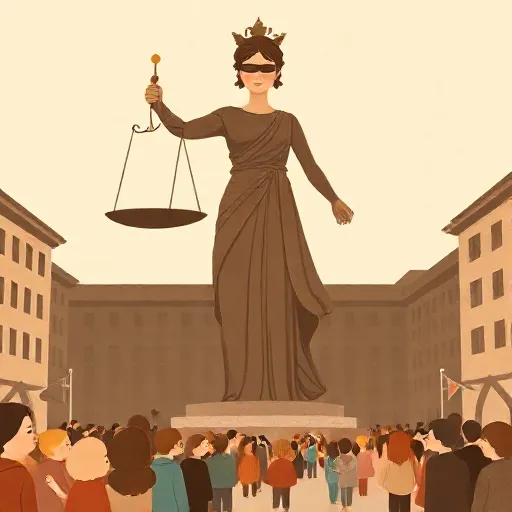
Imagine your teacher steps out of the room for five minutes. At first it feels like a holiday. But soon someone grabs your pencil case. Another person shouts over everyone else. A football match breaks out in the corner. The room gets loud, unfair, and maybe a little scary. No one can get anything done. And if you complain, who would listen? There is nobody in charge. This is what philosophers call anarchy — a state with no accepted authority and no settled rules.
Now stretch that picture to a whole town or country. Without shared rules and someone to enforce them, people would live in fear of violence, theft, and trickery. The strong would bully the weak. Trade would collapse. Schools would close. Aristotle (384–322 BC) and other ancient thinkers saw that human beings need political authority and law just to survive and flourish together. They asked a huge question: what kind of rules count as real law, and why should we obey them? The answer they developed is called natural law theory.
The Rule of Law Means More Than Just “Because I Said So”
Say a group of older kids took over the playground and started shouting orders. Would that be law? Most of us sense that real law has to meet certain standards — otherwise it’s just bullying. The natural law tradition has long argued that government must be exercised through the rule of law, not the whim of a ruler.
The twentieth-century legal scholar Lon Fuller (1902–1978) listed eight things a legal system needs to be worthy of the name. Laws should be public, clear, consistent, possible to follow, stable over time, and actually enforced as written. Most importantly, the rulers themselves must follow their own rules. If the people in charge constantly change the rules in secret, punish you for things you could never have known about, or ignore their own laws when it suits them, they are not governing through law. They are governing through fear and manipulation. That’s tyranny.
Fuller’s list shows why the rule of law is a matter of fairness. It treats citizens as partners in a shared project, not as pawns. But here’s the tricky part: a cruel government might still follow some of these formal rules — and use them to do evil more efficiently. As Joseph Raz (1939–2022) pointed out, a sharp knife can save a life in surgery or take a life in a crime. The rule of law is a tool. Natural law theorists reply that a truly rational ruler who respects people’s basic goods would not want to harm them in the first place. Fair procedures and just content go together.
When Laws Are Unjust: The Great Debate
What if a law itself commands something terrible? This question became tragically real after the Second World War. In 1945, leaders of Nazi Germany were put on trial at Nuremberg. They argued they had done nothing illegal because they were following German law at the time. The judges disagreed. They ruled that some acts violate the elementary dictates of humanity — a law higher than any single nation’s rulebook. This idea echoes a famous claim in natural law theory: an unjust law is not a law.
Thomas Aquinas (1225–1274) did not mean that an unfair rule simply vanishes from the books. He meant that such a rule loses its real authority — its power to bind our conscience. It is law only in a twisted, secondary sense. As the legal philosopher H.L.A. Hart (1907–1992) later put a similar thought, that some laws are simply too unjust to obey. The difference might sound small, but it matters. Hart wanted to keep the word “law” for all validly enacted rules, no matter how evil, so we could evaluate them clearly. Natural law theorists think that calling something law while admitting it deserves no respect hides the deep connection between law and morality.
So the slogan lex iniusta non est lex is not a denial of facts. It’s a reminder that law’s whole point is justice. When a rule is grossly unjust, it stops being a genuine reason for action — even if a government stamped it into a book.
Where Do Ordinary Laws Come From?

Natural law does not say that every just law is written into the stars. Most laws in any country could have been quite different and still be perfectly reasonable. Think of the speed limit on your street. It might be 30 miles per hour in one town and 25 in the next. Neither number is the one “correct” answer. But the principle — protect people from dangerous driving — requires that some specific limit be chosen and enforced.
Aquinas called this kind of choice a determinatio: a creative decision that gives concrete shape to a general moral requirement. He compared it to building a maternity hospital. The doors and ceilings must be more than two feet high, but countless other design choices — the colour of the walls, the layout of the rooms — are left to the architect’s good judgement. Once the building is finished, its details matter and must be respected.
Something similar happens when a legislature votes on a tax rate, a court settles a dispute, or a city council writes a parking ordinance. The resulting rule is positive law — law that exists because human beings made it. Yet it gets its moral force from the background requirement that we need a system of public rules to protect the common good: everyone’s basic wellbeing in a shared community. That moral background makes the social fact of the rule a genuine reason to follow it.
Can We Describe Law Without Judging It?

Some legal thinkers, called legal positivists, say law is purely a matter of social facts. They argue that a rule is law if it was made by the right people following the right procedures — no matter whether it is wise, fair, or cruel. Hart defended this view, as did Raz. They wanted a clean separation between what the law is and what it ought to be.
Natural law theorists disagree, but not completely. They accept that much of our law depends on social facts. In that, they share common ground with positivists. But they also claim that any general account of law has to make value judgements. To understand what law really is, you have to think about its purpose: helping people live together peacefully and fairly. That means law’s central, most fully realised form is just and reasonable law. Perversions — systems of harsh control without any real concern for the common good — still exist, but they are defective examples, like a quack medicine or a counterfeit coin.
Max Weber, a famous sociologist, tried to build a value-free theory of social institutions, but his own work betrayed him: he kept defining things by how they fell short of a rational ideal. Natural law theorists bring this into the open. They argue that you cannot describe law well without making moral judgements — and that doing so honestly makes for a clearer, more useful theory.
Why This Still Matters When You Question the Rules

You might never face a tyrant or a war crimes tribunal. But you do face school policies, team rules, family expectations, and laws in your town. Some feel reasonable; others might seem pointless or even unjust. Natural law theory gives you a way to think about this. It says: first, pay attention to what the rule actually is and where it came from. Respect the fact that communities often need settled schemes to function. But also ask whether the rule serves the genuine good of the people it affects, or whether it treats some people as less worthy of respect.
That does not mean you get to ignore every rule you dislike. Natural law theorists stress that positive law comes with a strong presumption that it should be obeyed — but that presumption can be defeated when a rule is seriously unjust. The harder a rule clashes with the basic goods of human life — safety, knowledge, friendship, fairness — the weaker its claim on your action.
In your own life, that might mean speaking up when a classmate is being bullied despite the “no snitching” rule. It might mean questioning a dress code that seems to unfairly target one group. Natural law theory doesn’t hand you easy answers. Instead, it hands you the big questions and a long tradition of careful thinking about how power, rules, and justice fit together.
Think about it
- If every student in your school voted for a rule that you believe is deeply unfair, what would you do? Do numbers always make a rule right?
- Can a gang leader’s command ever be called a law? What makes the difference between a real law and a threat backed by force?
- Think of a time you followed a rule you thought was pointless. Was obeying it the right choice, or would something important have been lost if everyone ignored it?