
The Monk Who Connected Everyone (and Thought Math Was Enough)
The Thursday Meetings
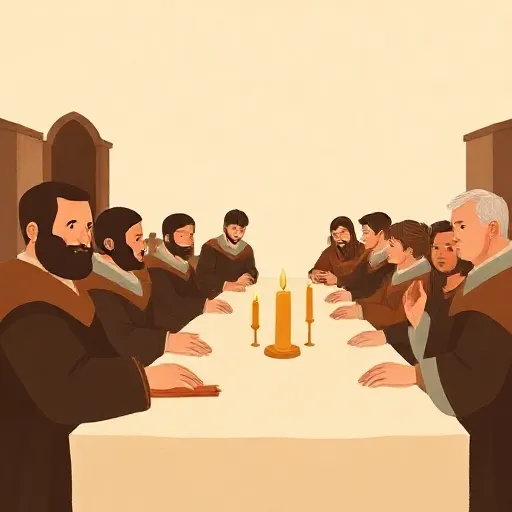
Imagine a Thursday afternoon in Paris, around 1635. A dozen men crowd into a room near the Place Royale, now Place des Vosges. One is a friar in a brown habit, Father Marin Mersenne (1588–1648). The others are mathematicians, physicists, and curious nobles. No prince is hosting them. No university approves the meeting. Yet this is the famous Academia Parisiensis, the private science club that Mersenne holds together.
A silk merchant’s son named Blaise Pascal might be there, still in his teens. Gilles Personne de Roberval (1602–1675) scribbles a new curve. Pierre de Fermat (1607–1665) sends a letter with a number‑theory puzzle. The talk jumps from prime numbers to the path of a rolling ball to the reason a lute string sounds sweet. Mersenne sits at the centre, not as a commanding genius but as a human switchboard. He reads someone’s letter aloud, asks a sharp question, copies a diagram, promises to forward the answer to Italy.
It was Mersenne who turned a scattered collection of curious minds into a living network — a preview of the scientific societies that would follow, like the Royal Society in England and the French Academy of Sciences. And he did it from a monk’s cell, with paper and ink.
From Fierce Defender to Friendly Connector

Mersenne had not always been so open. When he first published in the early 1620s, his pen was a weapon. Raised in a merchant family and educated by Jesuits at La Flèche — where he may have glimpsed a much younger René Descartes (1596–1650) — he joined the strict Minim order and threw himself into religious combat. His massive Quaestiones in Genesim (1623) and L’Impiété des Déistes (1624) attacked anyone he suspected of feeding atheism and magic. Hermetic authors like Robert Fludd, cabbalists, alchemists, and even Galileo were denounced. For Mersenne, to break with Aristotle’s philosophy was to risk heresy. He believed that learning real mathematics and true theology could slap down error. In those books, math served as a holy weapon: he “calculated” the size of Noah’s ark, explained the Trinity through the geometry of a point, and argued that optical science proved miracles were not tricks of the light.
Then, by the end of the 1620s, the tone shifted. Scholars still debate exactly why. Had he grown disillusioned with witch‑hunting arguments? Did his trip to the Netherlands in 1630 open his eyes to Protestant thinkers? What we know is that Mersenne became more interested in spreading useful knowledge than in condemning enemies. He began corresponding with Dutch Protestants and even earned the nickname “the Huguenot monk.” He poured his energy into promoting mixed mathematics — sciences where numbers and geometry are applied to physical things, like optics, mechanics, and music. He helped Descartes publish the Meditations and gathered the famous “Objections” from other thinkers, including Thomas Hobbes (1588–1679) and Pierre Gassendi (1592–1655). The man who once saw heretics everywhere had become the postman and peacemaker of the intellectual world.
How Much Can We Really Know?

In 1625, Mersenne published a dialogue called La Vérité des sciences (The Truth of the Sciences). In it, an alchemist boasts that he possesses perfect knowledge of nature, a skeptic argues that nothing can be known, and a Christian philosopher steps in to judge. Mersenne’s verdict surprises many readers: he agrees with a great deal from both sides, and then draws a line down the middle.
Against the alchemist, Mersenne sides with the skeptic. Humans will never grasp the inner essences of things. We cannot say what the true “cause” of gravity is, or what makes a thing an oak tree rather than a linden. The simplest object, he wrote, has an infinite number of relationships to everything else in the universe, and our minds cannot hold all of that. He even admitted — years before Descartes wrote his famous Meditations — that we cannot prove the external world is real. God could, in theory, feed our minds a complete dream of a world that isn’t there.
But against the complete skeptic, Mersenne pointed out that some truths really are solid. You cannot doubt that you are doubting: to doubt that you doubt would itself be another doubt, leading to an endless spiral. The principle “the whole is greater than the part” shines with its own light. And above all, mathematics gives us unshakeable certainty. When you say “2 + 3 = 5,” you are not guessing. Arithmetic and geometry rest on eternal truths that do not change with the weather of your senses.
So Mersenne arrived at a position that historians call mitigated skepticism. You can be absolutely sure about math, but when you turn to physics, you will have to settle for probabilism — that is, for opinions that are more or less likely, never perfectly proven. This wasn’t a counsel of despair. It was a permission slip for scientists: stop trying to read God’s secret blueprint; start measuring what you can actually see.
God’s Freedom and the Secrets of Nature

Why did Mersenne think physics could never reach final certainty? Part of the answer lies in his view of God’s freedom, a doctrine called voluntarism. He insisted that God was not forced to create the universe in any particular way. An infinite, all‑powerful being could have chosen a different set of laws, different kinds of matter, a different size for the stars. The world we see is one free choice among countless possibilities.
This had a practical consequence. If the laws of nature are not necessary in the way that 2 + 3 = 5 is necessary, you cannot prove them by pure reasoning alone. You must go out and look. Galileo might say that a falling body speeds up following a tidy mathematical pattern, but Mersenne would answer that maybe it usually does, but God could have made it otherwise, and that we should measure carefully before we call it a law. That is why Mersenne was cautious even about Copernicus’s idea that the Earth moves. The Church opposed it, but Mersenne’s deeper hesitation was philosophical: we see the phenomena, but we do not see the hidden structure God chose. The simplest explanation may still be the wrong one.
Interestingly, Mersenne did not extend this divine freedom to mathematics. Against Descartes, who famously claimed that God freely created the eternal truths — so that even “2 + 2 = 4” was a divine choice — Mersenne held the more traditional view. For him, mathematical truths flow from God’s own understanding, just as sunlight flows from the sun. They are co‑eternal with God’s nature, so they could not have been otherwise. That was why math alone could provide watertight demonstrations.
Measuring the World: Experiments Without Certainty

If reason alone cannot nail down nature, what is left? Mersenne’s answer: hands and instruments. He spent years testing Galileo’s claims about falling bodies and inclined planes. He did not just read about them; he built ramps, dropped cannonballs, repeated experiments, and wrote down the numbers. Sometimes his measurements disagreed with the Italian master’s. When they did, Mersenne didn’t accuse Galileo of cheating. He simply noted that nature is messier than a neat classroom equation and that every measurement has some error.
He summed up the limits of human understanding this way: we only truly know what we can make with our own hands and minds. Since we cannot make so much as a single fly or a blade of grass, our knowledge of the natural world will always be shallow. This was a humble version of mechanism — the idea that nature works like a machine. But unlike Descartes, who built grand invisible machines out of tiny particles, Mersenne stressed that our mechanical models are just useful guesses. They describe patterns, not ultimate causes. What you can trust is the measurement itself, captured in numbers.
In this way, Mersenne helped steer early modern science away from dizzying theories and toward a disciplined habit: pose a question, design an experiment, record the result, share it with others, and resist the temptation to pretend you have glimpsed the mind of God.
The Music of Everything
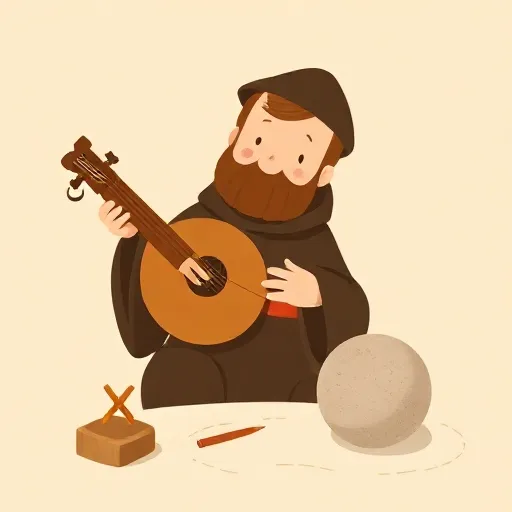
Of all the mixed‑mathematical sciences, music was Mersenne’s greatest love. His enormous book Harmonie Universelle (1636–1637) runs to hundreds of pages and explores everything from the physics of vibrating strings to the emotional power of a melody.
His central question was practical and deep: why do some combinations of notes sound sweet — consonance — while others grate on the ear? By measuring string lengths, tensions, and vibrations, Mersenne discovered that the ear prefers certain simple numerical ratios, like 2:1 for an octave. Yet the real world refused to be perfectly tidy. Suppose math predicts that doubling the tension of a string should raise the pitch by an octave. In the laboratory, the ear hears an octave when the tension is multiplied by something closer to 4.25, not 4. So even in music, you have to discipline your measurements with reason and adjust your models.
Music, for Mersenne, was more than acoustics. It was a glimpse of universal harmony — the hidden mathematical order that, he believed, runs through all of creation. The pleasure we feel when a chord rings true is our soul recognizing that order. Unison, the simplest consonance, reminded him of the divine unity: just as all numbers flow from one, all creatures depend on God. And yet, he noticed, we often prefer slightly imperfect consonances and even enjoy clever dissonance. That little quirk revealed something about our human condition: we are drawn to perfection, but we live in a world of mixed, imperfect beauty. Music became his model for all science — a blend of careful mathematics and honest feeling.
Why Mersenne Still Matters to You

Three centuries later, you have probably never heard of Marin Mersenne, but you live in the world he helped to build.
When you do a science experiment at school, you measure, you graph, you look for a pattern, and you write a conclusion. Your teacher doesn’t expect you to announce the ultimate cause of why things happen. That’s Mersenne’s mitigated skepticism in action. His insight — that we can describe nature with magnificent precision through mathematics, while staying humble about the deep “why” — is the quiet engine behind modern science.
He also showed how ideas travel best when people talk to one another. Today we have journals, conferences, and group chats. In the 1600s, you needed one person who would copy the letters, settle the quarrels, and make sure a discovery in Florence reached a mathematician in Holland before it was forgotten. Mersenne was that person. His network reminds us that science is as much about community as it is about solitary genius.
And he changed his mind. The young man who wanted to silence his enemies grew into a monk who listened to Protestants, gathered objections to Descartes, and worried less about being right than about being honest. That kind of intellectual shift — from certainty to curiosity — is still one of the bravest moves any thinker can make.
Think about it
- If you could measure exactly how fast a toy car speeds up but never know why it moves, would you feel you truly understand it?
- Mersenne changed from attacking people who disagreed with him to listening to them. Is a big change in your own thinking a sign of strength or weakness?
- Math often has one perfectly clear answer, but the rest of the world seems messy. Why do you think numbers can be so reliable while the weather stays so unpredictable?