Did a 13th-Century Monk Discover That Your Mind Builds Reality?
A Bold Voice in Paris
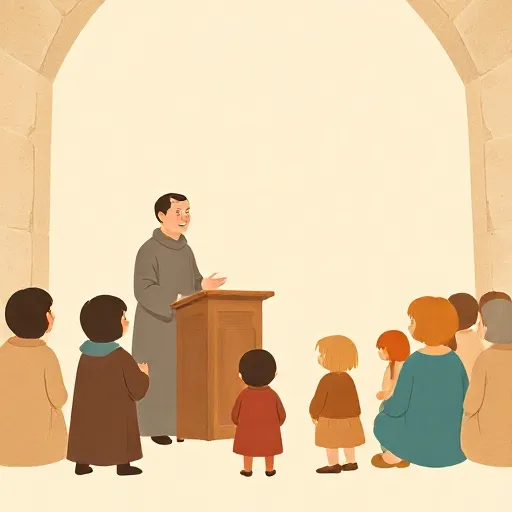
The year is 1296. A Dominican friar named Dietrich of Freiberg steps up to the lectern at the University of Paris. He has already earned a reputation as a sharp thinker who isn’t afraid to challenge the common view. In a few moments, he will argue that the human mind is far more powerful than most people believe. It doesn’t just absorb the world like a sponge. It actively builds the very categories you use to understand anything at all.
Dietrich was born around 1250 in Freiberg, Saxony, and joined the Dominican order as a youth. Most historians think he studied in Paris between 1272 and 1274, possibly under Henry of Ghent, a famous teacher his students called the “solemn master.” Over the next decades, Dietrich held important positions: lector in Trier, prior in Würzburg, and finally Provincial Superior of Germany—the same post once occupied by Albert the Great. He wrote treatises on nearly every branch of theology, philosophy, and natural science known to his time. But his most original ideas, the ones that still feel startling today, center on a single claim: your intellect doesn’t just record reality; it helps make it.
The Intellect That Builds Its Own Object

Most medieval thinkers saw the intellect as a mirror. Light from the outside world hits it, and knowledge is produced. Dietrich disagreed completely. For him, the intellect is an active power. It doesn’t just receive images from the senses; it constitutes the concepts that make things understandable in the first place.
He called this the constitutive power of the mind. Suppose you see a book lying on a table. Your senses take in colors and shapes. But where does the idea of “on” come from? Dietrich argued that three basic categories—substance, quantity, and quality—are rooted in nature itself. The other seven categories (like relation, place, time, and action) are produced by your intellect. The relation “on” isn’t a physical thing out there the way the book is. It’s something your mind adds to reality in order to grasp it.
This goes even deeper. The intellect also creates what Dietrich called quidditative being—the very “whatness” of a thing. To recognize a dog as a dog, your mind doesn’t just passively receive sensory data. It actively determines the quiddity, the essential what-it-is, that makes a dog intelligible to you.
Dietrich distinguished two sides of the intellect. The agent intellect is a spark of divine-like activity within you. It is always awake, always thinking, and contains a likeness of the entire universe. When it knows itself, it knows all other things in a single act. The possible intellect, by contrast, is more like a blank slate that wakes up only through contact with the world. But the real engine of knowing is the agent intellect, which Dietrich described as the “image of God” in the soul, capable of embracing everything that is.
For Dietrich, knowledge isn’t a picture you passively receive. It’s something your mind brings alive. Just as God emanates the world, the intellect emanates an inner universe of conceptional being—a mental world that includes not only the objects you think about but the act of thinking itself. This was a direct challenge to Thomas Aquinas, who held that the intellect is fundamentally passive. Dietrich’s intellect is a builder, not a camera.
A Universe Like a Cosmic Ladder
Dietrich’s picture of the mind was part of a much larger vision. He imagined the whole universe as a vast hierarchy—a kind of cosmic ladder stretching from pure intellect down to lifeless matter. At the very top sits God, who is pure being and pure intellect. From God, the first Intelligence flows forth. Then from that Intelligence comes a second, along with the soul of a celestial sphere and the sphere itself. This cascade continues downward through all the heavenly realms until it reaches the material world of earthly bodies.
This is an emanationist universe: everything flows out from the divine source in an ordered chain. Each level is an essential cause of the one below it, containing the lower reality in a nobler, more interior way. The Intelligence that moves a star doesn’t push it from the outside like a motor. It gives the star its very nature and motion from within.
Even time works differently at each level. God lives in eternity, with no beginning and no end. The heavens have sempiternity—a beginning but no end. The Intelligences enjoy aeviternity, a middle-mode between eternity and time. And earthly things exist in ordinary time, with a past, present, and future.
What does this ladder have to do with you? Everything. Dietrich believed that each kind of being has its own way of knowing, and that its being and its knowing are really the same thing. A pure Intelligence knows by its very essence; a human soul must work to know. But the agent intellect inside each person is a spark of that higher world. When the soul unites fully with its agent intellect—what Dietrich called the beatific vision—it can know all things at once, even God, without any intermediary. That union was, for him, the highest point human knowledge can reach.
Dietrich thought individuality comes not from matter, as Thomas Aquinas taught, but from real relations—like being equal, similar, or different—between beings. That means your mind is uniquely yours. Love and desire, he suggested, run through the whole chain: every being yearns to return to its source, driven by the same intellectual pull that keeps the cosmos in motion.
How a Single Raindrop Became a Rainbow

It’s easy to imagine a medieval monk spending all his time on prayer and manuscripts. But Dietrich was captivated by the natural world. He wrote detailed treatises on light, color, and the rainbow, and his explanation of the rainbow was so advanced it wouldn’t be fully matched for centuries.
The rainbow had puzzled thinkers since ancient times. Why does it form a perfect arc of color? And why do you sometimes see a fainter, upside-down rainbow above the main one? Dietrich built on the work of the Arab scientist Ibn al-Haytham (Alhazen), who had already traced light through water droplets using geometry. But Dietrich pushed further. He showed that when sunlight enters a spherical raindrop, it bends (refracts), reflects off the back of the drop, and bends again as it exits. That path creates the primary rainbow. To explain the secondary rainbow, he realized that sometimes the light reflects twice inside the drop before emerging, which reverses the order of the colors and makes the bow fainter and higher in the sky.
This was a genuine scientific breakthrough. The rainbow wasn’t a miraculous sign; it was a physical effect produced by countless tiny droplets, each acting like a prism. Dietrich even calculated the exact angle at which it appears. He also developed a theory of natural color based on the mixture of qualities in bodies—an idea that shows the influence of medical theories of his day.
For Dietrich, studying nature and studying the soul were not separate jobs. Physical light, in his view, behaves in a way that mirrors intellectual light. The same laws that bend a sunbeam inside a raindrop echo the way the intellect illuminates the objects it knows.
Why a Forgotten Monk Still Matters

Dietrich of Freiberg’s name faded after his death around 1310. When Thomas Aquinas was declared a saint and a Doctor of the Church in 1323, many of Dietrich’s works were forgotten or lost. But in recent decades, scholars have rediscovered his writings and found a thinker of extraordinary originality.
His idea that the mind actively constructs reality echoes in later philosophy. Five hundred years later, Immanuel Kant would argue that the mind imposes basic categories—like space, time, and causality—on experience. Today, cognitive scientists describe the brain as a prediction machine that builds our picture of the world, not a passive recording device. Dietrich’s insight that “to know” is not to copy but to make feels more alive than ever.
He also reminds us that science and philosophy don’t have to be enemies. Dietrich was a careful observer of rainbows and a deep theorist of the soul. He refused to let religious dogma twist his philosophy, yet he saw the universe as a reflection of divine intellect. For him, the world’s complexity was a reason to study it closely, not to look away.
So the next time you see a rainbow, ask yourself: is that arc of color just “out there,” or does your mind have a hand in putting it together? Dietrich of Freiberg would say the answer isn’t simple. Your intellect, in its own quiet way, helps shape the world you experience.
Think about it
- When you learn a new word, do you think your mind is soaking up its meaning like a sponge, or are you actively building the concept? Can you know something without your mind adding anything of its own?
- If the universe is a chain of beings where higher intelligences cause lower ones, does that mean your own thoughts are ultimately caused by something above you? How would that change the way you think about your own freedom?
- Dietrich refused to let religious teachings override what his reason showed him. Can you think of a time when you had to decide between what you were taught and what your own thinking told you? How would you decide which one to trust?