Can You Trust Your Mind? Descartes’ Rules for Finding Truth
The Soldier Who Saw Certainty

In 1618, a twenty-two-year-old French soldier named René Descartes (1596–1650) was stationed in the Dutch town of Breda. He wasn’t yearning for battle — he was starving for a way to make knowledge unshakeable. One day he met Isaac Beeckman (1588–1637), a Dutch scientist who combined mathematics, mechanics, and physics in a way that nobody had seen before. Beeckman called this blend “physico-mathematics,” and it sparked something in Descartes.
Descartes began imagining a method so reliable that if you followed its steps exactly, you would never mistake a falsehood for the truth. You wouldn’t waste your mental energy. Instead, you’d build up your knowledge stone by stone until you truly understood everything within your reach. This wasn’t a daydream. Over the next decade, Descartes filled a notebook — the Rules for the Direction of the Mind — with detailed instructions for how to think. He never finished or published it, but the core ideas reshaped his whole career. The central question remained: can a method turn our minds into perfect instruments of certainty?
A Toolkit for the Mind: Intuition, Deduction, and Enumeration
Descartes believed that real knowledge had to be “certain and evident cognition” — meaning you could see it clearly and you could not possibly doubt it. He proposed three mental operations that would get you there.
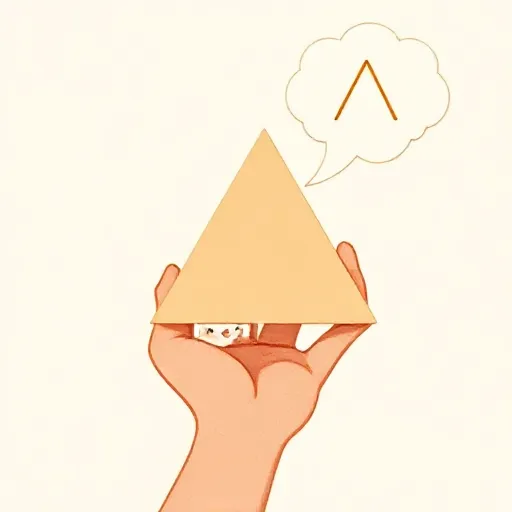
Intuition is not a hunch. It’s the lightning-fast act of seeing something with your mind so directly that nothing feels hidden. When you grasp that a triangle is bounded by exactly three lines, or that you are thinking at this very moment, you are intuiting. The fact is just there, luminous and unavoidable. Behind every intuition, Descartes argued, lies a simple nature — a basic building block of all thought. These simple natures are the “atoms” of knowledge. They include intellectual notions like doubt or volition, material ones like extension, shape, and motion, and common ones like existence or unity. Everything we understand, he claimed, is ultimately a combination of these simple pieces.
Deduction strings intuitions together into a chain. You move from one clearly understood truth to another, each step so obvious that it feels like intuition, until you reach a conclusion that wasn’t obvious at first. Descartes said that when you deduce that nothing without extension can have a shape, you see that shape and extension are locked together — you can’t imagine one without the other. His deduction isn’t about memorizing logical forms; it’s about following real connections between natures.
But what if the chain gets so long that you forget the beginning? That’s where enumeration comes in. Enumeration can mean several things: combing through a complex problem and ordering its parts from simplest to most complicated, running through every possible alternative to rule out false ones, or sweeping back and forth over a long deduction until you can hold the whole sequence in your mind at once, as if it were a single picture. Without enumeration, your mind might drop a link — and with it, certainty.
The Four Rules That Fit on a Napkin

When Descartes finally published a version of his method in 1637’s Discourse on Method, he condensed everything into four rules. They looked almost casual, but each packed a punch.
First: never accept anything as true unless you see it so clearly and distinctly that you have no reason to doubt it. Second: divide every problem into as many smaller parts as you need. Third: begin with the simplest objects and climb, step by step, to the more complex, always following an orderly path. Fourth: make your reviews so complete and your enumerations so thorough that you can be sure you have left nothing out.
Descartes knew no set of written rules could cover every twist a real problem throws at you. So he shifted his focus from theory to practice. The best way to learn the method, he thought, was to watch it work on actual problems — in light, in weather, in geometry, and even in the search for what you can know about yourself.
Bending Light: How Descartes Used His Method
Descartes didn’t just talk about method. He applied it to natural puzzles with spectacular results. One of his early tests was the problem of the anaclastic line — the shape a glass lens needs to focus all parallel rays of light onto a single point, like in glasses or telescopes. First, he enumerated. He broke the problem into a chain of smaller questions: What is a natural power? What is the action of light? How does a ray pass through a transparent body? How does refraction happen? What’s the relationship between the angle of incidence and the angle of refraction? Only then could he deduce the lens shape. The whole chain rested on observations — watching how light actually behaves in water or glass — which then guided the deduction, rather than replacing it.
That chain led him to one of his most famous achievements: the law of refraction. He imagined light as a tendency to motion, pressing instantaneously through space like the pressure a blind person feels through a stick. To work out the exact relationship, he compared light to a tennis ball puncturing a thin linen sheet. The ball loses half its speed. Two components of its motion — a perpendicular one and a parallel one — behave differently at the surface. By reasoning from these simple suppositions, Descartes showed that the sines of the angles of incidence and refraction must keep a constant ratio for any given pair of media. It was a tidy mathematical law, deduced from a clever physical picture.
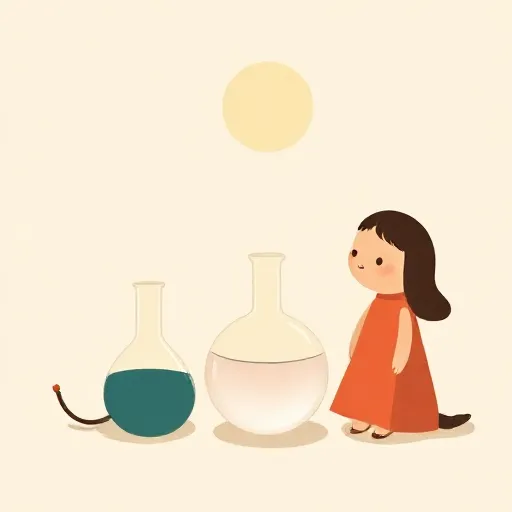
The rainbow offered an even richer illustration. Descartes started by capturing a rainbow effect in a round flask of water. He angled the light, noting that a brilliant red appeared only when his eye made a 42‑degree angle with the flask, and that a fainter red appeared at about 52 degrees. Then he probed the cause by blocking different light paths with opaque objects, isolating which rays were responsible. To settle why only certain rays produced colors in a fixed order, he compared the flask to a glass prism. The prism eliminated reflections and reduced the number of refractions, yet still produced the same spectrum. That meant the true cause had to lie deeper — in the micro‑mechanical particles of light. The particles, he argued, acquire different tendencies to spin after being refracted, and these spin speeds paint the red at one end, the violet at the other. So the rainbow wasn’t a fuzzy marvel; it was a deductive machine you could trace step by step.
Bending Lines: Geometry and the Pappus Problem

In geometry, Descartes faced a challenge that had stumped his predecessors: the “problem of dimensionality.” You can draw a line (one dimension), a square (two), and a cube (three). But what about a fourth or fifth power? Multiplying more than three lines seemed to have no meaning — you can’t draw a four‑dimensional figure. Descartes swept that worry aside with a clever use of similar triangles. He showed that the product of two lines is just another line, sharing a fixed proportion with the others. So all magnitudes, no matter how many times you multiply them, stay within the world of lines. Algebra could now roam freely in geometry.
That freedom unlocked a general method. To solve any problem, you first “consider it solved,” assigning letters to all known and unknown lines. You then find an equation that expresses an unknown exclusively in terms of known quantities. Finally, you construct the required line using only basic tools like a straightedge and compass. Descartes demonstrated this on a problem that had baffled the ancient geometer Pappus of Alexandria (c. 300–350), which involved finding a point such that drawn lines met a complicated proportional condition — even when more than six lines were involved. Descartes showed that, no matter how many lines, an equation and a construction were always possible. The method turned what looked like an unsolvable mess into an orderly deduction that you could literally see take shape on the page.
Doubting Everything to Find Something
Descartes brought the same mental machinery to the most personal problem of all: what can you be absolutely certain of? In his Meditations, he used enumeration in a different but related way. Instead of ordering sub‑problems from simple to complex, he sorted his beliefs into classes and tested whether any class could withstand doubt. He didn’t examine every single belief; he took samples. Beliefs from the senses could be misleading — distant objects fool us. Even the belief that he was sitting by the fire might be a dream. What about the simplest mathematical notions, like that two plus three makes five? A malicious demon might have arranged his mind so that he blundered even there.
By running through these categories, Descartes arrived at a point where no class of doubt could touch him: the very act of doubting proved that he existed. The proposition “I am, I exist” could not be placed into any of the doubtful groups, because even the most extreme doubt required a thinker. This wasn’t a deduction from prior principles. It was an intuition that appeared only after enumeration had cleared away everything else, and it became the first firm step on which he could rebuild. In metaphysics, analysis — finding first principles — had to come before synthesis, because the mind needed to learn how to see clearly and distinctly.
Why a 17th‑Century Toolkit Still Matters

You probably use pieces of Descartes’ method without thinking about it. When a video game puzzle stumps you, you might list what you know, divide it into smaller tasks, and test possible solutions. In science class, you design experiments to eliminate wrong explanations, just as he eliminated spurious causes with his flask and prism. In math, you turn word problems into equations with variables — a direct echo of “consider it solved.”
Descartes’ dream was absolute certainty, the kind that leaves no room for doubt. That dream ran into a problem he openly acknowledged: nature is so rich that many possible causes can produce the same effect, and you often need experiments to choose among them. Even his own rainbow deduction leaned heavily on careful observations. So while his method gave science a powerful push toward systematic reasoning, it also planted a question that still buzzes underneath everything: can we ever be completely certain about the physical world, or must we settle for the best explanation we can check? Philosophy classrooms still debate that. And every time you wonder whether to trust a piece of evidence, dismantle a tricky claim, or hunt for an assumption you didn’t notice, you’re walking in Descartes’ footsteps — even if you never touch a flask or a compass.
Think about it
- If you tried to doubt everything the way Descartes did — your memories, your senses, even that the world exists — is there anything you would be unable to doubt? Why?
- Scientists use experiments to check their ideas, but experiments can’t test every possible case forever. Does that mean scientific knowledge is never really certain? Does that matter?
- Think of something you believe is true but can’t prove in a step‑by‑step deduction. How do you handle the uncertainty, and would Descartes’ method help or make things harder?