Can You Figure Out What’s True Just By Thinking?
Doubting Everything from an Armchair

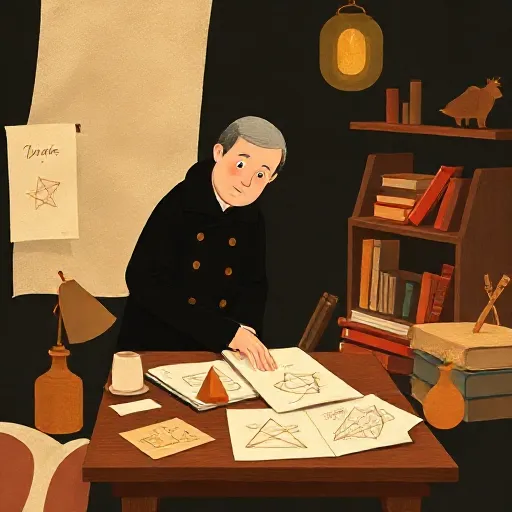
René Descartes (1596–1650) loved a good doubt. He imagined that a powerful evil demon might be tricking him about everything — his own hands, the floor under his feet, even that two plus three equals five. His goal was to find a single belief so solid that no dream or demon could shake it. And he wanted to reach that belief without ever looking up from his chair.
That chair, and the thinking that happens in it, became a symbol of a whole way of doing epistemology — the study of what knowledge is and how we get it. For Descartes, the proper method was pure reflection. You put aside messy senses and look inside your own mind. You try to spot ideas that are “clear and distinct.” If an idea passes that test, you’re safe to trust it. This approach is called a priori reasoning (that’s Latin for “from the earlier”): knowledge that comes just from thinking, not from checking the world.
Most philosophers today don’t go as far as Descartes. They don’t demand absolute certainty, and many think his argument got tangled in a circle. But they kept three habits that still define what’s often called traditional epistemology.
First, they treat epistemology as an armchair business. You figure out what knowledge must be by testing made‑up cases against your intuitions — never by running an experiment. Second, they say epistemology is autonomous from science. Science can learn from philosophers, they think, but not the other way around. Third, and most importantly, they insist that knowledge isn’t just about what’s true — it’s about what’s justified, what you ought to believe. That’s a normative question: it’s about standards and correctness, not just facts.
So, for centuries, epistemology looked like a one‑person drama. A thinker, a chair, and a pile of puzzles about when a belief deserves the name “knowledge.”
Handing the Job Over to Science

In 1969 the American philosopher W. V. O. Quine (1908–2000) threw a bucket of cold water on that drama. In a famous paper called “Epistemology Naturalized,” he argued that the whole Cartesian project was doomed. You can’t translate every fact about physical objects into pure sense‑experience, and you certainly can’t prove that your steps from evidence to belief are perfectly certain. So why keep pretending?
Quine’s suggestion was startling: stop manufacturing stories about how beliefs should be built. Instead, he said, treat the knower as a natural creature. A human gets a “meager input” — sounds, light waves, bumps — and eventually produces a “torrential output”: a full theory of tables, planets, and history. If you want to understand how evidence connects to belief, just watch the whole process happen. Naturalized epistemology, in Quine’s hands, becomes “a chapter of psychology.” You can use the tools of science to see how real brains form beliefs.
At first glance, Quine seemed to toss out everything traditional. He wasn’t telling philosophers to borrow a few psychological findings; he was saying psychology can replace traditional epistemology. He even argued that skepticism — the worry that we can’t know anything — is itself a scientific worry, born from noticing that our senses sometimes fool us. And if the doubt is scientific, he said, we can answer it with science. For instance, we might look to Darwin: creatures who were hopelessly bad at learning from experience didn’t survive long.
Later, Quine softened his tone. He insisted that normativity — the “should” — wasn’t really dropped. It just became a kind of engineering problem. If truth is your goal, he said, then good cognitive habits are like reliable tools. That’s a practical “ought,” not a mysterious one. But many readers were unconvinced.
The “Should” Won’t Disappear
The biggest objection came quickly: normativity. The philosopher Jaegwon Kim (1934–2019) summed it up. Epistemology, he said, is about justification — the difference between a lucky guess and a belief you’re entitled to hold. If you hand the whole job to psychology and just describe which mental processes happen, you lose the idea of which ones you ought to follow. For Kim, that means you’ve stopped doing epistemology altogether.
Think of it like this. Suppose a classmate guesses an answer on a test and gets it right. Her belief was true but, in a deep sense, she didn’t know — she just got lucky. Quine’s pure description tells you how her brain cells fired. It doesn’t tell you whether that brain‑firing pattern is one you should rely on. The normative question — “Was she reasoning well?” — seems to vanish.
Quine’s later answer, that normativity is just a matter of finding the best means to reach the goal of truth, faces a fresh problem. Why is truth the goal? And how can a naturalized philosopher prove that without secretly doing armchair philosophy? If you argue for Quine’s view, you’re using logic, intuitions, and evidence — exactly the old‑fashioned tools that naturalism seemed to dismiss. This is the self‑defeat objection: the naturalist’s own argument depends on the very methods it tries to push aside. That stuck like a thorn, and later thinkers worked hard to pull it out.
Knowledge as a Natural Kind

A more radical naturalist, Hilary Kornblith (contemporary), took a completely different path. He argued that the armchair habit of defining the word “knowledge” is a mistake. What we should study, he said, is knowledge itself — a real, natural phenomenon, like water or gold. Just as you don’t settle the nature of water by asking people what they think “water” means, you don’t settle the nature of knowledge by testing intuitions. You look.
Kornblith points to research on animal behavior. A border collie that correctly locates a hidden toy seems to know something, and that knowing is a reliable product of its cognitive wiring. Across species, he says, knowledge turns out to be true belief produced by reliable processes — processes that help the creature survive and meet its needs. It’s a natural kind that evolution keeps around.
What about the “should”? Kornblith offers an answer grounded in what we care about. Whatever your goals are — happiness, safety, finding lunch — you need to figure out what’s true. So you have a reason to want a reliable belief‑forming system, even if you don’t pause to think about it. Truth plays a special role because all your plans depend on getting the facts right. That, he says, is exactly what epistemic evaluation is about.
He also tackles the self‑defeat worry head‑on. When a philosopher “just knows” that a person in a story has knowledge, Kornblith claims that’s not some spooky a priori insight. It’s the same skill you use when you judge that the furry creature in your yard is a squirrel — a quick, experience‑based judgment. Even armchair intuitions, he says, are really a posteriori (knowledge that comes from experience). No magic required.
But Alvin Goldman (contemporary) spotted a problem. There are lots of possible extra‑mental things you could study — true belief, reliably true belief, justified‑but‑false belief. How do you pick the right one without first using concepts and intuitions to point the way? Without that guide, Goldman thought, you’re like a blind explorer without a guide dog.
Armchair First, Lab Second

Goldman’s solution is a moderate naturalism. He agrees that justification is all about the psychological processes that create and hold onto beliefs — particularly how reliable those processes are. But he insists that an epistemologist has to start with conceptual investigation, the same careful sorting of ideas that traditional philosophers do. Only after you’ve pinned down what you’re looking for can you turn to psychology to check which mental habits deliver it.
Goldman even argues that concept‑sorting itself is an empirical activity. When you ask yourself whether a character in a thought experiment “knows” something, you’re not accessing a truth from another realm. You’re inspecting your own mental categories — a kind of experimental observation of how your mind organizes the world. So, in his view, the whole inquiry stays naturalistic.
Still, a puzzle remains. If normativity comes from our concepts, who says our concepts are the right ones? This worry got a boost from experimental philosophy, a recent movement that tries to test people’s intuitions like any other data. Some early studies suggested that people’s epistemic gut feelings vary widely across cultures and genders. If that’s true, then a theory built on a single group’s intuitions might just be local custom.
Yet many of those early results haven’t held up. More careful studies now point to a shared core of “folk epistemology” — basic intuitions about what counts as knowing that seem to pop up everywhere. So the jury is still out. The debate over how much weight to give to armchair thinking is itself a very live, very empirical question.
Your Own Armchair and Your Own Lab

So why does a philosopher’s fight about armchairs and brain scans matter to you? Because you do a bit of both every single day.
When a friend sends you a surprising story, your mind jumps into armchair mode. You ask, “Does this make sense? Is the source someone who usually knows what they’re talking about?” Those are intuition‑based checks — your own little conceptual laboratory. But you probably also click around, find another report, or look for photos. That’s the empirical part, the part Quine and Kornblith would cheer for.
Neither method, on its own, feels complete. Pure armchair thinking can trick you into trusting a tidy story that’s completely false. Pure data‑crunching can make you forget to ask what “good evidence” even means. The debate between traditional and naturalized epistemology isn’t settled, and maybe it shouldn’t be. It’s a reminder that figuring out what to believe is a dance between what’s in your head and what’s out there in the world.
Think about it
- Suppose you have a strong gut feeling that a rumor is false, but you haven’t checked any facts. Do you think that feeling gives you a good reason to say “I know it’s false”?
- If a brain scanner could show exactly why you’re about to believe something wrong, would you still be free to stop yourself and think again?
- Are there situations where it’s smarter to trust your reasoning without looking for outside evidence? When would that be okay?