
The Man Who Doubted Everything — and Found One Solid Rock
A Book He Was Afraid to Publish

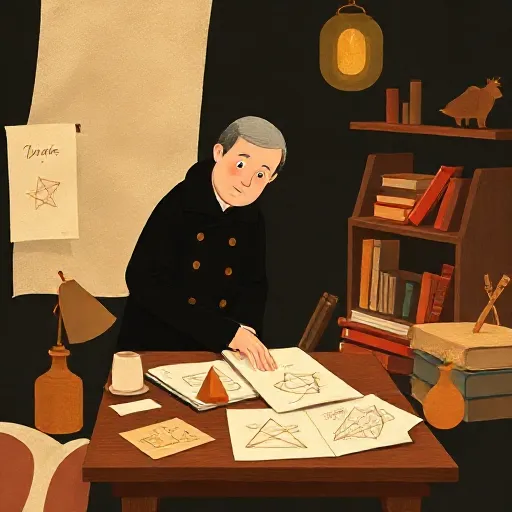
One day in 1633, the French thinker René Descartes (1596–1650) sat at his desk with a finished manuscript called The World. It was his grand plan: a book that would explain everything — from distant stars to the human body — using only mathematics and clear reasoning. But then chilling news arrived. In Italy, the astronomer Galileo Galilei (1564–1642) had just been condemned by the Catholic Church for claiming that the Earth moves around the Sun. Descartes’s book also assumed a sun-centered universe. The same authorities could come after him. So Descartes made a painful choice. He locked the manuscript away. It would not be published in his lifetime.
That moment captures Descartes’s whole life. He burned with a desire to build knowledge that no one could question — yet he knew how dangerous new ideas could be. To understand why he risked everything, you have to go back to his childhood.
From Schoolboy to Soldier-Scientist

Descartes was born in 1596 in the small French town of La Haye. His mother died when he was a baby, and he was raised by his grandmother. At age ten, he entered the Jesuit college of La Flèche. His days were filled with Latin, rhetoric, theology, and the philosophy of Aristotle — but even as a boy, he felt uneasy. The old books contradicted each other. He later recalled that he was embarrassed by so many doubts and errors. After studying law at university, he realized his real fire was for mathematics. In that subject, everything was certain.
In 1618, at twenty-two, he joined the army of Prince Maurice of Nassau. While stationed in Breda, he met a Dutch scientist named Isaac Beeckman (1588–1637). The two talked for hours about physics, harmony, and mathematics. Beeckman’s questions reignited Descartes’s ambition: to discover a method that would give him the same unshakeable certainty in all fields that you find in geometry. He began working on a set of rules for directing the mind. One day, he promised himself, he would tear down all his old beliefs and build them back on a rock.
Tearing Down the House of Knowledge
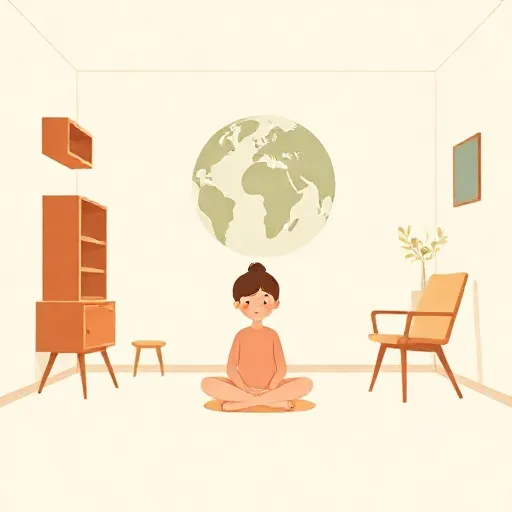
In 1641 Descartes published his most famous work, Meditations on First Philosophy. The book begins like a wrecking ball. Descartes wants to find at least one truth that is absolutely certain. So he decides to doubt everything that can possibly be doubted — even if it sounds crazy.
First, he notes that the senses sometimes fool you: a straight stick in water looks bent. Then he asks: how do you know you are not dreaming right now? The dream feels real while you are in it. Then he imagines something even more extreme: an evil demon that could control all your experiences, making you see a body, a room, even the logic of mathematics, that is completely fake. If such a demon exists, you cannot trust anything.
But Descartes spots something the demon cannot erase. Even if the demon tricks him about the world, about his body, about arithmetic, the demon cannot trick him into believing he exists when he does not. To be tricked, he must be thinking. And if he is thinking, he must exist. That is the one solid rock: he argued that because he thinks, he therefore exists (often called the Cogito).
From that single certain point, Descartes tries to rebuild. He argues that the idea of a perfect God could not come from an imperfect mind unless God truly exists and planted it there. And a perfect God would not be a deceiver. So, when Descartes grasps something very clearly and distinctly — such as mathematical truths — he can trust it. That opens the door back to a real physical world.
Rebuilding the Universe from the Inside Out
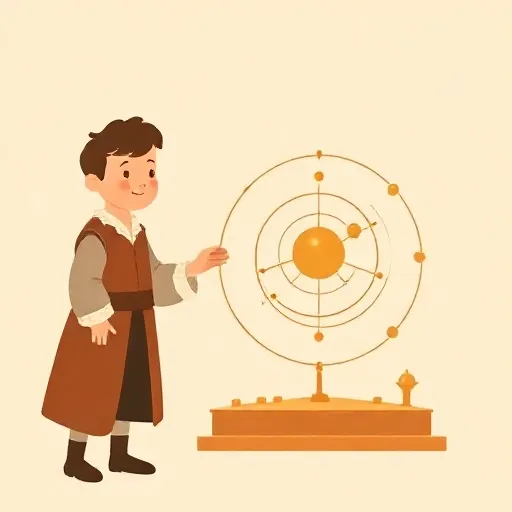
With the foundations in place, Descartes set out to rewrite science. In his Principles of Philosophy (1644), he claims that the essence of a physical body is extension — simply having length, width, and depth. For Aristotle, bodies were hot, cold, wet, or dry; for Descartes, only size, shape, motion, and position matter. This is mechanistic philosophy: the world is a huge machine, and everything in it can be explained by the arrangement and movement of tiny particles.
This led to some startling conclusions. Descartes argued that a vacuum — a space with absolutely nothing in it — is impossible. If extension always belongs to some substance, “nothingness cannot possess any extension.” So every corner of the universe must be filled with material. He also insisted that matter is infinitely divisible: you could keep cutting a piece of wax forever without ever reaching a smallest unit. Some critics, like the French philosopher Pierre Gassendi (1592–1655), objected that this would remove all firm ground from physical things. But Descartes stood firm; his physics was built on pure reasoning, not on experiments.
Others noticed a deeper crack. If the world is a machine of extended stuff, and the mind is a separate, thinking thing with no extension, how do the two connect? That question became the most stubborn puzzle Descartes ever faced.
The Ghost and the Machine

Descartes was a committed dualist: he believed mind and body are two completely different kinds of substance. Your thoughts, doubts, and feelings belong to the mind. Your height, warmth, and heartbeat belong to the extended body. This clean split troubled one of his sharpest readers, Princess Elisabeth of Bohemia (1618–1680). In a series of letters, she pressed him: if the mind has no surface, no length, no width, how can it possibly make the body move? Bodies seem to cause motion only by touching one another. But a mind cannot touch anything.
Descartes worked hard on an answer. He suggested that the mind interacts with the body through a tiny part of the brain, the pineal gland. But Elisabeth and other critics found this explanation weak. In his last major work, The Passions of the Soul (1649), Descartes argued that bodily processes cause mental states — passions — and that wise people can learn to control those passions. Yet the fundamental problem remained: if dualism is true, how mind and body interact is a genuine mystery. Even today, philosophers call this the mind–body problem, and it began in the letters between a princess and a philosopher.
Why Descartes Still Haunts Us

Descartes died in 1650, far from home, in a frigid Swedish winter. But his questions outlived him by centuries. Every time you wonder whether a computer could ever really think, you are stepping into his shoes. If thinking is something immaterial, can a machine ever have it? When neuroscientists show that thoughts light up certain brain regions, Descartes would ask: is that the thought itself, or just the physical shadow of an immaterial mind?
His method of radical doubt also gave science a powerful tool. To this day, scientists try to question every assumption and build from evidence they cannot escape. And Descartes’s demand for certainty reminds you that some of your firmest beliefs might turn out to be illusions. Next time you feel absolutely sure of something, you can ask yourself: could an evil demon be fooling me right now?
Think about it
- If an evil demon could make you see a whole world that isn’t real, how would you ever know you aren’t being fooled?
- If your mind is non-physical, why does a bump on the head change the way you think and feel?
- Suppose you uploaded every fact about your brain into a program that perfectly imitates you — would the program have a mind, or just be a lifeless copy?