
Can Everything Be Explained by Bouncing Particles? Descartes’s Big Bet
A Forbidden Book and a Secret Plan

In 1633, the scientist Galileo knelt in Rome and was forced to declare that the Earth did not move around the sun. Nearly a thousand miles away, a French thinker named René Descartes (1596–1650) was putting the final touches on a huge manuscript called The World. The book described a universe built entirely from tiny particles that pushed and spun one another — and it quietly assumed Galileo’s forbidden idea that the Earth orbited the sun. When Descartes learned what had happened to Galileo, he locked his manuscript away. He would not risk prison.
But hiding the book did not mean giving up. Descartes was convinced he had found a way to explain everything in nature — from falling apples to the rainbow — without using the strange invisible powers philosophers had leaned on for centuries. He would spend the next decade refining a physics that turned the universe into a vast, swirling game of bumper cars. No mysterious spirits, no hidden urges in matter. Just particles, motion, and a few simple rules.
The Old Way of Explaining Things
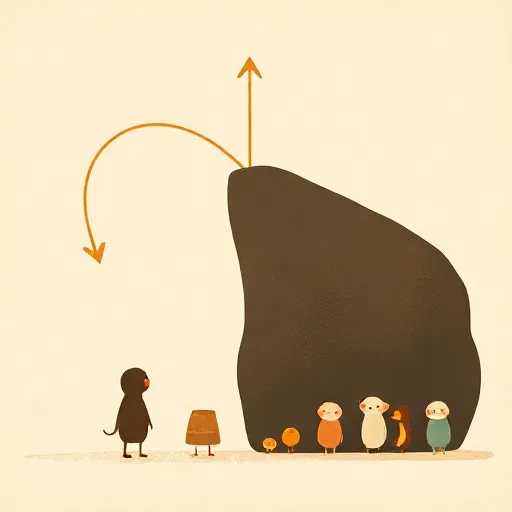
To understand what made Descartes so bold, you need to see what he was up against. For hundreds of years, the dominant science in Europe was shaped by the ideas of Aristotle and later thinkers called the Scholastics. They believed that every material thing, from a billiard ball to a thundercloud, was made of two parts: a shapeless “primary matter” and a special substantial form that gave that thing its powers. A rock, for example, didn’t fall because of a force — it fell because its form made it strive toward the center of the Earth, almost as if it knew where to go.
Descartes found this deeply unsatisfying. He argued that such talk of forms and goals gave a false sense of understanding. If you say gravity works because a body has a “form of heaviness,” you haven’t really explained anything — you’ve just given the problem a fancy name.
So he tried something radical. He proposed that the physical world is made of nothing but extension — that is, the simple fact of taking up space in three dimensions — plus motion. Shape, size, position, and movement were enough. Heat, color, and taste were not real properties of objects themselves; they were effects bodies produced in our minds. Today we call this the primary/secondary quality distinction, and Descartes was one of the first to build a whole science on it. In his picture, matter was just stretchy stuff. There could be no truly empty space, because any region of space, being extended, simply was a body. The universe was a packed, jostling plenum — no vacuum allowed.
The Motion Puzzle: Who’s Really Moving?

If the whole world is a plenum, you can’t talk about motion the way we normally do. You can’t say, “The car moved through empty space,” because, for Descartes, there is no empty space. Instead, he defined motion as the transfer of a body out of the neighborhood of the bodies touching it and into the neighborhood of others. When a fish swims, it isn’t moving through a void — it’s swapping neighbors: different water particles now press against its sides.
This leads to a strange but elegant idea. According to Descartes, motion is completely reciprocal. If body A separates from body B, then B equally separates from A. There’s no absolute fact about which one is really rolling and which is really standing still. You can pick any set of resting neighbors you like, and that will decide what counts as motion. The Earth itself, Descartes would later claim, could be considered at rest with respect to the material band swirling around the sun — a clever move that let him accept Copernican astronomy without technically saying the Earth moved.
But this relational picture immediately tangled with his own laws. Suppose a small ball flies toward a large stationary ball. From the small ball’s neighborhood, the large one is sitting still; but from the large ball’s neighborhood, the small one is rushing forward. Which one gets treated as moving for the sake of Descartes’s collision rules — and which as resting? Descartes couldn’t tell the difference without standing outside the whole system and picking a reference frame, something his strict relational view wasn’t supposed to need. The reciprocity of transfer beautifully denies any special moving “stuff” inside bodies, but it also makes it nearly impossible to decide which of two approaching objects is going to hit the other.
Three Laws That Rule the Universe
Despite that tangle, Descartes gave science something it had never had: a clear set of laws of nature expressed as rules for moving bodies.
His first law says every body keeps itself in the same state — moving or at rest — unless something outside disturbs it. This is the seed of what we now call inertia. It smashed the old idea that motion naturally dies out. For Descartes, if you throw a rock in deep space, it will glide forever in a straight line unless it bumps into something.
The second law sharpens the picture: all movement, left to itself, follows a straight path. A stone whirled in a sling isn’t trying to curve — it’s always straining to shoot off in a straight line, and only the sling keeps it circling.
The third law describes what happens when bodies collide. Descartes claimed the universe conserves a single quantity: the total quantity of motion, which he measured as a body’s size multiplied by its speed. Hit two balls together, and before and after the crash, size × speed summed together must stay the same.
That sounds neat — until you see the specific collision rules Descartes laid out. In his fourth rule, he insisted that a smaller moving body can never push a larger stationary body forward, no matter how fast it’s going. Instead, the smaller one simply bounces backward. To save his conservation law, he granted the large resting body a kind of force of resistance that grows with the incoming speed, so total quantity of motion remains unchanged even though the large body stays put. (Try imagining that with a ping-pong ball slamming into a bowling ball — it’s hard to believe.) That stubborn conclusion exposes a deeper question: was this force of resistance a real property inside matter, or just a way of describing how God keeps the world’s motion tally balanced? Descartes never settled it cleanly. He insisted extension was the only essence of body, yet his laws constantly spoke of forces and tendencies as if they were real things bodies carried around.
Cosmic Whirlpools and the Earth That Doesn’t Move
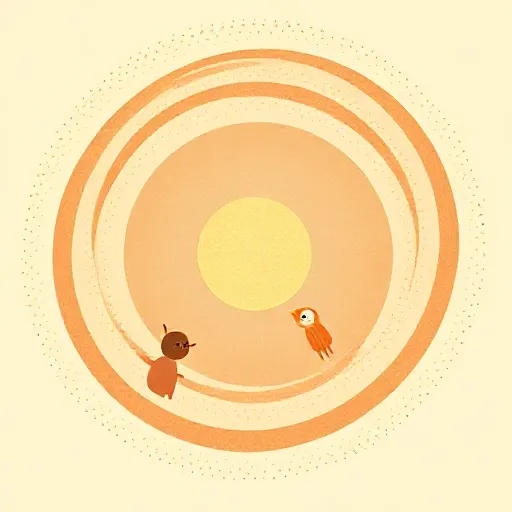
The grandest part of Descartes’s physics was his vortex theory. Picture the entire universe as a giant honeycomb of rotating whirlpools. Within each vortex, bands of particles spin around a central star or sun. A planet doesn’t fly through space by itself — it simply sits at rest inside its own swirling ring, carried along like a leaf caught in a current.
This let Descartes explain many things at once. Gravity wasn’t a mysterious attraction across empty space; it happened because a planet’s own centrifugal pushing outward was balanced by the push of the tiny particles in the vortex band around it. If a planet sank to a lower band or rose to a higher one, that was because its outward tendency was stronger or weaker than the surrounding particles — so it settled where the pushes balanced. Comets, in his story, were former suns whose vortices had collapsed, turning them into wandering travelers that passed from one whirlpool to another.
The vortex cosmos had an enormous appeal. It was mechanical and visual, and it sidestepped the dreaded “occult quality” of gravity that later critics like Newton would be accused of inheriting. But it never really worked. No one — not Descartes nor his followers — could turn the vortex picture into precise mathematics that matched the actual paths of the planets. And when experimenters spun barrels of beads to test his predictions, the particles didn’t behave as his theories said they should. By the mid-eighteenth century, the vortices were swept away by Newton’s gravity.
Why Descartes Still Matters

Descartes’s physics, as an answer to how the world works, didn’t survive. His collision rules were wrong, his vortex theory collapsed, and even his definition of motion bred contradictions. But the questions he asked, and his insistence that the universe could be understood through a handful of conservation laws and the geometry of moving bodies, shaped everything that came after.
Isaac Newton’s own three laws of motion openly rest on the first two that Descartes stated first. The very idea that science should hunt for conserved quantities — some number that stays the same through all the crashing and burning — is a Cartesian habit that physicists still practice today. And the dream of building the laws of physics from the simplest ingredients, without magic or hidden purposes, became the engine of modern science.
So the next time you coast on a bicycle and feel the world glide by around you without you pushing the pedals, you’re feeling Descartes’s first law in your bones. And every time a scientist says “this quantity never changes,” you’re hearing an echo of a French philosopher who once hid a book because he believed the Earth moved.
Think about it
- If you defined motion as a change of neighboring things, would a person sitting on a moving train be at rest or in motion? What does that tell you about how we pick “who’s really moving”?
- Descartes thought a small ball could never budge a big ball at rest, no matter how fast it went. Can you think of an everyday example that might challenge that idea? What would you need to change to make his rule work?
- Descartes believed God set a fixed amount of motion that never changes. If scientists today tell you the total energy in the universe can never be created or destroyed, does that make the universe feel more like a giant clockwork machine, or more mysterious? Why?