
Why Did Leibniz Think Descartes Was Bad at Physics?
The Boy in the Rosental Grove

In 1661, a fifteen-year-old named Gottfried Wilhelm Leibniz took a walk in a wooded park outside Leipzig, Germany. He was trying to decide: should he keep believing in the old idea that every thing has a special inner nature, or throw all that out in favor of a new mechanical picture of the world—where everything is just matter and motion? As he later recalled, “Mechanism finally prevailed.” That walk sent him toward mathematics, physics, and a lifetime of arguing with the most famous scientists of his age.
The mechanical philosophy that excited Leibniz was the idea that all natural changes could be explained by the size, shape, and motion of tiny bits of matter—no hidden spirits or mysterious “substantial forms.” It was a bold, clean view. Descartes and other moderns had championed it. Leibniz (1646–1716) threw himself into it. But by his late twenties, he began to see cracks. Something was off with the rules the mechanical philosophers used to describe moving bodies. The question Leibniz would chase for the rest of his life was: what is the real measure of the force a moving body carries, and what does that tell us about space, time, and matter itself?
Descartes’s Big Mistake: Why Speed Times Size Is Wrong
René Descartes (1596–1650) had a clear recipe for physics. He said the quantity of motion in the world never changes. To find that quantity, you multiply a body’s speed by its size (roughly what we’d call mass). If one ball moves twice as fast as another but is half as big, they contain the same quantity of motion. God, Descartes argued, guarantees this quantity stays constant, like a savings account that never loses a penny.
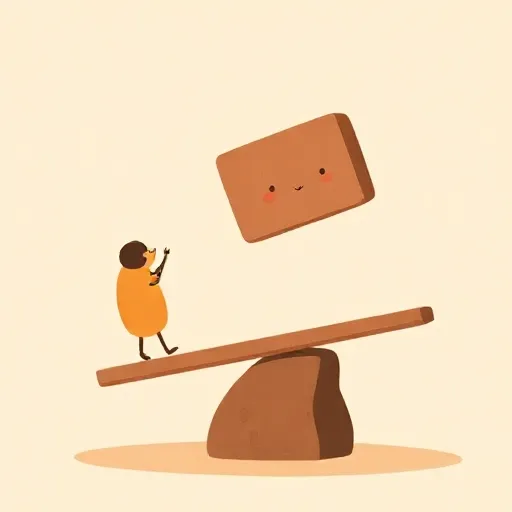
Leibniz thought this made no sense. In 1686, he published a short paper—his Brief Demonstration—that aimed to prove Descartes wrong with a simple thought experiment. Imagine two bricks: a four-pound brick and a one-pound brick. First, drop the four-pounder from a height of one meter. By the time it hits the ground, its speed is one meter per second. According to Descartes, its quantity of motion is 1 × 4 = 4 units. Now raise the one-pound brick to a height of four meters and drop it. According to Galileo’s law, it will fall for two seconds, reaching a speed of two meters per second. Descartes’ quantity of motion is 2 × 1 = 2 units.
But here’s the catch: both bricks start with exactly the same force—the same power to do work—because the amount of force a body gains falling is equal to the force it would take to lift it back up. If force and quantity of motion were the same thing, the two bricks would have equal numbers. They don’t. So quantity of motion can’t be the right measure of force. Leibniz concluded that the true measure is mv²—mass times speed squared. The four-pound brick’s living force is 1² × 4 = 4 units. The one-pound brick’s is 2² × 1 = 4 units. The numbers finally match.
Leibniz’s new conserved quantity earned a name: vis viva, Latin for “living force.” Where Descartes saw only speed and size, Leibniz saw stored power—an ability to cause an effect. And that power, he insisted, is never truly lost.
Living Force and Dead Force: The Hidden Power Inside Things

Leibniz did not stop at living force. He distinguished it from dead force. Dead force is the push or pull felt at a single instant, like the tug of a stretched bowstring before the arrow moves, or the weight of a stone pulling on a sling while your hand still holds it. Living force, by contrast, is built up from an infinity of tiny dead-force pushes—like the accumulated power of a falling body after many instants.
This distinction let Leibniz explain what happens when two soft balls of clay collide and stick together. At first glance, it seems like vis viva vanishes. Descartes’ rule would claim motion is lost. Newton’s later physics would agree that kinetic energy (the modern version of vis viva) can turn into other forms. Leibniz’s approach was different: he argued that the gross bodies we see are made of infinitely many smaller bodies, each one elastic. When two lumps of clay collide and stop, the living force doesn’t disappear—it’s just transferred to those tiny inner parts, where it no longer pushes the whole lump forward. The force is conserved, but redistributed, hidden from our eyes.
This idea rested on a radical picture of matter. For Leibniz, no physical body is ever truly solid or indivisible. Every chunk, no matter how small, is actually subdivided to infinity. There is no smallest particle, no final atom.
No Atoms, No Empty Space: Matter Without End

Many early scientists imagined the world was built from hard, unbreakable atoms moving through empty space. Leibniz rejected both halves of that picture. He argued, first, that a truly hard atom would have to change direction instantly upon colliding—a change through a leap, which violated his principle of continuity: nature never takes jumps. For a change to be infinitely abrupt, Leibniz reasoned, the colliding bodies would need to be infinitely rigid, but nothing in nature is. All bodies must be elastic and thus have parts that can shift. So atoms cannot be solid, indivisible blobs.
Second, he denied that empty space could exist at all. His principle of plenitude said that existence itself is good, so God creates as much variety as possible. Any region of empty space would be a missed opportunity to put more being in the world. The actual universe, Leibniz insisted, is a plenum—completely full of matter, with every part moving and divided without end.
Even shape gets strange in such a world. If every piece of matter is infinitely divided, no body can have a perfect geometric shape like a flawless sphere or cube. Real shapes are infinitely complicated, full of tiny bumps and dents all the way down. The neat geometry of atoms was, for Leibniz, a useful fiction.
The War Over Space and Time: Leibniz vs. Newton

Leibniz’s most famous debate came late in life, in a series of letters with Samuel Clarke (1675–1729), a defender of Isaac Newton (1643–1727). Newton had described absolute space and time as real, independent things—like a vast, invisible container that would exist even if there were no objects at all. Clarke added that space was God’s own immensity, something like God’s sensorium.
Leibniz fired back on two fronts. His Principle of Sufficient Reason (PSR) demanded that nothing happens without a reason why it happens one way rather than another. If space were an absolute container, God could have created the whole world rotated a few degrees or shifted a mile to the left, and there would be no reason to prefer one arrangement over the other. That, Leibniz said, means absolute space can’t be real.
His second weapon was the Principle of the Identity of Indiscernibles (PII): if two things are truly distinct, there must be some recognizable difference between them. An absolute space would allow two supposedly different universes that look exactly alike in every observable way. That too, Leibniz thought, was impossible.
So what are space and time? Leibniz’s answer: ideal systems of relations. Space is an order of things that exist together—like the arrangement of a city’s streets, not a box the city sits inside. Time is an order of events that happen one after another. He compared them to a family tree: the tree is not a physical object separate from the people; it’s a way of organizing relations like “mother of” and “brother of.” Space and time, for Leibniz, are similarly abstract—real enough to be useful, but not containers made of anything.
Why Leibniz’s Physics Still Matters Today
You may not have heard of vis viva, but you live with its descendant every day. Leibniz’s conviction that something like mv² is conserved in the world was a key step toward the modern law of the conservation of energy. He was wrong about some details—dead force isn’t quite the same as Newtonian force, and physics later abandoned the idea that all energy is just motion of tiny parts. But his deep claim that there is a quantity of change-making power that runs through the universe, never lost, only transformed, became a cornerstone of science.
His relational view of space and time also left a mark. The question of whether space is a thing or a web of relations still shows up in philosophy of physics and in the puzzles of quantum gravity. When you look up at the night sky and wonder if space goes on forever, you’re touching the same sense of mystery that Leibniz and Clarke argued about three centuries ago.
More than anything, Leibniz’s story is one of a thinker who refused to accept that the world was exactly as it looked on the surface. He kept asking, “What’s really going on underneath?” And each time he dug deeper, he found forces, relations, and endless hidden structure—right where others saw only simple matter in an empty box.
Think about it
- If you swing a pendulum and it slowly comes to rest, where does its “living force” go? Could Leibniz’s answer—that it’s absorbed by invisible tiny parts—still make sense today?
- Imagine two parallel universes: in one, every object is shifted one meter to the left; in the other, everything is just as it is now. If no measurement could tell them apart, are they really different universes? Why or why not?
- When you play a sport or a video game, you feel like some objects have more “oomph” than others. Is that feeling closer to Newton’s idea of force, or to Leibniz’s idea of accumulated dead-force pushes? What would it take to decide?