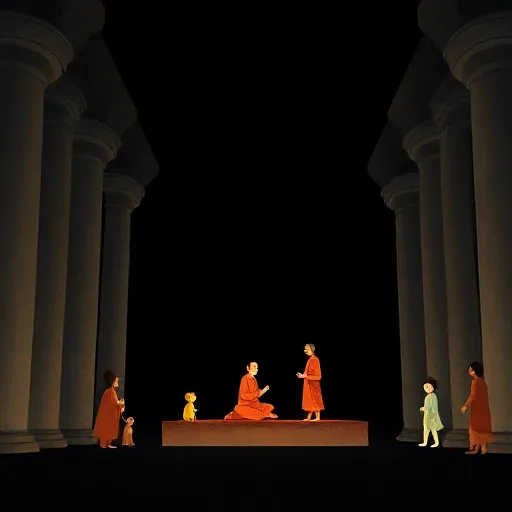

Can Arguments Lead to Silence? The Madhyamaka Split
The Prince Who Gave Up a Throne to Break Arguments

Around the year 250, a prince from what is now Sri Lanka walked away from his kingdom. He took monastic vows, studied the Buddhist scriptures, and became a direct student of the great thinker Nāgārjuna. His name was Āryadeva (fl. ca. 225–250 CE), and he devoted his life not to ruling but to a strange kind of argument — one designed to stop you from wanting to win arguments at all.
Āryadeva’s main work, the Four Hundred Verse Treatise, leads readers through a series of critiques. He shows that beliefs in a permanent self, in things that can truly satisfy us, and in independent causes all fall apart under scrutiny. But he never offers a replacement belief. Instead, he asks his readers to notice how tightly they hold their views and to see that attachment to one’s own opinions is itself an obstacle to nirvana — the stillness of mind free from craving, anger, and confusion.
In one famous passage, Āryadeva points out that believers in a permanent self say such a self cannot be harmed, yet they still forbid killing and harming others. The two ideas, he argues, cannot both stand. By the end of the Treatise, Āryadeva has presented a general template for this move: show that any positive view — that a thing is one, that it is many, that it is both, that it is neither — leads to chaos. For example, a clay pot cannot be a single thing because it has color, shape, hardness, and other different qualities. It also cannot be many things, because none of those qualities alone is a pot. And you cannot just say it is a whole made of parts, because the parts have contradictory natures (shape is visible, touch is not) that cannot form a coherent unity. Yet to deny that the pot exists at all seems to go against everyday experience. What do you do? Āryadeva does not answer. He lets the confusion settle, inviting you to stop demanding answers.
Two Truths: The World of Words and the Silence Beyond

All Mādhyamika philosophers share a starting point: the doctrine of two truths. The first is conventional truth (vyavahāra-satya or saṃvṛti-satya), the everyday understanding of the world. It includes everything we talk about with words — pots, people, causes and effects, choices, and the whole business of ordinary life. Language works here because language is built on the assumption that things have identifiable natures and that relationships like causality hold.
The second truth is ultimate truth (paramārtha-satya), which is nirvana itself — a direct, non-conceptual awareness free of all attachment, aversion, and delusion. This truth is unconditioned, peaceful, and utterly beyond what any sentence can express. You cannot describe it; you can only experience it. For all Mādhyamikas, emptiness (śūnyatā) means precisely that nothing has an inherent nature (svabhāva) — no essence that belongs to it independently of everything else. But this emptiness is the deepest fact about things, and it cannot be captured in a theory.
The trouble, then, is obvious. If the goal of the Buddhist path is a silence that words cannot reach, what is the point of all the Buddhist teachings, debates, and philosophical treatises? Are carefully reasoned arguments a ladder that helps you climb over the wall into wordless peace, or are they just more noise that keeps your mind trapped in concepts? Every Mādhyamika agreed that language and concepts can never directly grasp ultimate truth. Yet they disagreed fiercely about whether clear thinking and formal argumentation were friends or enemies on the way there.
The Great Split: Defending Emptiness or Just Destroying Views?

The earliest surviving commentary on Nāgārjuna’s Fundamental Verses on the Middle Way (MMK) comes from Buddhapālita (ca. 470–540 CE). His method is simple: take a philosophical question — like the relation between a cause and its effect — and show that every possible answer leads to an absurd consequence. For example, if an effect were identical to its cause, it would already exist and would have no need to arise. If the effect were completely different from the cause, then anything could arise from anything — a flame from darkness, a pot from a river. To say both identity and difference hold at once is just to combine two broken ideas. To say neither holds destroys causality altogether. Buddhapālita never offers his own theory of how effects arise. He leaves the problem in ruins. Critics called this vitaṇḍā — mere sniping — and said it was a low form of debate that avoided responsibility.
Bhāvaviveka (fl. 6th century CE) took up that challenge. In his Lamp of Wisdom, he insisted that Mādhyamikas do have a conviction worth defending: that all phenomena are empty of inherent nature. They should therefore produce independent arguments (svatantra) for that thesis, using the formal logical method of Dignāga (ca. 510 CE). Dignāga’s system required stating a topic, an observed reason, and the property to be proved — like using smoke to infer fire on a mountain. Bhāvaviveka argued that when Nāgārjuna negated a proposition such as “a phenomenon arises from itself,” he was negating the whole statement, not just the predicate. A sentential negation (“It is not the case that a phenomenon arises from itself”) leaves no hidden positive claim, so the Mādhyamika can safely reject all four possibilities without slipping into a positive view. Language, Bhāvaviveka believed, can at least convey the general nature of reality — namely, that reality is beyond language — and so can help a person move step by step toward the final, wordless insight.
Candrakīrti (early 7th century CE) came to Buddhapālita’s defense with fierce counterarguments. In his Clear-worded Commentary and the earlier Introduction to Centrism, he declared that demanding independent arguments goes against everything Nāgārjuna and Āryadeva taught. Nāgārjuna himself had written that he had no thesis to advance and neither affirmed nor denied any proposition. Āryadeva had said that someone who makes no claim — either that something exists or that it does not — cannot be refuted. Candrakīrti concluded that the entire point of Madhyamaka is to bring all disputation to an end, not to win debates. To offer a positive position is to invite endless counterarguments and to miss the goal: silence. The Mādhyamika’s proper job is to show the unwanted consequences (prasaṅga) of every possible position until the other person sees that all linguistic views are groundless. This strategy leaves nothing to defend and therefore nothing to be attacked. Later Tibetan scholars would label Bhāvaviveka’s approach Svātantrika (“those who use independent arguments”) and Candrakīrti’s approach Prāsaṅgika (“those who rely on consequences”). The split shaped Buddhist philosophy for over a thousand years.
Why It Still Matters: The Habit of Clinging to Views

Candrakīrti’s radical move was to say that we should take ordinary experience seriously — we see things arise and perish, we feel like conscious selves, we communicate in everyday language — but we should never mistake that ordinary picture for a set of fixed truths. The task of philosophy, on his view, is not to replace unwarranted beliefs with justified true ones. It is to break the habit of forming beliefs, declaring them to be true, and then becoming emotionally attached to them.
This is where the old argument strikes close to home. Think of a time you got into a heated debate with a friend over which movie is best, or what is the right way to handle a problem, or whether something was fair. If all you did was try to prove your side right, the argument probably never really ended — one of you just got tired. The Prāsaṅgika instinct is different: it suggests that showing the flaws in every fixed position, without insisting on a replacement, can be more freeing than winning. It doesn’t mean you never have opinions; it means you hold them lightly, aware that language and thought are always conventional and never final.
The Mādhyamikas were not anti-intellectual. They produced some of the most rigorous reasoning in the history of philosophy. Yet they kept their eyes on a destination beyond arguments. Whether you think reason is a ladder to the wall or just part of the noise, the question remains alive: can the very act of arguing teach you when to stop?
Think about it
- If someone always spotted the weaknesses in your beliefs but never told you what to believe instead, would you find that helpful or annoying? What might make the difference?
- Imagine you’re in a long argument where both sides keep making good points but nobody ever convinces the other. What would it mean to “win” such an argument? Is winning even the right goal?
- Think of a time you held an opinion very tightly. What eventually loosened your grip — a better argument, a change of mood, or something else? Could sitting with the confusion, without rushing to a new belief, ever be more useful than finding an answer?