How Did Indian Philosophers Invent the Perfect Argument?
A Game of Questions in an Ancient Hall

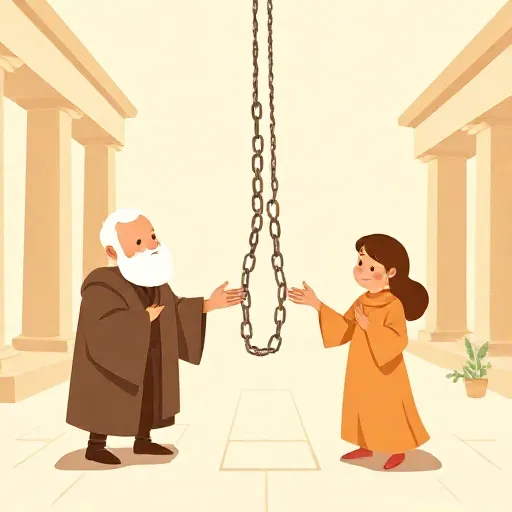
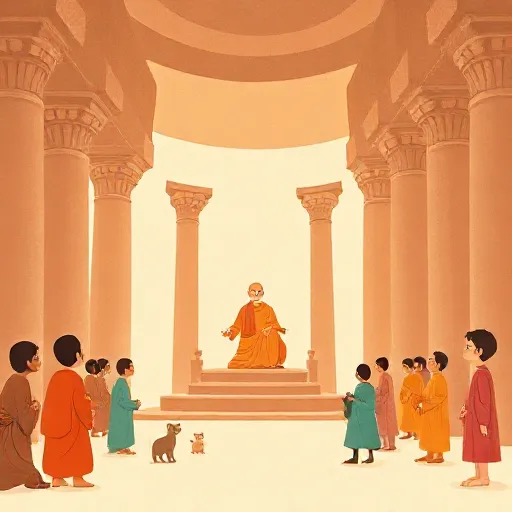
Around 250 BCE, somewhere in India, a Buddhist monk stood before a rival philosopher. The monk was a Theravādin. The rival belonged to a school that believed each person has an unchanging soul — a Pudgalavādin. Their debate, part of a text called the Kathā-vatthu, followed strict rules. No one shouted. The room expected a clear winner.
The monk began: Do you believe the soul is known truly and ultimately?
The Pudgalavādin answered, Yes.
Then the monk asked: Is it known in exactly the same way as any other ultimate fact?
The Pudgalavādin hesitated. No.
The monk had him. If the soul is an ultimate fact, it must be known like any other ultimate fact. Saying “yes” and then “no” produces a pair of statements that cannot both be true. The monk had shown, gently, that his opponent held an inconsistent position. He had used logic — the study of what follows from what — without needing a single insult.
This exchange is one of the earliest surviving records of argument in India. It reveals something important: even without modern symbols, people understood that arguments have a shape. They recognized that if a statement like “if A, then B” is true, then its contrapositive, “if not B, then not A,” must also be true. In the Kathā-vatthu and other early texts, we see the first attempts to figure out what makes reasoning good.
The Five-Stage Recipe for an Argument

For several centuries, Indian thinkers built arguments largely through analogy. The most famous example appears in the Caraka-saṃhitā, a medical text from around the 1st century CE. It lays out an argument in five parts — a kind of recipe for proving a claim.
Here is how that recipe worked, with a claim about the soul:
- Proposition: The soul is eternal.
- Reason: Because it is unproduced.
- Example: Space is unproduced and it is eternal.
- Application: And just as space is unproduced, so is the soul.
- Conclusion: Therefore, the soul is eternal.
Notice the structure. The arguer picks a familiar example (space) that shares a certain feature (being unproduced) and also has the property in question (being eternal). The argument then says: because the soul shares that first feature, it must share the second. This form is called an analogical syllogism. It relies on similarity. A similar argument could also be run with dissimilarity: “Sound is not eternal, because it is produced by effort, unlike space, which is eternal and not produced.”
This five-part pattern was widespread. It gave debates a clear format and helped audiences follow the reasoning. But there was a problem: similarity is slippery. Two things can be alike in one way without being alike in another. A clay pot is produced, and it perishes; but the fact that a pot and sound are both produced does not automatically prove that sound perishes too. The analogy only works if there is a hidden universal rule that all produced things perish. Indian thinkers soon realized they needed to make that rule explicit.
From “Like” to “Only If”: The Birth of the Universal Rule

By the 4th century CE, a shift had taken place. Buddhist writers, including one known only through a Chinese translation called Upāya-hṛdaya, began to reject arguments that relied on sheer analogy. In their place they championed a deductive form — one where the conclusion must be true if the premises are true.
An argument from the text Rúshí lùn (often called the Tarka-śāstra) shows the difference. The claim is that sound is not eternal. The old analogical version would point to a pot and say, “Just as a pot, arising from effort, perishes, so does sound.” The new version goes further:
- Proposition: Sound is not eternal.
- Reason: Because it arises due to an effort.
- Example: If a thing is eternal, it does not arise due to an effort. For example, space is eternal and does not arise due to effort.
- Application: Sound is not that way.
- Conclusion: Therefore, sound is not eternal.
Now the example contains a true universal statement: whatever is eternal does not arise from effort. When you combine that with the reason, the conclusion is forced. There is no gap left for analogy to fill.
The Buddhist thinker Vasubandhu (5th century CE) made the shape of a good argument even tighter. He dropped the application and conclusion statements, keeping only the proposition, the reason, and an example that expresses an indispensability relation — a connection where the reason cannot be present without the property to be proved. His canonical syllogism looked like this:
Thesis: p has S.
Reason: Because p has H.
Example: Whatever has H has S, like d (where d is a different thing that clearly has both H and S).
Indian logic had now acquired its backbone: the syllogism whose core is a deductively valid argument. But the next question was: how do you know when a reason really is a good one?
Dignāga’s Wheel and the Three Secrets of a Good Reason

Dignāga (c. 5th–6th century CE) took the next giant step. He studied with Vasubandhu and went on to write a masterwork, the Pramāṇa-samuccaya, that dominated Indian logic for centuries.
Dignāga described two sides of reasoning. Inference for oneself (svārtha-anumāna) is the private mental act of realizing something new from what you already know. Inference for another (parārtha-anumāna) is the public display of that reasoning — an argument meant to convince someone else. Both, he argued, are two sides of the same coin.
He also refined the canonical syllogism. His version included not one but two example statements:
- Thesis: Sound is non-eternal.
- Reason: Because it is immediately connected with an effort.
- Similar example: Whatever is immediately connected with an effort is observed to be non-eternal, like a pot.
- Dissimilar example: Whatever is eternal is observed not to be immediately connected with an effort, like space.
Notice the word “observed.” Even though the statement says something about all cases, it is introduced through things we have actually seen. That small word has sparked centuries of debate among scholars: was Dignāga building an inductive logic based on experience, or was he simply adding a practical check to ensure arguments weren’t empty? The evidence suggests he wanted a deductively valid argument, but he also wanted it to be persuasive. So he required that the reason appear in at least one similar object and be absent from at least one dissimilar object — otherwise, you might be talking about only the original subject, which would be a circular argument.
To make this screening systematic, Dignāga created the wheel of reasons (hetu-cakra). It is a three‑by‑three grid that checks where the reason occurs among similar things and among dissimilar things. Only two of the nine possibilities count as good: the reason must occur in all similar things and not in any dissimilar things; or it must occur in no similar things and not in any dissimilar things (a trickier case that still works). Dignāga called these the three forms of a reason (tri‑rūpa‑hetu): the reason must actually belong to the subject, it must be present in similar examples, and it must be absent from dissimilar examples.
This might sound fussy, but consider a real bad argument that Dignāga rejected. Some Brahmin thinkers held that sound is eternal. Their argument was: sound is eternal because it is audible. That is deductively valid but utterly unpersuasive, because audibility is a property only of sound itself. No independent example exists of something both audible and eternal. Dignāga’s rules kicked such arguments out.
Why Your Next Argument Depends on Ancient India

You may never sit in a pillared hall debating the nature of the soul. But every time you say, “That’s unfair, because the rule applies to everyone,” you are using a reason. Every time you point to a similar situation — “Look what happened to Sam when she tried that” — you are providing an example. The structure that Dignāga, Vasubandhu, and their predecessors wrestled with is the same structure you use every day.
Their work reminds us that not all arguments are equal. A good argument needs a reason that is genuinely tied to the claim — not just a random similarity. It should be a reason that works across many cases, and ideally one that could never be present if the claim were false. Indian thinkers called this the relation of indispensability: the reason must not exist without the conclusion’s truth.
Understanding this helps you catch bad reasoning. If someone says, “You should believe me because I’m older,” ask: what is the universal rule? Does being older always make a statement true? If the only example the speaker can name is themselves, the argument is circular. If they point to just one other person and ignore a hundred counterexamples, the argument falls apart. Indian logic gave us tools to see these flaws — not by memorizing symbols, but by attending to the shape an argument must have before it deserves to be believed.
Think about it
- Can you think of a time when you were convinced by an analogy that later turned out to be misleading? What was missing that would have made the argument stronger?
- If someone argues, “This medicine works because it cured me,” is that a good reason? What would a universal rule look like for that claim, and how could you test it?
- Why might an argument that is perfectly logical still fail to convince a careful listener — and is that a problem with the logic or with the evidence?