
You’re Right Until Someone Proves You Wrong
The Silver‑and‑Shell Puzzle

Imagine walking along a sunny beach. You spot something shiny half‑buried in the sand and your brain instantly shouts, “Silver!” You bend down, only to find it’s a piece of broken shell with a pearly shimmer. For a moment you were completely confident — and then you weren’t. Which thought should you have trusted more: the first one, or the second?
This puzzle is at least as old as classical Indian philosophy. Thinkers often used the example of mistaking glinting mother‑of‑pearl for a silver coin. The mistake feels real until you pick the thing up. But the bigger question is: when you see something, do you need extra proof before you’re allowed to believe it — or is seeing enough, unless you later discover you’re wrong?
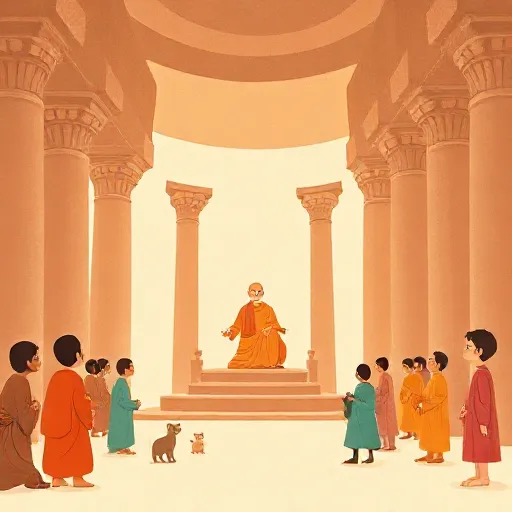
That question split the intellectual world of seventh‑century India into two fierce camps. On one side stood Kumārila Bhaṭṭa (flourished around 650–700 CE), a sharp‑tongued defender of the Vedic tradition. On the other side were Buddhist philosophers like Dignāga (5th–6th century CE) and Dharmakīrti (7th century CE), who insisted that trust must be earned. Their clash wasn’t just about shells and coins — it was about how anybody can know anything at all.
Kumārila’s Rule: Beliefs Arrive with a Built‑in Pass

Kumārila belonged to a school called Pūrva Mīmāṃsā, which spent centuries working out how to interpret the ancient Vedic scriptures. But before he could even talk about scriptures, he had to answer an even bigger challenge: why should anyone take the words of a book seriously in the first place?
His answer became his signature idea. Kumārila argued that every clear, honest thought — what philosophers call a cognition — carries its own permission to be believed. He called this property intrinsic validity (svataḥ prāmāṇya). In plain English: a thought is automatically a good reason to believe something, just because it showed up in your mind as a definite, contentful idea.
His reasoning was simple but hard to sidestep. Imagine you demand that every belief needs a separate proof before you accept it. But then that second proof is itself a belief — so it would need a third proof, and a fourth, without end. Kumārila said that’s like trying to climb a ladder that has no first rung. Therefore, the very first belief must be allowed to stand on its own. Later, if a stronger, contrary idea appears — what he called an overriding cognition — then you adjust. But until that happens, your mind is doing exactly what minds do: giving you a world to work with.
The Buddhists Fight Back: Only What Works Is Real

The Buddhist thinkers who argued against Kumārila had a very different picture of the mind. Dignāga and Dharmakīrti believed that our ordinary experiences are often sneaky liars — especially the habit of jumping from “I see a patch of shiny white” to “that’s a piece of silver.” They wanted to ground knowledge in something more solid: direct, non‑conceptual perception.
For them, the gold standard was pragmatic efficacy. Something is real only if it can actually do something in the world. A jar that you can carry water in is real; a mirage of a jar is not. So they argued that a first glance is never enough. You need to check whether the thing you think you’re seeing can actually cause an effect — whether lifting it, pouring water from it, or tapping it produces the expected result. Only that kind of second‑step success, they said, makes your original belief trustworthy.
Kumārila shot back with a question: why do you trust the “it works!” thought any more than the first one? After all, the feeling that the jar held water is just another cognition. If you’re going to be suspicious of the first glance, why give the second glance a free pass? His opponents, he said, were pretending to have found a special magic key — but the key was cut from exactly the same metal as the lock.
The Book That Cannot Lie: How the Vedas Got Special Status

If the debate stopped here, it would already be extraordinary. But Kumārila had a bigger goal. He wanted to show that the ancient Vedic texts — collections of stories, hymns, and ritual instructions — are not just another source of ideas, but the most reliable source of all.
That’s because the Mīmāṃsā tradition held that the Vedas have no human author. They are apauruṣeya — “not made by any person.” Kumārila combined this with his epistemological rule: if a text has no author, there is no limited, fallible human mind whose mistakes or lies could ever give you a reason to override what the text says. When you read a Vedic sentence that tells you to perform a sacrifice, the cognition it produces is automatically trustworthy, and there is simply no one to blame if you later want to call it false.
For Kumārila’s critics, this was a breathtaking move. It meant that an entire tradition of commands — things you ought to do — could present itself as beyond questioning. Buddhist and Nyāya philosophers pushed back hard. But Kumārila challenged them to explain where the very idea of meaning comes from: you can’t invent language from scratch with a single first conversation, because you’d need a language to have that conversation. Language, he argued, is always already there, an eternal background that makes any particular word possible.
The “I” Inside Your Memory: A Quick Glimpse at the Self
Kumārila also used his trust‑first rule to defend something that feels very personal: the idea that you are a single, lasting self.
Buddhists at the time taught that what we call a “person” is just a string of momentary mental events — like a river that looks continuous but is really made of different water every instant. Kumārila disagreed. He pointed to memory. When you remember something that happened to you last summer, the thought isn’t just “someone was eating mangoes in the park.” It’s “I was eating mangoes in the park.” The “I” is baked right into the memory itself.
For Kumārila, that immediate sense of “I” is a clear, cognitively rich experience. Unless a specific reason arrives to show it’s false, we are justified in believing that it genuinely refers to a real, continuing self. Once again, he refused to let abstract doubt erase what felt unmistakably real.
Why This 1,300‑Year‑Old Fight Still Matters

So was Kumārila’s project a clever way to lock people into a set of rules by declaring them unquestionable? Some modern scholars think so. They’ve argued that by claiming the Vedas were authorless and automatically trustworthy, his tradition gained enormous power — it decided what counted as real knowledge and silenced other voices. That kind of move still happens today whenever a group says, “This is just the way things are, don’t ask who benefits.”
But other readers find something more generous in Kumārila’s picture. He reminds us that we all swim in an ocean of language and tradition that we didn’t choose, and that most of the time we have no choice but to trust what our eyes, ears, and memories tell us. Before you can question a claim, you have to start somewhere. The real fight, then and now, is about who gets to decide what counts as a good “somewhere” — and how openly we can argue about it.
Next time you hear a surprising story from a friend, or scroll past a shocking headline on your phone, you’re facing the same fork in the road: do you believe it on the spot, or demand proof first? Kumārila and his Buddhist opponents drew the line in two different places, and they argued with breathtaking honesty. The debate is far from settled — and that’s exactly why it’s worth having.
Think about it
- If you had to prove that the thing you’re looking at right now is real, what proof would you use — and how do you know that proof isn’t just another belief that needs its own proof?
- Some traditions say their rules come from a source that cannot make mistakes. If someone told you that, how would you decide whether to accept the rules without checking them?
- Think of a time you were absolutely certain about something and later found out you were wrong. Were you wrong to trust your first thought, or was that trust an essential first step in learning?