
The Forgotten Monk Who Solved the Mystery of What Words Point To
A king, a monk, and a missing name
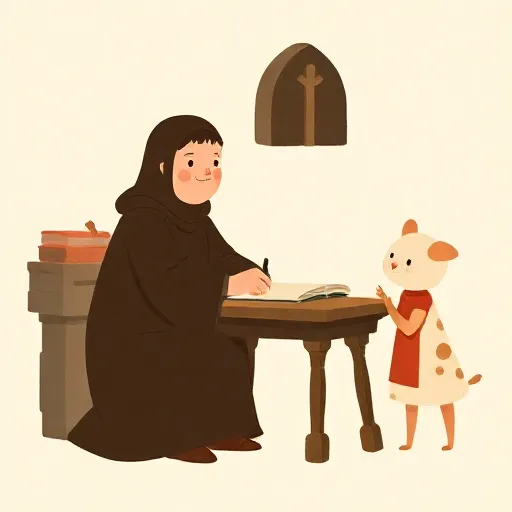
Sometime in the 1250s, a Dominican monk named Lambert sat across from a teenager in a quiet room. The teen was Theobald II, soon to be crowned king of Navarre, a small kingdom in what is now northern Spain. Lambert had been hired to teach him logic—the art of clear thinking. To help his royal student, Lambert wrote a textbook. One of the surviving copies tells us this, right in a note at the end: the book was written by “Lambert, teacher of the king of Navarra.”
The textbook was called the Summa Lamberti—“Lambert’s summary.” It became popular across Europe and survived in at least fifteen handwritten copies. Yet, oddly, we still don’t know exactly who Lambert was. Different manuscripts call him different things: one says “Master Lambert of Ligny-le-Châtel,” another “Lambert, brother of Saint-Victor,” and a third “Lambert of the Order of Preachers.” Modern scholars argue about whether he should be named “of Auxerre” or “of Lagny.” The evidence is tangled, and unless a new document turns up, the argument will keep going. So, to keep things simple, we’ll just call him Lambert the logician—the monk who helped a future king think about how words work.
What happens when a word points to the world?

Think of the word “cat.” By itself, “cat” just brings to mind a furry, four-legged animal. That’s its signification: the basic meaning it carries. But in a sentence like “Every cat has fur,” the word does a new job. It reaches out and stands for every actual cat you could find. Lambert gave that reaching-out a name: supposition. A term’s supposition is the way it stands for something when it appears inside a sentence.
Lambert noticed that people used the word “supposition” in four different ways, but only one of them mattered to logic. The important one was this: a term taken to stand for itself, for its meaning, or for one or more individual things that fall under its meaning. Those individual things were called supposita (say it “sup-POS-i-ta”). If you say “A cat is sleeping,” the term “cat” supposits for some real cat out there—its suppositum.
Lambert went on to sort supposition into different kinds. Two big ones were common supposition and discrete supposition. Common supposition covers general terms (like “cat”), which can point to many individuals. Discrete supposition handles singular terms—proper names like “Socrates” or phrases like “this man.” Lambert thought discrete supposition was a type of personal supposition, which means it points to a real, existing individual. But some later thinkers found this grouping puzzling. A proper name already singles out one person; it doesn’t behave like a general term that ranges over many things. Scholars still debate whether Lambert’s choice was a smart simplification or a crack in his system. The puzzle shows how tricky it is to draw a single map that fits every kind of word.
Do unicorns get to join in?

Lambert had another tool in his word-kit: appellation. Like supposition, “appellation” had a few everyday meanings, and again only the fourth one mattered for logic. In its logical sense, appellation is the acceptance of a term for something that actually exists right now. So if you say “Unicorn,” the word still has supposition—you can talk about unicorns, imagine them, paint them on walls. But it lacks appellation, because no unicorn walks the earth.
This split helped medieval logicians handle tricky sentences. You can say “I want a unicorn” and the sentence does its job—you aren’t talking nonsense. But the word isn’t pointing to a real thing the way “horse” does. Lambert’s move was to let words do two different kinds of heavy lifting: they could stand for whatever fell under their meaning (supposition), and, separately, they could hook onto things that have genuine, current existence (appellation). Not everyone at the time drew the line exactly like Lambert, but the distinction stuck around in later debates about what it means for a word to refer.
Why “the king” changes depending on where you stand
A word’s supposition doesn’t just sit frozen. It can be squeezed smaller or stretched wider. Lambert spotted two ways this happens: restriction (standing for fewer things than usual) and ampliation (standing for more). What’s special is how he handled restriction.
One kind was natural restriction. Add an adjective, and the range shrinks. “Cat” covers all cats; “calico cat” restricts the supposition to only those cats with a splotchy orange-and-black coat. That kind is simple.
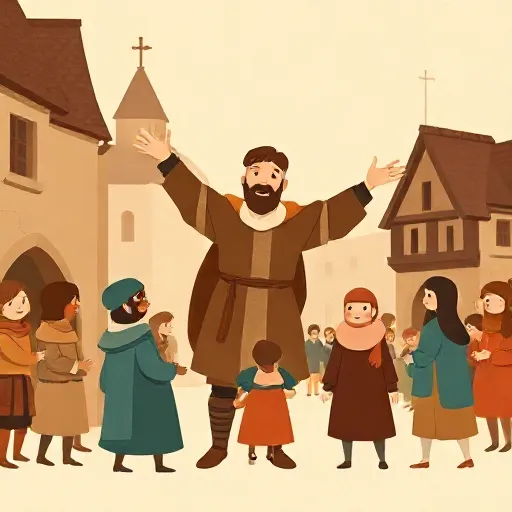
The other kind was use-based restriction (usualis restriction), and here Lambert did something his fellow textbook writers—William of Sherwood and Peter of Spain—didn’t do. Use-based restriction doesn’t come from adding extra words; it comes from the situation around you. Lambert gave the example: “The king is coming.” What does “king” refer to? It depends on the country where the sentence is spoken. In Navarre, it picks out the king of Navarre. Say the same sentence in France, and “king” points to the French king. The context does the trimming.
That may sound obvious to us, but in the 13th century, noticing it and putting it into a theory of logic was a big step. Lambert was spotting something like what modern thinkers call pragmatics—the role of context in shaping meaning. His student king would have understood: when a herald shouts news, you don’t need a full description; you just know which king matters where you stand.
Why Lambert still matters when you speak

Lambert’s textbook didn’t disappear into a dusty library. One copy was donated to the Sorbonne around 1280 and was still being used as a teaching text there until at least 1334. His ideas about supposition left traces in the work of later philosophers, including the famous John Duns Scotus. The very puzzle he tackled—how do words hook onto pieces of the world?—is alive and well in philosophy of language today.
You meet that puzzle every time context saves you from confusion. When a friend texts “Bring the bat,” you know whether to grab a baseball bat or a toy flying animal because the situation restricts the word. When you say “The teacher is late,” the teacher your sentence points to depends on whose class you’re in. Lambert didn’t have a theory of smartphones, but he was already mapping the same invisible rules you use without thinking. A monk teaching a young king in a quiet room ended up describing something that still runs quietly beneath every sentence we speak.
Think about it
- If you say “The teacher is late” while standing in the hallway, but there are three teachers, which one does your sentence point to? How does the situation help you and your listeners agree?
- Can you think of a word that works like “unicorn”—something you can talk about clearly even though it doesn’t exist? What’s the difference between telling a story about a real cat and telling one about an imaginary creature?
- Your friend says “I saw a cat.” Later you find out they saw a drawing of a cat in a book. Does the word “cat” still point to a real cat? If not, what exactly is it pointing to, and would Lambert’s system help you describe the difference?