Do You Know the Cat, the Mat, or the Whole Situation?
The Cat, the Mat, or Something Else?

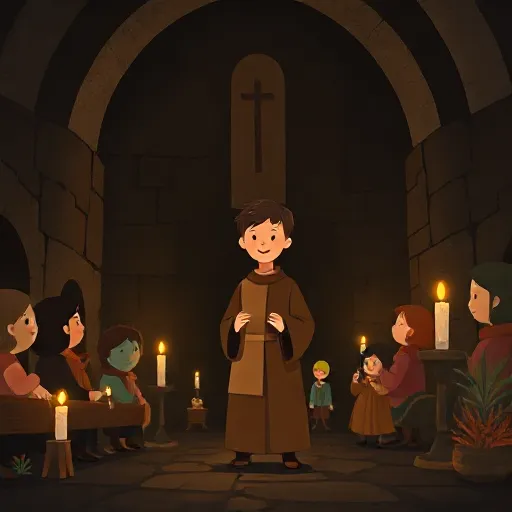
It is a chilly morning in Oxford, England, in the year 1332. In a narrow stone lecture hall, a young Franciscan friar named Adam Wodeham (c. 1295–1358) stands before a room of students. He holds up a slip of parchment with a simple line scribbled on it — not a word, just a mark — and asks a question that has tied philosophers in knots for centuries: when you know that a sentence is true, what exactly do you know?
Wodeham had studied under two of the sharpest minds of the age, William of Ockham (c. 1287–1347) and Walter Chatton (c. 1290–1343), and he knew their answers well. Both agreed that knowing a sentence like “the cat is on the mat” meant knowing something about the world. But they violently disagreed about what the knower’s mind latches onto.
Ockham argued that the object of knowledge — the thing you really grasp — is just the individual terms of the sentence. You know the cat, and you know the mat. The link “on” is merely a mental trick that joins them. Chatton thought that was too thin. The real object, he said, is the single thing the subject points to: the cat. You know the cat, and that act of knowing is all that matters.
Wodeham looked at both answers and shook his head. If knowing a truth was just knowing separate things, why does the whole sentence feel so different from a list of words? And if knowing the truth is only about the cat, what happened to the mat? Something vital was missing.
The Third Answer: The Complexe Significabile

Wodeham’s answer was bold and, in its own quiet way, revolutionary. He said that when you know “the cat is on the mat,” the object of your knowledge is neither the cat, nor the mat, nor a ghostly sum of the two. It is a special kind of thing that can only be expressed by a whole sentence — a complexe significabile, or “that which can be signified in a complex way.”
Think of a jigsaw puzzle. Ockham pointed to the individual pieces; Chatton pointed to the picture on the box lid. Wodeham pointed to the completed puzzle — a single whole that includes the pieces and their arrangement. That whole cannot be broken into independent bits without losing what makes it what it is. The fact that the cat is on the mat is not just “cat” plus “mat” plus “on.” It is an arrangement, a state of affairs, and your mind can grasp it all at once.
This turns out to be a very natural idea. If your friend tells you, “My room is messy,” you do not picture the room and the messiness as two floating items. You picture a whole situation. Wodeham argued that reality contains such situations, and that they are the proper objects of our knowing when we assent to a proposition. He insisted they were not imaginary or merely “in the mind.” They had some real weight in the world, even though they did not fit neatly into Aristotle’s categories of substance or accident.
Later thinkers, like Gregory of Rimini (c. 1300–1358), picked up the idea and ran with it. For many years the complexe significabile was misattributed to Rimini, but modern scholars have shown it was Wodeham’s invention. It remains a puzzle: are these fact-like entities real additions to the world, or just a handy way of talking? Wodeham opened a door that philosophers are still walking through.
How Sure Can You Be? Wodeham’s Evidence Levels

If we can know whole states of affairs, the next question slaps you in the face: how certain can we ever be? Wodeham did not want to hand out false confidence, so he sorted our evidence into three degrees.
The first and lowest degree covers experiences that incline us to believe but can still be wrong. Picture a straight stick poked into a glass of water. It looks broken. Your senses seem to scream a clear proposition: “the stick is bent.” But you can doubt that. Other experiences, or a quick reasoning check, lead you to suspend judgment. The evidence is good enough to provoke a judgment, not strong enough to force one.
The second degree fixes the “can be wrong” worry but not the “can be doubted” worry. A necessary truth like “2 + 2 = 4” cannot ever turn out false. Yet, Wodeham thought, a person could still doubt it — perhaps because another apparent truth seems to clash with it, or because a clever argument muddles the mind. The truth itself is safe; the human intellect is not forced to nod.
The third and highest degree leaves no escape. These are per se nota (self‑evident) propositions. They are not only necessarily true but also utterly impossible to doubt. Wodeham’s example would be something like “the whole is greater than the part.” No matter what other ideas flood your head, your intellect is compelled to assent.
Scientific knowledge, for Wodeham, is built by climbing this ladder. A conclusion that starts out merely believable can be raised to the third degree when it is linked to self‑evident premises in a demonstrative syllogism — a watertight chain of reasoning. Crucially, you cannot just glance at the conclusion and be certain; you must hold the entire chain in your mind. If you forget a premise, the compulsion disappears. Certainty is a fragile, whole‑sized thing.
Only the Heart Matters: Wodeham on Good and Evil
Just as Wodeham put facts at the center of knowing, he put the will at the center of being good. In a debate that sounds startlingly modern, he squared off against John Duns Scotus (c. 1266–1308) over where moral worth lives.
Scotus said that an act of will — wanting to help a friend — carries moral goodness. But the external act — actually helping — adds a second layer of goodness on top. The more you manage to do, the more praiseworthy you are. Wodeham found that baffling. Imagine you will to rescue a drowning child, but you cannot swim and so never jump in. Should you be blamed for lacking the power to perform the act? Of course not, Wodeham insisted. If the external outcome is not under your free control, it cannot add to your merit or blame. Only the inner choice is truly yours.
Walter Chatton pushed back with a worry about faith. If believing certain things about God is necessary for salvation, but the act of believing is not directly controlled by the will, wouldn’t Wodeham’s view make belief meaningless? Wodeham drew a sharp distinction. He said there is infused faith, which is a pure act of the will, given by grace. And there is acquired belief, which is an act of the intellect swayed by evidence. Acquired belief, like the calm acceptance of a conclusion without a flicker of doubt, is not what saves you. If you will to believe but are kept from feeling calm by a melancholic mood, a burst of passion, or a confusing sophism, God does not hold that against you. The heart’s desire, not the brain’s quiet, is what counts.
It is a crisp, challenging picture: you are not responsible for the consequences your body cannot deliver. Only the will’s motion, free and inward, bears moral weight. Wodeham’s take still echoes whenever we ask whether a good intention excuses a clumsy outcome.
Why Wodeham Still Walks Your Hallways

Adam Wodeham’s name is not a household word. But the puzzles he chased follow you through everyday life.
Whenever you tell someone a fact — “the game starts at eight,” “this cookie tastes salty” — you are trading in complexe significabilia. The idea that sentences point to whole states of affairs, not just bagged‑up objects, became central to later philosophy. In the twentieth century, thinkers like Ludwig Wittgenstein wrestled with very similar questions about facts, pictures, and the logical structure of the world. Wodeham’s intuition, scribbled in a cramped Oxford lecture hall, had a long afterlife.
His degrees of evidence, too, map onto modern worries. Scientists debate how certain we can ever be about a theory, and you yourself navigate life with a mix of second‑degree confidence (you’re pretty sure your friend will meet you) and first‑degree appearance (the stick always looks bent, even when you know it isn’t). Wodeham did not solve certainty, but he gave us a clear map of the territory.
And his ethics? The tension between intention and outcome keeps judges, parents, and friends awake at night. If you meant well but things went wrong, how much praise or blame do you deserve? Wodeham did not say the outcome doesn’t matter for the world; he said it doesn’t add to your moral score. That is a claim you can test against your own sense of fairness every time a plan goes sideways.
Wodeham’s world was one of friars, parchment, and candle smoke. But the questions he asked — about facts, certainty, and the secret duty of the will — are still sitting right there on your desk, in the next sentence you speak, and in the very next choice you make.
Think about it
- If you intend to help a friend but accidentally make things worse, should you still be praised for your good intention? Why or why not?
- Can you recall a time when you were completely sure about something, only to discover later you were wrong? How did that change what you believe about being certain?
- When you tell someone, “My favorite team won the game,” what exactly are you communicating — just the team and the game, or something more?