Are Some Ideas Already Inside You Before You Learn Them?
A Slave Boy Finds Geometry Inside Himself
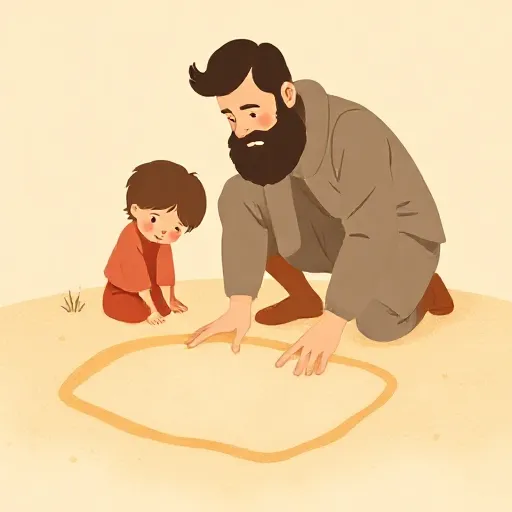
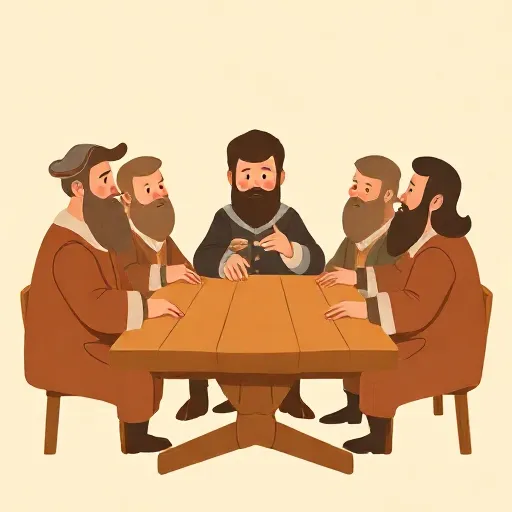
The year is around 380 BCE, and a strange experiment is about to unfold. The philosopher Plato (c. 428–348 BCE) writes a scene where his teacher, Socrates, calls over an enslaved boy who has never studied geometry. Socrates scratches a square in the dirt and begins asking simple questions. Step by step, the boy figures out a version of the Pythagorean theorem — a relationship about squares and their sides that was already a legendary discovery.
How could he do it? Socrates had not whispered the answers, only asked the right questions. Plato’s explanation is shocking: the boy didn’t learn anything new. He recollected what was already inside him. Plato called this anamnesis, the doctrine that all learning is really just remembering. Before this life, our souls already grasped the deep truths about numbers, shapes, equality, and justice. Experience just reminds us.
This little dirt-floor episode kicked off one of the longest arguments in human history: is anything already in the mind when we are born, or does everything come in through the senses?
An Ancient Split: Like Knows Like, or the World Stamps Itself In

Long before Plato, pre-Socratic thinkers were already leaning toward one side or the other. Empedocles (c. 494–434 BCE), a poet and speculator who believed reality cycled through waves of Love and Strife, held that knowing is a matter of “like by like.” The mind, he thought, is already made to resonate with the world, as if a tuning fork in us hums when the right note is struck outside.
His rival Anaxagoras (c. 500–428 BCE) flipped the picture. He said, “perception is by opposites.” The world has to impress itself on an unformed mind. Imagine a lump of blank clay that gets its shape only when a seal is pressed into it. That image of a receptive, empty mind would eventually become the famous blank slate — the tabula rasa — of 17th-century Empiricism.
Even their personalities seemed to prefigure later battlers. Empedocles had a dreamlike, speculative style, while Anaxagoras came across as clear-headed and no-nonsense. Those two temperaments will echo again and again.
Plato’s Big Bets: Things We Can’t Get from Just Looking

Plato didn’t rest with a single clever demonstration. In his dialogue Phaedo, he offered a deeper reason to believe in innate knowledge. Look at two sticks and call them “equal.” But the sticks themselves are never perfectly equal — one always has a tiny chip, a bent edge, a small difference. Where, then, did your mind get the idea of perfect equality? Not from the sticks, and not from any experience of the physical world, which is always a little off.
Plato’s answer: you have an innate grasp of the Form of Equality, an ideal, unchanging template that ordinary objects only dimly resemble. Experience activates this built‑in understanding, but it cannot supply it. Modern philosophers call this type of argument a poverty of the stimulus argument: sensory input is too thin to explain the rich ideas we end up with, so something must be inside us from the start.
Plato also linked innateness to a larger metaphysical picture. He believed the soul existed before birth, and that pre‑existence explains not only how we know but also why we should bother searching for truth at all. Inquiry is just deep memory recall — a helpful idea if you plan to spend your life asking people about justice and courage. But skeptics then and now point out that Socrates’ questions might have been sly hints. The slave‑boy show has remained a brilliant teaching trick rather than a proof.
Rationalists Double Down: Descartes and Leibniz
Fast‑forward nearly two millennia. The scientific revolution has overturned the old picture of perception. Light bouncing off objects now only sends patterns of motion into the eye — no shapes, no colors, no “intelligible forms.” How, then, do we understand the world with the clarity of geometry and physics?
The rationalist philosopher René Descartes (1596–1650) brought the innateness question roaring back. In his Meditations, he asks you to consider a piece of wax fresh from the hive: it tastes of honey, smells of flowers, has a definite shape. Put it near the fire — all those sensible qualities dissolve. Yet you still recognize it as the same piece of wax. Your concept of it as a colorless, odorless extended substance that obeys mathematical laws cannot come from the senses, because the senses keep changing. Descartes concluded that you have an innate, abstract idea of a physical object, a template your experience “fills in” with concrete details.
Gottfried Wilhelm Leibniz (1646–1716) sharpened the poverty‑of‑the‑stimulus case even further. Experience always shows you contingent particulars — this square, this relation here. But when the slave boy grasped the geometry of squares, he saw something that must hold for all possible squares, in all possible worlds, not just the scratchy lines in the dirt. Leibniz argued that rationality requires more than induction from experience. It relies on innate principles that let you see not just how things happen to be, but why they have to be that way.
Leibniz also tackled a pressing puzzle. If innate ideas are in the mind from the start, why aren’t we always conscious of them? His bold proposal: some mental states are unconscious. He compared the mind not to a blank slate but to a block of marble whose veins already mark out the shape of a statue. Sculpting reveals what was always there. And he suggested that some innate endowment might be procedural — inborn ways of thinking and reasoning, not just frozen ideas. Both Descartes and Leibniz tied innateness to a grand dream: understanding the deepest structure of reality, not just the buzzing confusion of the senses.
Empiricists Push Back: Locke’s Blank Slate and Hume’s Twist

The real modern battle started with John Locke (1632–1704). He opened his Essay Concerning Human Understanding with a demolition job on innate principles. If, he said, certain truths were stamped innately on every soul, then everyone — including children and “idiots” — would be able to state them and agree to them. But they can’t, so innateness fails on the facts. Even if supporters retreated and said we assent once we understand, Locke replied that this watered‑down version is basically trivial: of course we accept “whatever is, is” once we grasp the words; that doesn’t prove the idea was sitting there all along.
But Locke knew that the real contest wasn’t won by poking holes. The Empiricist must show how experience alone can build the abstract ideas that Rationalists claimed were innate. He sketched how the senses feed us simple ideas, and then the mind’s faculties — combining, comparing, abstracting — construct our concepts of infinity, number, substance, and causality. The mind is a blank slate, a tabula rasa, that gets written on by sensation (the outer world) and reflection (the mind’s own operations).
David Hume (1711–1776) pushed this Empiricism to a purely naturalistic endpoint. He argued that all ideas must be copies of original sensory impressions. From that premise, he concluded that we have no real idea of an objective causal power “out there” — only a habit of expecting one event to follow another. And then he dropped a surprising note. From Hume’s own perspective, he said, all impressions are innate — they arise originally in the mind, not as copies of an external world. What matters to his Empiricism isn’t whether ideas come before or after birth, but that every meaningful idea traces back to some concrete sensory experience. So even the anti‑nativist champion ended up admitting that the debate needed sharper framing.
Kant’s Middle Way: The Camera That Creates Its Own Picture
Immanuel Kant (1724–1804) wanted to break the stalemate. He accepted Hume’s challenge that experience alone cannot give us necessary truths — truths that must be so in every possible world. But he was equally unhappy with Rationalist innateness theories that just said “God put true principles in us.” How would we ever check which principles are genuinely innate and correct?
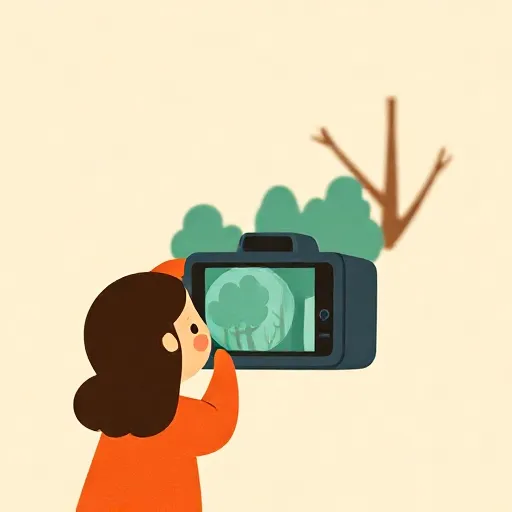
Kant’s revolutionary move was to say that the structure we find in our experience comes from us, but it doesn’t belong to a world beyond experience. He distinguished Forms of Sensible Intuition — like Space and Time — which shape all our sense perceptions, and Categories of the Understanding — like Causality and Substance — which organize those perceptions into an objective world. Imagine a digital camera: every photo it takes has a pixel grid. That grid is not a feature of the trees or sky outside; it is the camera’s own contribution. Similarly, the spatiotemporal and causal order we see is our mind’s ordering, not a blueprint of reality‑in‑itself.
In this vision, Kant is a Nativist: we bring innate structuring powers to experience. But he insisted that we have no innate representations or ideas sitting in consciousness. Pure ideas of Space, Time, and Causality must be acquired by reflecting carefully on the nature of experience itself — a skill that takes work. With this turn, the debate shifted from “what were you born with?” to “what does your mind have to contribute for you to have experience at all?”
Why This Old Fight Still Matters

For a long time, Empiricism seemed to win. The 20th century adopted Hume’s view that only sense experience provides evidence, and innateness looked like a relic of supernatural thinking. But then the argument circled back. When the linguist Noam Chomsky argued that children couldn’t possibly learn the rules of grammar from the messy talk they hear, he revived a poverty‑of‑the‑stimulus case for a built‑in language faculty. Today, researchers in cognitive development, genetics, and evolutionary psychology ask whether babies come into the world with core expectations about objects, numbers, fairness, and even minds — the very sorts of concepts Plato and Leibniz thought were innate.
The old fight isn’t just about dusty philosophers. It’s about who you think you are. If your deepest knowledge is a gift you’re born with, then learning is an act of uncovering something already there. If everything comes from experience, then you are a builder of your own understanding, brick by brick. The boy in the sandy courtyard wasn’t the last person to be startled by what was already inside him.
Think about it
- If you could design a simple test to give a newborn baby to probe whether they already have a sense of “equal,” what might that test look like?
- Suppose a scientist could predict every choice you will ever make by watching patterns in your brain. Would it still make sense to hold people responsible for their wrong actions?
- Why might it matter if you’re born with a basic sense of right and wrong, rather than learning all of it from your parents and teachers?