How Much Is Already Inside Your Head When You’re Born?
The Baby Who Knew Too Much
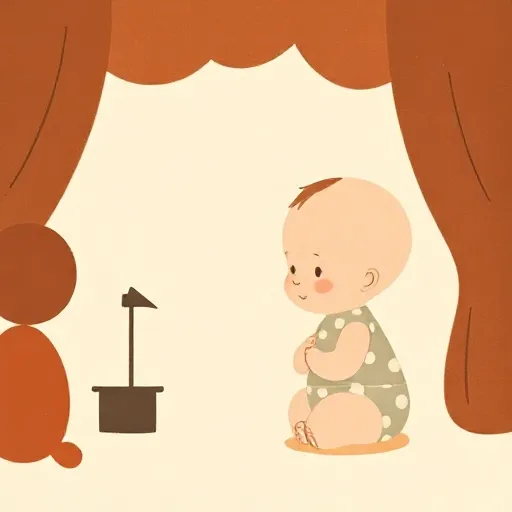
Imagine you’re only five months old. You see a toy duck slide across a table and disappear behind a screen. Then the screen drops — and the duck is gone. You stare. Your heart beats a little faster. According to scientists who study babies, you already know that solid objects should not vanish.
This is the kind of experiment that has turned a centuries-old philosophical debate upside down. The fight is between nativism and empiricism. Nativists say some knowledge is built into your brain from birth — factory settings you don’t need to learn. Empiricists say the mind starts out as a blank slate, and everything you know comes from your senses and experience. For a long time, empiricism seemed simpler and more scientific. But work with very young children is now pushing many researchers toward nativism.
The Great Battle: Blank Slate or Blueprint?
The philosopher John Locke (1632–1704) argued that the mind is like white paper — everything written on it comes from experience. This gave empiricism a head start. It seemed bold and simple: we observe the world, notice patterns, and gradually learn.
Nativism looked old-fashioned, even a little mystical. It reminded people of ideas about souls and God putting knowledge into us. But in the 1950s, a linguist named Noam Chomsky (1928–) changed the game. He argued that children could not possibly learn their first language just by listening, because the grammar they pick up is far too complicated and they don’t get enough examples. Instead, he said, every human is born with a universal grammar — a mental toolkit for building any language on earth.
Chomsky drew attention to the poverty of the stimulus. The data a child hears — people talking, sometimes in incomplete sentences — is a poor guide to the full system of rules that a language requires. Yet every normal child masters those rules fast, without formal lessons, and even filters out mistakes in what they hear. The only plausible explanation, Chomsky argued, is that much of the machinery is already inside.
Catching Babies Thinking
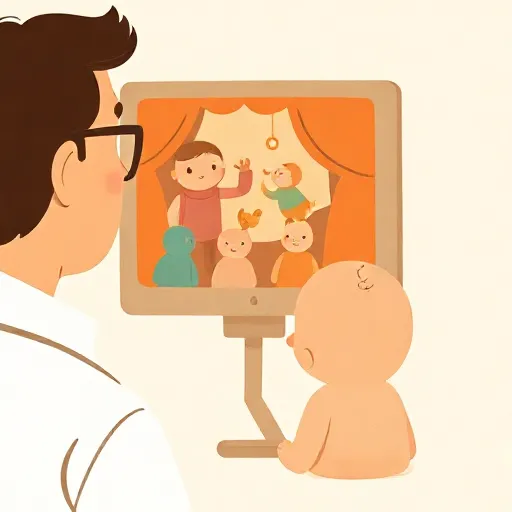
So how do you test a baby who can’t talk? Researchers use a method called violation-of-expectancy. Babies, like adults, stare longer at things that surprise them. If a ball seems to roll through a solid wall, they look and look, as if trying to make sense of it. If the ball stops at the wall, they quickly get bored.
In a famous 1985 study, Renée Baillargeon showed that 5-month-olds already understand object permanence — the idea that things continue to exist even when hidden. Piaget had claimed babies don’t grasp this until around 18 months. But when a screen appeared to rotate right through the space where a toy should be, babies stared far longer. They expected the hidden toy to block the screen.
Even 2-month-olds reliably expect objects to move on connected paths, not to teleport, and to take up space so that two things can’t be in the same place at once. These expectations appear so early and so universally that it’s hard to explain them as learned — unless learning happens at super-speed.
The Number Sense You Never Had to Learn
Babies also seem to carry a rough-and-ready number system. They can tell the difference between 8 dots and 16 dots, and later between smaller ratios. This analog magnitude system isn’t precise — you can’t use it to calculate 13,455 minus 2,104 — but it lets you see at a glance which crowd is bigger or which bowl has more rice.
Young babies track small numbers exactly, up to about three, using a separate object-tracking system that tags items in their attention. In one study, 5-month-olds watched a hand place two toys behind a screen and then remove one. They expected one toy to remain, staring longer if the screen lifted to show two. Yet when the number rose to four, babies stopped keeping track — as if their system simply hit its limit.
These numerical abilities aren’t unique to humans. Adult monkeys, rats, crows, and even newborn chicks show similar approximate number skills. Evolution, it seems, gave many animals a rough mental ruler, and we share that ancient tool.
Little Mind-Readers
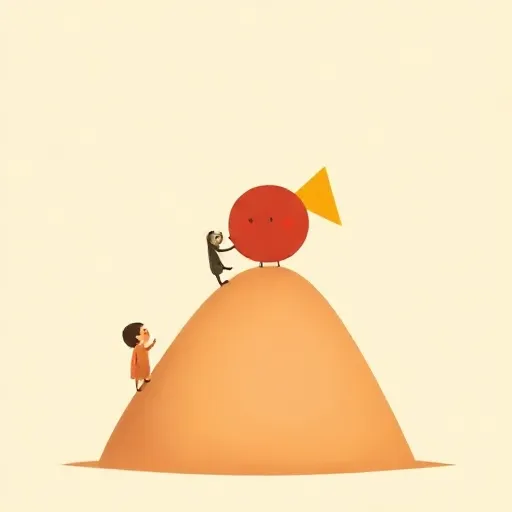
By six months, babies also draw a line between helpers and hinderers. In one famous experiment, infants watched a red circle struggle to climb a hill. A yellow triangle gently helped, while a blue square shoved it back down. Afterward, babies reached for the helpful triangle, not the mean square. By they’re five months old, they even prefer those who punish hinderers over those who help them.
Researchers see this as evidence of an early theory of mind — a built-in framework for understanding other beings as agents with goals, preferences, and information. Babies pay attention to what another person can see. They grasp that someone who didn’t witness a toy being moved might search in the wrong place. In one study, 15-month-olds expected an adult to look for a toy where she last saw it, even though the baby knew the toy had been moved. That means the baby was tracking the adult’s false belief — a milestone that older children often fail in conversation-based tests.
Newborn chicks even imprint on objects that move on their own, as if recognizing a special kind of thing — an agent. The seeds of social understanding may already be there when we hatch, not just when we grow.
Empiricism Fights Back
Empiricists haven’t surrendered. They point out that powerful new learning models can do surprising things. Connectionism, for example, imagines the mind as a network of simple units that adjust their connections through experience. With enough data, such networks can learn to recognize faces or parse sentences — all without any pre-loaded rules.
Bayesian approaches go further. They use a mathematical rule to show how a mind could pick the best guess from messy data by combining new evidence with prior assumptions. The catch is that those prior assumptions — the priors — are doing a lot of the work. If a visual system starts with the automatic belief that light usually comes from above, it resolves ambiguous shadows quickly. Researchers have shown that chicks raised under light from below still assume overhead light. That prior appears to be innate.
So the debate narrows. Empiricists must show that even the most sophisticated priors can themselves be learned from experience using only domain-general methods. Nativists bet that some priors, like our sense of objects or our taste for helpers, are simply baked in. The fight is about how high the ladder of learning can climb before it leans on something it didn’t build.
Why Your Inner Factory Settings Matter

If humans really do come with some knowledge built in, that doesn’t mean experience doesn’t matter — it means the two work together. You might have a built-in “physics engine” that expects objects to be solid and stable, but you still have to learn that Jell-O wobbles and a soap bubble pops. You might arrive with a rough sense of right and wrong, but you still need your family and friends to teach you what’s fair in your particular world.
For education, this has big implications. It suggests that certain ideas — about numbers, grammar, or other minds — aren’t planted from scratch. Teachers can build on a foundation that already exists. It also reminds us that humans aren’t empty bottles waiting to be filled. We are, from the very start, active meaning-makers.
The next time you learn something almost too fast to explain, consider the possibility that your brain wasn’t starting from zero. It might have been filling in a shape it always knew could exist.
Think about it
- If you found out that a newborn already expects objects not to float away, would that make a “blank slate” mind more or less likely? Why?
- Suppose scientists discover that a certain animal knows, from birth, to avoid a specific poisonous plant. Does that count as knowledge? What would an empiricist say?
- If some of what you know is built in, does that mean you can’t change your mind about it later? Can you think of a belief you once had that you completely gave up?