Born Knowing Nothing? The 400‑Year Fight Over Where Ideas Come From
The Riddle of the Empty Mind
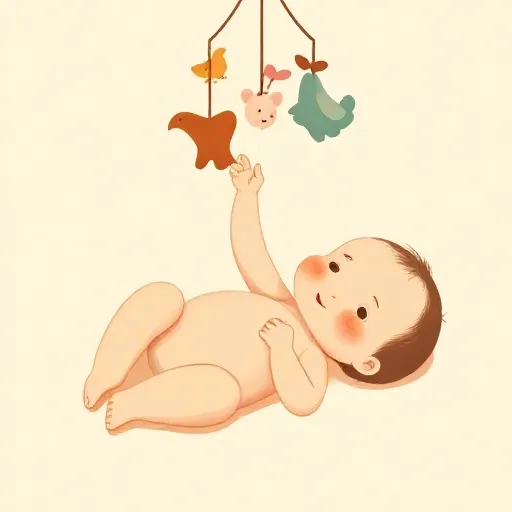
Picture a baby who has just opened her eyes for the first time. Does she look out at the world with a mind that is completely blank, waiting to be filled by every sound, color, and touch? Or is her mind already humming with some basic ideas — ideas she didn’t have to learn, ideas that are just part of being human?
That question has been at the center of a philosophical boxing match for more than four hundred years. On one side are the rationalists, who think that reason itself gives us knowledge and that some of our concepts are built right in, not learned through the senses. On the other side are the empiricists, who insist that all our ideas and knowledge come from experience — what we see, hear, taste, touch, and feel. The fight is about nothing less than where your thoughts come from.
Two Camps: Reason and Experience
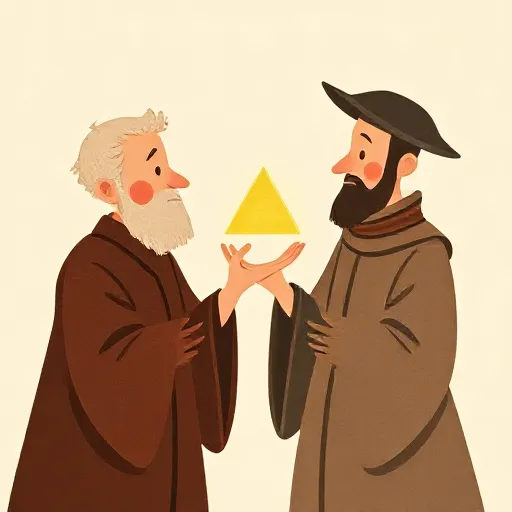
Both rationalists and empiricists agree that we can know some truths just by thinking about them, without checking the world. For example, you don’t need to count apples to know that 2 + 2 = 4. That kind of knowledge, which doesn’t depend on any particular experience, is called a priori knowledge. Both sides agree that intuition — a direct, immediate “seeing” with the mind — and deduction — reasoning from one truth to another — give us a priori knowledge of things like mathematics and logic.
The real disagreement begins when we ask about truths that are about the world — not just about numbers or definitions. Rationalists claim that some of these truths are already printed inside us, or can be known by reason alone. Empiricists reply that every single piece of information about the world must come in through the senses. If you have an idea that didn’t arrive by experience, they say, you don’t really have it.
Plato’s Slave and the Knowledge We Were Born With
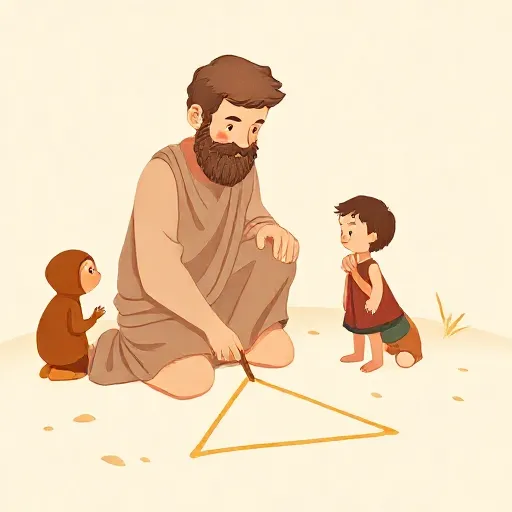
The ancient Greek philosopher Plato (c. 428–348 BCE) believed that learning is really a kind of remembering. In one of his dialogues, Socrates guides a young slave boy through a geometry problem. The boy has never been taught geometry, yet by answering questions, he seems to pull the right answers out of himself. Plato’s explanation: the boy’s soul knew geometry before he was born, and the questions helped him recollect it.
This is a strong version of the Innate Knowledge thesis — the claim that some truths are part of our natural makeup, not taught by experience. Much later, René Descartes (1596–1650) argued that our idea of God as an infinitely perfect being could not have come from our limited experiences. Such an idea, he said, must have been placed in us at creation. Similarly, mathematicians like Gottfried Wilhelm Leibniz (1646–1716) insisted that we know necessary truths — such as “everything must have a cause” — in a way experience could never provide. Experience shows us what is, they argued, not what must be.
But this view faces a sharp challenge. If we are born with innate knowledge, why don’t newborns and toddlers already know geometry? John Locke (1632–1704) pressed that point hard. He wrote, “No proposition can be said to be in the mind, which it never yet knew, which it never yet was conscious of.” If we make innateness just a capacity to learn, Locke shot back, then all knowledge would count as innate, and the idea becomes meaningless. The rationalists must find a middle ground: something is innate without being present from the first breath. Leibniz answered by comparing the mind to a block of marble whose veins run in a certain pattern. The block isn’t yet a statue, but it will accept the shape of Hercules rather than a random blob. Experience chisels out what was always possible.
Locke’s Blank Slate and Hume’s Test
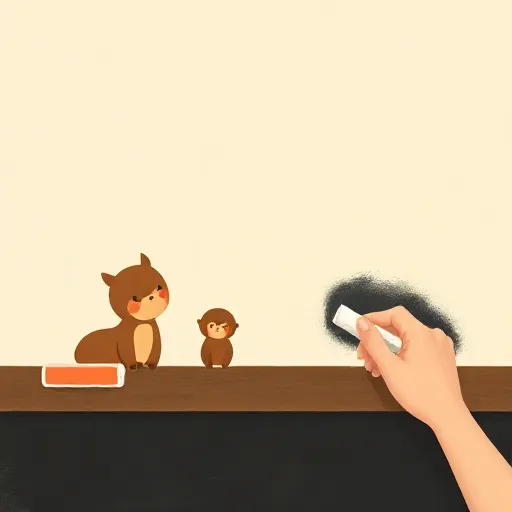
Locke turned the empiricist position into a powerful system. He pictured the mind at birth as a tabula rasa — a blank slate. All our ideas come from two sources: sensation, the input of the outer world, and reflection, our noticing of our own mental operations. Simple ideas, like the redness of an apple, flow in passively. Complex ideas, like that of a unicorn, are built when the mind mixes and matches those simple ones.
David Hume (1711–1776) took empiricism even further. He divided all mental contents into impressions — the vivid data of the present moment — and ideas, which are fainter copies of impressions. For Hume, every meaningful idea must be traceable to some impression. If you can’t point to the experience that gave you a concept, then you don’t really have that concept. He used this test to shake up some of philosophy’s biggest words.
Take causation. When you say “the fire caused the water to boil,” what do you mean? Hume hunted for the impression behind our idea of a necessary connection. He found none. All you ever see is one event (fire) followed by another (boiling), over and over. The feeling that the first forces the second is just a habit of the mind. Our idea of causation, then, isn’t a picture of some hidden power in the world — it’s a mental expectation built from repeated experience. This doesn’t mean the world isn’t governed by causes; it means our concept of causation is thinner than we thought, and knowledge about it is rooted in experience, not reason.
There’s a famous hole in this tidy story. Hume imagined a person who has seen every shade of blue except one. Even without ever seeing that exact shade, the person can probably “fill in the blank” using imagination. That would mean the mind can produce a new simple idea — which sounds uncomfortably close to what rationalists would expect. Hume admitted the example was a problem but didn’t think it sank his overall theory. It has kept philosophers busy ever since.
A Modern Twist: Born to Learn Language?

In the twentieth century, linguist Noam Chomsky (b. 1928) revived a version of innateness. He noticed that children learn language incredibly fast, on the basis of messy, incomplete examples. They also make certain kinds of grammatical mistake that no adult would teach them. Chomsky proposed that children must be born with a “universal grammar” — a set of deep rules that shape every human language.
It is important to see just what kind of innateness this is. Chomsky is not claiming that babies secretly know full sentences or conscious truths before they speak. Instead, they possess an inborn mental structure, a kind of learning gear, that makes language possible. This idea is actually closer to the empiricist picture — where the mind has built-in faculties, not built-in knowledge — than to Plato’s recollection. Still, the very fact that the debate has shape-shifted into modern science shows that the tension between “inborn” and “learned” is far from settled.
Why It Still Matters: Hardwired or Wired In?
The rationalist‑empiricist debate isn’t a dusty museum piece. Whenever you wonder whether a musical talent is something you’re born with or something you develop, you’re stepping into the same argument. If the mind is mainly a blank slate, then education, environment, and personal effort matter enormously — everything you become is written by what you experience. If, on the other hand, some ideas are already seeded inside you, then part of understanding the world is learning to listen to reason’s quiet voice, uncovering what you already, somehow, know.
This division also colors how we think about morality, art, and even artificial intelligence. If all concepts come from experience, could a computer that senses the world and reflects on its states ever develop truly new ideas — or would it be trapped rearranging what we gave it? And when you feel absolutely certain that hurting someone for fun is wrong, is that certainty just a feeling hammered in by upbringing, or is it the tip of an iceberg of built‑in moral truth?
Next time you learn something that just “clicks” — a math proof suddenly makes sense, or you recognise a tune you’ve never heard — you might find yourself asking the very question that started all this: Was that idea already hiding in you, or did you build it fresh from the pieces the world handed you?
Think about it
- If you had never, ever seen a color — but had seen every other shade around it — do you think you could picture it in your mind? Why or why not?
- When you suddenly understand a hard math problem, does it feel like you are finding something new, or like you are remembering something you already knew? What would each side of the debate say?
- Someone is said to have a natural talent for drawing. Does that mean they are born with artistic ideas, or just with a brain that learns to draw quickly? How could you tell the difference?