Are You Born Knowing How to Talk? The Fight Over What’s ‘Innate’
Two Friends, One Bird’s Nest, and a Big Disagreement
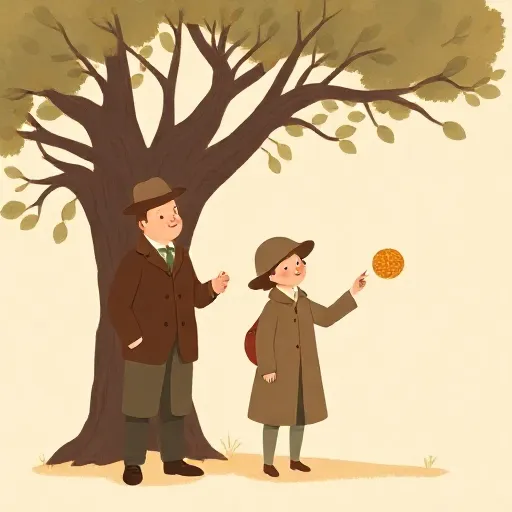
In 1869, Alfred Russel Wallace (1823–1913) sent an angry letter to his friend Charles Darwin (1809–1882). The two men had discovered the idea of natural selection together, but now Wallace was boiling mad — not about evolution, but about something that seemed much smaller: how a sparrow builds its nest.
Darwin saw the nest as a perfect example of instinct — a complicated behavior an animal is born knowing how to do, without teaching or practice. He believed instincts, like a bird’s nest‑building drive, had evolved slowly by natural selection, just like wings or beaks. Wallace disagreed sharply. He argued that birds could construct nests using a simple kind of reason and imitation, not inborn knowledge. If a young bird watches older birds and copies them, why call it an instinct at all?
That question might sound like a dusty Victorian squabble. But it lit a fuse that has burned for more than a century. Wallace and Darwin were fighting over something much bigger than twigs: are any of our skills or ideas truly innate — already present at birth, untouched by learning — or does everything come from the outside world? This is the debate over nativism, and it still hasn’t been settled.
The Wild List: From Cleanliness to Coyness
By the 1890s, Darwin’s side seemed to be winning. Psychologists rushed to catalogue human instincts. The most famous list came from the American thinker William James (1842–1910). In his Principles of Psychology, James boldly claimed that humans have more instincts than any other animal. His list included an “instinct of cleanliness,” a “native impulse in everyone to conceal love affairs,” and even “an instinct of personal isolation, which in women is called coyness.”
James was not saying that adults are slaves to those urges. He had a clever twist: instincts, he thought, only fire during early development. A toddler might feel an instinct to hide a secret, and that first impulse gets reshaped by reason, habit, and experience. Once the habit forms, the original instinct fades away. Others at the time, however, saw instincts as permanent and impossible to overwrite.
Unsurprisingly, this explosion of instinct‑hunting created chaos. One researcher counted 110 human instincts; another found only two. Scientists couldn’t agree on what an instinct even was. The British psychologist Conwy Lloyd Morgan (1852–1936) collected over a dozen rival definitions. For some, instincts were unconscious; for others, they were packed with feeling. Some said they came only from natural selection; others said they were faded‑out memories of clever acts our ancestors performed. The word “instinct” was starting to mean everything — and therefore nothing.
Kuo and the Behaviorists: Tear It All Down
In the early 20th century, a new generation of psychologists decided the whole instinct business was a scientific dead end. The most ferocious critic was Zing‑Yang Kuo (1898–1970), a Chinese researcher trained in the strict behaviorist tradition. Behaviorists believed psychology should study only what could be seen and measured — no hidden mental forces.
Kuo called instinct theory “finished psychology.” The label “innate,” he warned, gave scientists an excuse to stop looking for the real environmental causes of behavior. He challenged instinct‑hunters to show him three things: a fixed behavioral pattern, the precise neural machinery that produced it, and a direct link to specific genes. In his view, none of them could. Embryos were bathed in environmental influences from the very start. Even behaviors that looked fixed and automatic, he argued, were shaped by learning we simply hadn’t noticed yet.
Instead of asking “Is this behavior instinctive?” Kuo wanted to ask “How is this behavior acquired?” Many North American psychologists followed his lead, and the study of instinct all but vanished — for a while.
Konrad Lorenz and the Goose That Knew
In Europe around World War II, the study of innate behavior made a surprising return. Two biologists, Konrad Lorenz (1903–1989) and Niko Tinbergen (1907–1988), founded ethology — the study of animal behavior from an evolutionary viewpoint. They treated behavior like a bone: a trait that can be compared across species and that has a history shaped by natural selection.
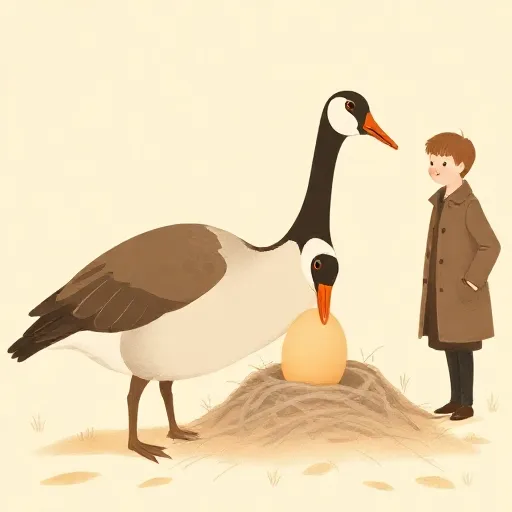
Lorenz and Tinbergen described fixed action patterns, behaviors that are rigid, species‑typical, and appear fully formed even in animals raised in isolation. A famous example: a greylag goose that has never seen another goose roll an egg will still retrieve it with an identical, stereotype movement. The early ethologists ran deprivation experiments — raising an animal without any chance to learn a particular behavior — and then observed whether the behavior still appeared. If it did, they labeled it innate.
But North American critics struck back. Daniel Lehrman (1919–1972) pointed out that raising an animal in isolation doesn’t remove all environmental influences. Subtle feedback, like the texture of an egg against the goose’s beak, might still play a role. A deprivation experiment only tells you that the particular thing you removed wasn’t necessary — not that everything from the outside is irrelevant. Tinbergen eventually agreed that calling a behavior “innate” was doing more harm than good. Lorenz too revised his ideas, suggesting that a trait is innate only to the degree that its development is guided by inherited information — a kind of know‑how that natural selection “learnt” over generations.
Chomsky’s Big Bet: A Grammar Kit in Your Head
The instinct debate might have faded yet again if not for one linguist who changed the whole conversation. Noam Chomsky (born 1928) noticed something strange about the way children learn language. The speech they hear is messy — full of stops, mistakes, and half‑finished sentences. Yet by around age five, they speak in full, grammatical sentences, following rules nobody ever explained to them.
Chomsky called this the poverty of the stimulus argument. The information available in the environment, he reasoned, is simply too thin to explain the rich grammar that children acquire. They must start out with something inside — a built‑in language instinct, or what he called a “language acquisition device.” In this view, every normal childhood is like a deprivation experiment: the environment is “impoverished,” yet language blossoms anyway.
Chomsky’s idea reshaped psychology. It suggested that the mind is not a blank slate but comes pre‑equipped with core knowledge — special‑purpose systems for things like language, faces, numbers, and objects. Researchers soon proposed that children are born with an innate “theory” of how living things differ from tools, or an innate sense of how objects move through space. Nativism was back, now dressed in the language of modern cognitive science.
Why It Still Matters: Are You ‘Just Born That Way’?
So after 150 years of sparrows, geese, and toddlers, where does that leave you? The fight over what is innate and what is learned has never been just a scientific puzzle. It sneaks into how we judge ourselves and others. If a talent for music is strongly innate, should schools push every child to practice equally? If certain personality traits are “in the DNA,” do we give up trying to change them? Wallace already worried about this: he argued that if we call something instinctive, we might stop looking for ways to teach or improve it.
Philosophers who study the science have found that the whole idea of innateness is surprisingly messy. Paul Griffiths and Matteo Mameli identified at least twenty‑six different meanings scientists have attached to the word “innate” — from “present at birth” to “shared by the whole species” to “unchangeable by experience.” These meanings don’t always travel together. A trait can appear early but still be completely shaped by environment. A trait that is typical of a species can be entirely learned.
Part of the trouble, some suggest, comes from folk biology — the deep‑down way human beings naturally think about the living world. We tend to believe that each species has an essence, a hidden inner nature that fixes how its members look and behave. This mental shortcut might have helped our ancestors sort plants and animals quickly, but it doesn’t match modern biology. Genes are not a blueprint that hard‑wires you in a predictable way; development is always a dance between genes and environment.
Given all that confusion, some philosophers recommend that scientists stop using the word “innate” as a technical label — not because the question is silly, but because a single, slippery word encourages bad reasoning. They suggest that we describe exactly what we know instead: which specific environmental factors matter, how much variation is due to genes, and what happens when you change a child’s surroundings. The old, broad question — “Is it innate or learned?” — might be the wrong question entirely.
And yet the tug of the question remains. When you watch a toddler figure out grammar with almost no instruction, or see a chickadee hide seeds without ever being taught, the feeling that something is “just there” from the start is hard to shake. The real lesson of the last 150 years may be that the story is never simply “nature” or “nurture” — it is always an intricate, surprising, and unfinished mix of both.
Think about it
- If a scientist could show that a skill you love — drawing, storytelling, solving puzzles — was heavily influenced by your genes before you were born, would you feel differently about working to get better at it?
- Suppose we stopped using the word “innate” and instead always described exactly what experiences or conditions help a behavior develop. Would that change the way we raise children, train pets, or treat people who struggle to learn?
- Wallace worried that calling something an instinct might stop us from looking for its real causes. Can you think of something about yourself — a habit, a fear, a talent — that you’ve always assumed was “just the way you are”? What questions would you ask to find out if learning had a bigger role than you expected?