
Is It Wrong to Love Your Family More Than Strangers?
London, 1793: A Fire That Still Burns

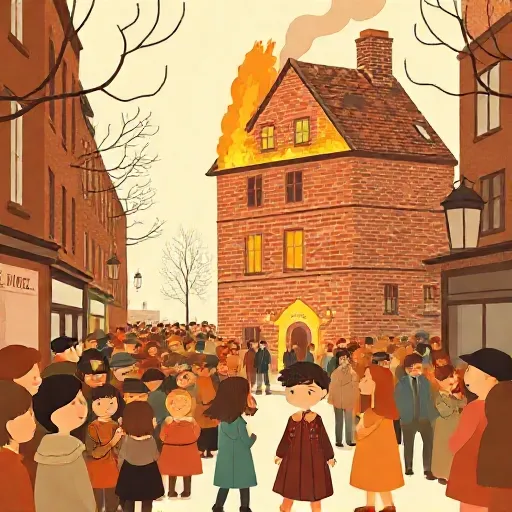
A fire roars through a building. Inside are two people: an archbishop, known for his brilliant writings that improve thousands of lives, and an ordinary chambermaid. You can save only one. The radical writer William Godwin (1756–1836) had no doubt: save the archbishop, because his survival will do far more good for humanity.
Then Godwin makes the choice personal. What if the chambermaid is your wife or your mother? He refuses to budge. “What magic is there,” he asks, “in the pronoun ‘my’ to overturn the decisions of everlasting truth?” For Godwin, being moral means treating every person’s welfare as equally important, no matter how close they are to you. Most people feel that this is monstrous. The fight between fairness and love is the problem of impartiality — and it has been dividing philosophers ever since.
The Many Faces of Impartiality

Not every kind of impartiality has anything to do with right and wrong. A person who hires an accountant and ignores whether candidates are male or female acts impartially about gender, but her choice might be purely selfish. An extreme example: a serial killer who picks victims only because they resemble a celebrity is impartial with respect to their religion or job, yet nobody would call that moral. Impartiality in the broadest sense simply means you leave out some consideration when deciding.
This broad idea can even be morally wrong. Suppose you promised a treasured family heirloom to your son Phil, but then decide to flip a coin to choose between Phil and his brother Bill. Flipping the coin is an impartial procedure, yet it ignores the moral obligation created by your promise. The philosopher Bernard Gert captured this by defining impartiality as a matter of not letting which member of a group benefits influence your action. But that definition is a tool; it doesn’t yet say when impartiality is demanded, or what kind of impartiality is morally required.
Godwin’s Extreme Impartiality: The Consequentialist View

Godwin’s fire rescue is a classic example of consequentialist impartiality. Consequentialist moral theories say the right action is the one that produces the best overall outcome, counting everyone’s well‑being equally. Impartiality is built right in: you may not prefer your own happiness, or your loved ones’, when deciding what to do.
This leads to a demanding picture. A consequentialist agent must feed hungry strangers instead of her own children, if that does more total good. She must sacrifice a spouse’s life to save a person whose future contributions will be greater. In our own time, the philosopher Peter Singer (born 1946) has argued that many of us in wealthy countries could prevent people from dying of hunger or easily treated diseases by donating more of our income. For Singer and his followers (the effective altruists), the logic of impartial benevolence means that buying a video game while children starve is not just ungenerous — it is morally wrong.
Critics call this the demandingness objection. By refusing to let personal concerns count specially, consequentialism seems to ask too much. As Brian Barry put it, it extends the strict impartiality we expect of judges and umpires to every corner of daily life. If we truly lived that way, could we have close friendships, be loyal to family, or even keep our own identity? Many think the answer is no.
Kant and the Veil of Ignorance: Fairness Without Demanding Everything

Not all impartial moral theories are as harsh as Godwin’s. Deontological views hold that right and wrong are not simply a matter of calculating the best results; instead, we must follow principles that respect every person as an equal. Impartiality enters through universalizability — the idea that you should only act on a rule that you could will everyone to follow. Roughly, you must be willing to apply the same standard to yourself that you apply to others.
The most famous modern version comes from John Rawls (1921–2002). He asked: what rules would we choose for a society if we didn’t know anything about our own place in it — our wealth, talents, race, or even our deepest beliefs? Behind this veil of ignorance, self‑interest forces you to be fair, because you might end up as anybody. Rawls argued that rational people behind the veil would guarantee basic liberties for all and allow inequalities only when they help the least well‑off.
Such a view is second‑order impartial: the rules are justified impartially, but they allow plenty of first‑order partiality. For instance, a rule requiring parents to care especially for their own children would be chosen behind the veil, because everyone wants their future children to be protected. So deontological impartiality does not demand that you treat your child like a stranger; it demands that the system of rules be acceptable to everyone equally.
The Partiality Problem: Can We Be Too Impartial?

Even with deontological safeguards, some philosophers think impartiality goes too far. They argue that morally admirable partiality exists and cannot be reduced to impartial rules. Loyalty to family, friends, or community is a virtue. The philosopher Bernard Williams (1929–2003) wrote that for a person to even consider sacrificing their spouse for the sake of impersonal justice is a kind of moral mistake. If you regard your child as just one among millions, you are not being admirably fair; you are missing something essential to being a good parent and a good person.
Partialists claim that these special attachments have genuine moral weight. An impartialist might reply that rules permitting partiality can themselves be justified impartially — as Rawls’s veil of ignorance shows. After all, a parent who always puts their own child first is still following a rule that everyone could accept for themselves. But the partialist pushes back: is it really the same to love your child because a rule says you may, rather than because she is your child? Many feel that the very texture of love and loyalty gets lost when we try to ground everything in impartiality.
Why an Old Fire Still Burns

The debate doesn’t stay in philosophy books. When you decide whether to share your snack with a close friend or give it to a hungry classmate you barely know, you are inside Godwin’s dilemma. When you choose between spending your allowance on a treat for your sibling or donating it to help strangers far away, you are weighing partial and impartial reasons. We all want to be fair, but we also feel the pull of loyalty and love.
Impartiality forces a hard question: how much of our moral attention belongs to the people near us, and how much to the world as a whole? You will never settle that question once and for all. But learning to feel its weight — to see yourself as one person among billions and still honor the bonds that make life meaningful — is what growing into a thinking person looks like.
Think about it
- If you could save either your best friend or three strangers from a dangerous situation, whom would you choose — and why? Does your answer change if the strangers are in great need but your friend is not?
- Imagine a rule that says everyone must always share their dessert equally. Would that be fair? What if some people never brought dessert to begin with?
- Should you care as much about helping a hungry child on the other side of the world as you do about helping your own classmate who forgot lunch? Why or why not?