
Does Morality Actually Demand Too Much From You?
Two Doctors and a Runaway Trolley

Imagine you are a surgeon. You have five patients who will die without new organs: a heart, a liver, a stomach, a spleen, and a spinal cord. Then you meet a healthy person who, by sheer luck, is a perfect match. You could quietly use his parts to save all five. Most people feel this would be wrong — you cannot kill an innocent person, even for a good cause.
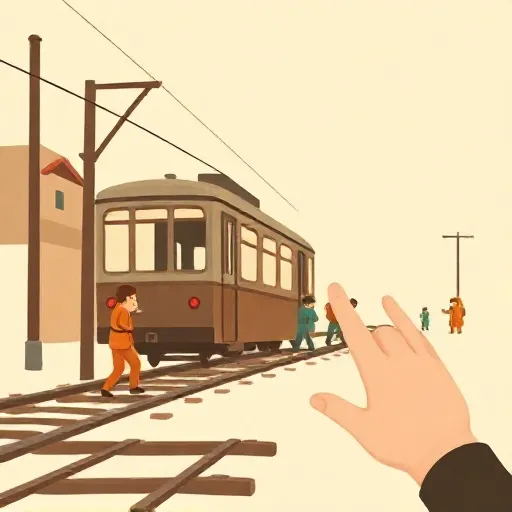
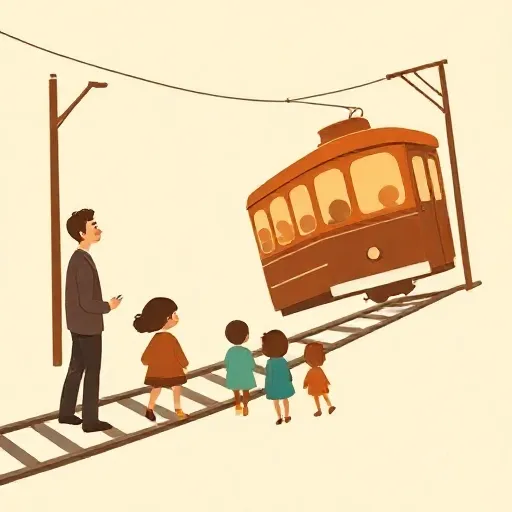
Now imagine you are driving a trolley whose brakes have failed. Ahead of you on the track are five people who cannot escape. You can steer onto a side track where there is only one person. Most people feel that turning the trolley is not just allowed but might even be required.
Both cases involve deliberately causing one death to prevent five deaths. Yet our gut moral reactions are totally different. That puzzle — why we react so differently to situations that are, in a certain light, so similar — is the kind of thing that keeps philosophers up at night. It shows that our everyday moral intuitions, the collection we call common-sense morality, are a bit of a mess.
Why Our Gut Feelings Keep Fighting Each Other
Common-sense morality is the set of immediate judgments you make before you sit down to think hard about principles. You probably feel that it is worse to kill someone than to simply let someone die. You also probably feel that it is okay to care more about your own family and friends than about strangers. And you probably think that, all else being equal, you should treat everyone fairly, without favoritism.
These gut feelings can clash. The philosopher Henry Sidgwick (1838–1900) thought our common-sense judgments were important clues, but he also saw that they often contradict each other. For example, our commitment to impartiality — the idea that everyone counts equally — bumps right into our sense that parents have special, partial obligations to their own children. If you were perfectly impartial, you would not treat your own child’s needs as more urgent than a stranger’s. Yet a mother who made no special effort for her own child would strike most people as a bad mother, not a moral hero.
Philosophers also note a self/other asymmetry: you are allowed, even admired, if you sacrifice your own good to help someone else, but it is outrageous to sacrifice another person for the very same goal. These tangled intuitions are the raw material that moral theorists try to sort into a clear, coherent system.
Building a Moral Theory: What Should a Right Action Look Like?

A moral theory is an attempt to give a systematic account of why actions are right or wrong. It usually sets out a criterion of rightness — a standard that tells you what makes an action the thing to do. For example, consequentialism says the right action is the one that produces the most good overall. Deontology says the right action is the one that respects our duties, such as never using a person as a mere means to an end. Virtue ethics says the right action is whatever a truly virtuous person would characteristically do.
But a theory does more than state a criterion. It also aims to explain why something has that moral quality, to simplify our moral thinking, and to help us understand connections between concepts like goodness, duty, and character. The best theories are simple, coherent, and cover the cases we feel strongly about. And because we are not all-knowing, many theorists distinguish between the objective standard (what would actually be right, given all the facts) and subjective decision-procedures (rules we can realistically follow, given what we know at the time). You might try your best to maximize the good, even if you don’t actually succeed — and that effort might still be what makes your action worthy.
This gap between the real criterion and the everyday guidebook is important. It lets theories avoid telling you that you must think like a philosopher every time you help a friend or choose a snack.
The Morality Machine Is Too Demanding

In the late 20th century, a group of philosophers began to argue that the whole project of building a grand moral theory is not just hard — it is harmful. The most famous of these critics was Bernard Williams (1929–2003). He argued that what he called “the morality system” has several troubling features.
First, morality is inescapable and overriding. In this system, moral obligations are not optional. They have authority over all other kinds of reasons, and they never go away. If you have a duty to promote the good, then even small decisions — which shoes to wear, what show to watch — can turn into moral choices, because one option might, in some tiny way, do more good than another. Williams wrote that morality’s demands “they will be waiting to provide work for idle hands…” That begins to feel suffocating.
Second, morality is alienating. Impartial, universal rules can pull you away from the very things that make your life feel like yours. A friend who visited you in the hospital only because doing so maximized overall well-being, and not because she simply cared about you, would feel like a fake, not a true friend. Real human connection seems to require acting out of partial love, not a calculation.
Third, morality leaves no proper space for special obligations — the intense, non-universal duties you have to your own children, your close friends, or your own long-term projects (what Williams called “ground projects”). If the right action is always the one that is impartial between everyone, then a parent’s fierce devotion to her own child looks like bias, not a virtue.
Williams and others, like Annette Baier (1929–2012), argued that morality cannot be captured in a system of rules at all. Some went so far as to say we should stop trying to build moral theories — a view called anti-theory — and focus instead on cultivating good character and moral perception. Robert Louden, writing in the 1990s, suggested that virtue ethics is best seen not as a competing theory but as a way of doing ethics without the rigid, rule-bound structure that Williams attacked.
Can We Fix Morality Without Breaking It?

Many philosophers have taken Williams’ worries seriously, but they disagree that the only choice is between a suffocating rulebook and no theory at all.
One strategy is to build partial norms directly into the theory. Virtue ethicists, for example, point out that there are virtues of partiality. A good mother is not impartial; she prefers her own child’s well-being, and that is exactly what makes her a good mother. This does not mean morality has no standards — it means the standards themselves include room for special relationships.
Another strategy is to keep an impartial basis but use it to justify partial norms. Marcia Baron (b. 1955) argued that impartiality operates at the level of the principles that justify our rules, not at the level of day-to-day decisions. You do not need to think “I am maximizing the good” every time you read your kid a bedtime story; the habit of being a loving parent is itself justified by an impartial principle that says such habits make the world better. This way, you are not alienated from your own reasons — your love is genuine, even if, deep down, you understand why genuine love is an impartial good.
In recent decades, consequentialists have even started rethinking the nature of value itself. Douglas Portmore and others argue for agent-relative value: it is not just that you feel closer to your child; it is actually more valuable, from your point of view, that your child thrives than that a distant stranger thrives. If value itself is agent-relative, then a consequentialist can say you are doing the right thing when you prioritize your own family, because you are promoting what is, in fact, most valuable from your perspective.
A related idea is sophisticated consequentialism, defended by Peter Railton (b. 1950). He argues that the criterion of right action is objective — it is the action that actually produces the best consequences. But a wise person will develop strong, partial dispositions to love and care, and will not constantly calculate. Your decision-procedure can be entirely separate from the ultimate justification. Railton compares this to a good tennis player who does not think about the physics of racket angles during a match, yet whose training makes her shots obey those physics. The theory need not be constantly in your head to guide your actions rightly.
These responses all keep the idea that morality can be systematized, but they try to loosen its grip on your inner life and protect the precious space where you are simply a friend, a parent, or a person with dreams that are yours alone.
Why This Fight Matters for Your Everyday Life

You will probably never face a runaway trolley or a surgeon’s terrible dilemma. But you will face a quieter version of the same tension. When you have a few hours of free time, should you spend them helping a community clean-up, or should you use them to hang out with a friend who has been feeling lonely? When you have a little money, should you buy a gift for your sibling or donate it to a charity that helps strangers overseas? These are not fake puzzles; they are real moments where impartial morality and partial love pull in different directions.
The debate between moral theorists and anti-theorists is about whether there is one right answer that your reasoning could uncover, or whether you simply have to live with the tug-of-war. If Williams is right, the attempt to treat all these pulls as parts of a single system does violence to the texture of a real human life. If his opponents are right, a good theory can actually set you free — it can show you that caring fiercely about your family is not a failure of morality but one of its deepest demands, properly understood.
Either way, noticing the tension is the first step toward growing up morally. It will not make your choices easy. But it will make you aware of what is at stake whenever you balance being good to the world against being good to the ones you love.
Think about it
- If you had one extra ticket to a concert, would you invite your best friend or a stranger who you know really likes the music? Why?
- Imagine a person who always tries to do the greatest good for the greatest number, but nobody feels that this person truly cares about them as an individual. Is that person a good friend? A good person?
- Should parents ever be morally required to treat all children exactly the same, including their own? What would the world lose if they did?