
Would You Push a Fat Man to Save Five Lives?
The Runaway Trolley: A Decision You Can’t Escape
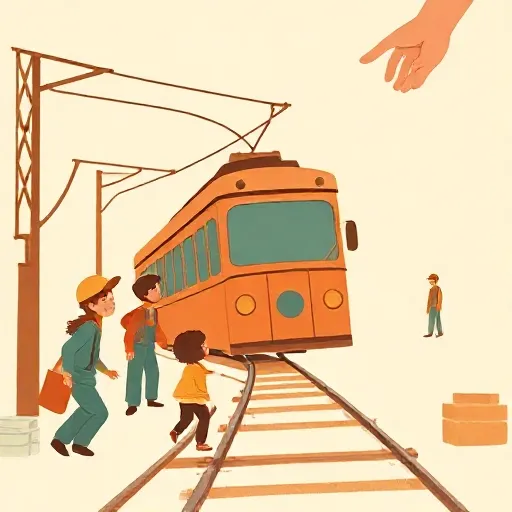
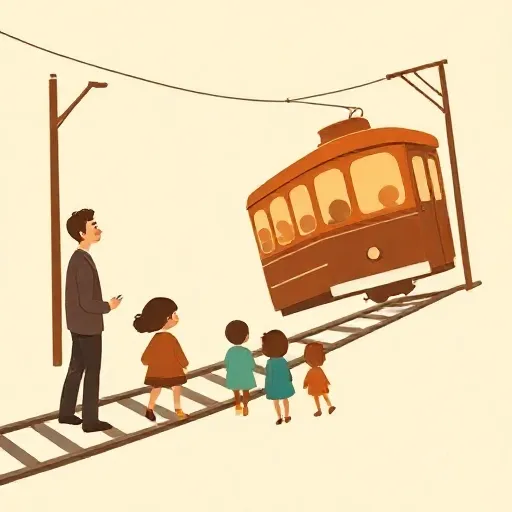
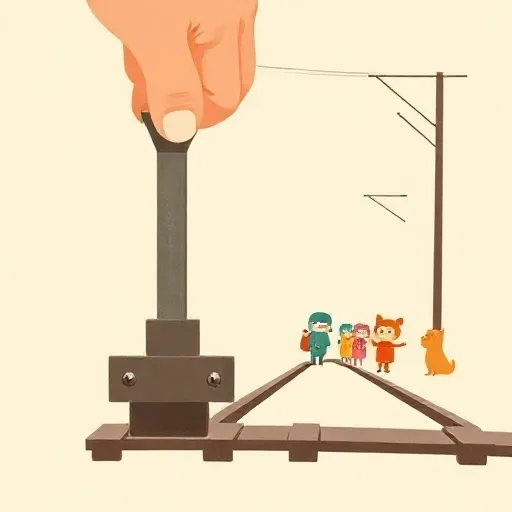
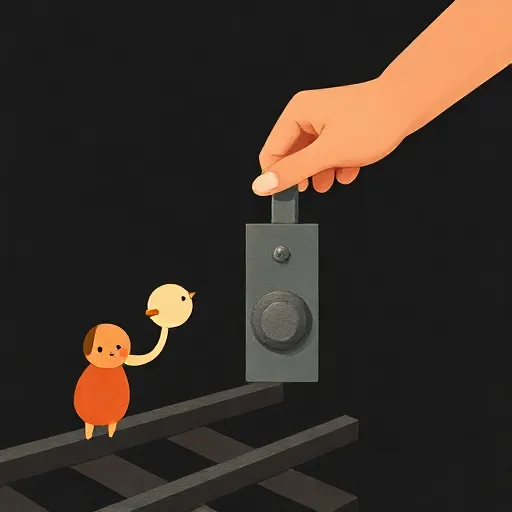
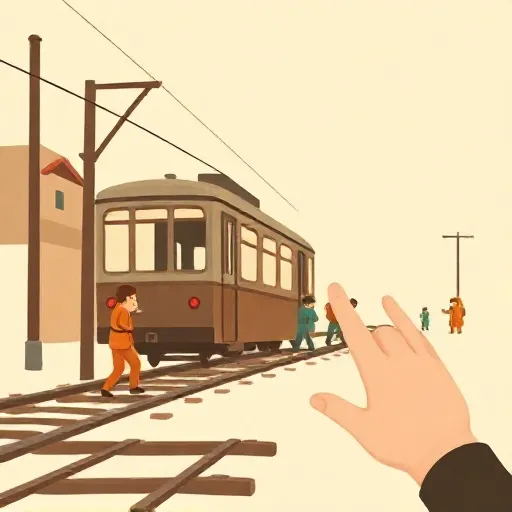
Imagine you see a trolley speeding out of control down a track. Five workers are tied to the track ahead — they will certainly die. You stand next to a switch that can send the trolley onto a different track. But you notice one worker trapped on that side track, too. If you flip the switch, you save five lives but you cause the death of one person. If you do nothing, five die and the one remains safe.
What should you do? Most people, when they first hear this story, say you should flip the switch. Saving five by sacrificing one feels like the better outcome. But now imagine a different case. A skilled surgeon has five patients dying from organ failure. In the waiting room sits a healthy traveler whose organs could save all five. If the surgeon kills the traveler secretly and transplants the organs, five live and one dies. Almost everybody says that is wrong — you cannot kill an innocent person, even to save five others.
These two scenarios, famous in philosophy, pull our moral instincts in opposite directions. They force us to ask a huge question: Is the right thing to do always the one that produces the best results? Or are some actions just wrong, no matter how many lives they might save?
This is the fight between two ways of thinking about morality — consequentialism and deontology.
Counting Up Happiness: The Consequentialist Dream

Consequentialism says that the right action is the one that brings about the best overall state of affairs. What matters is the outcome — how much good (often called “the Good”) is produced and how much harm is avoided. The most famous version of this idea is utilitarianism, defended by philosophers like Jeremy Bentham (1748–1832) . Utilitarians believe the Good is pleasure, happiness, or well-being. If an act produces more total happiness than any other act you could do, it is the right act. If it doesn’t, it’s wrong.
For a pure consequentialist, every choice is either required or forbidden. There is no middle ground — no zone where you are just allowed to do something, and no room for actions that go beyond duty. That can be exhausting. You could never just relax with your friends because giving your time and money to strangers far away might produce more good. Critics like Bernard Williams (1929–2003) worry that consequentialism is alienating: it asks you to treat your own projects, family, and friendships as if they are no more important than anyone else’s.
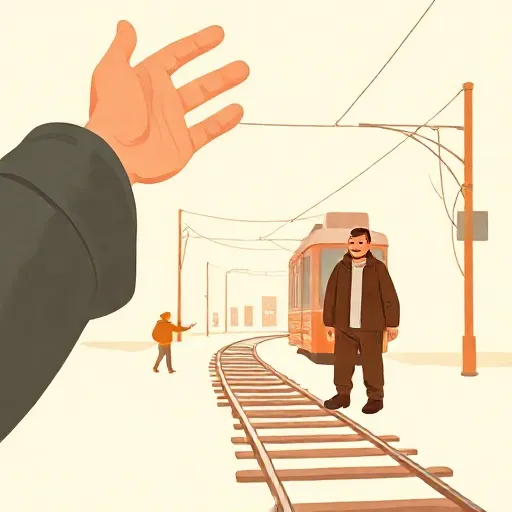
At the same time, consequentialism seems to let you do terrible things if the math works out. In the surgeon case (the Transplant problem), killing one to save five would be permitted — maybe even required — by a simple consequentialist calculation. In the Fat Man case, where you push a large man onto the track to stop the trolley, the same logic applies. Many people feel these acts cross a line that should never be crossed.
Consequentialists have replies. Some switch from directly judging every act to judging the rules that, if everyone followed them, would produce the best results. Others say we only have a duty not to make the world worse (a negative duty), but no strong duty to make it better (a positive duty). So you must not kill the one, but you don’t have to sacrifice everything to save strangers. Yet these moves often look like they are trying to borrow the appeal of the rival theory — deontology.
Just Wrong, No Matter What: The Deontologist’s Dare
Deontology is the view that some acts are forbidden even when doing them would bring about much better outcomes. The word comes from the Greek deon, meaning duty. For deontologists, the Right — that is, keeping moral rules — has priority over the Good. You may never do certain things, no matter how much happiness they produce.
The most famous deontologist is Immanuel Kant (1724–1804) . He argued that the only thing good without qualification is a good will — the intention to do your duty for its own sake. This points to a central feature of one major kind of deontology: agent-centered views. These theories focus on what the person acting — the agent — intends and causes.
An agent-centered deontologist rips apart the Trolley and Transplant cases by looking inside your mind. In Trolley, when you flip the switch, you foresee that one worker will die, but you don’t intend that death as your goal or as your means. Your goal is to save the five; you only accept the side effect. In Transplant or Fat Man, you directly intend to harm the healthy person to use their body as a tool. Many agent-centered thinkers rely on the Doctrine of Double Effect, an idea with roots in the work of Thomas Aquinas (1225–1274) . The doctrine says that it is sometimes permissible to cause a bad outcome as a side effect of a good action, but never permissible to intend a bad outcome — even to achieve something wonderful.
This view makes intention morally magic. You can flick a switch and cause a death if you only foresee it, but you cannot push a man even to save a thousand. Critics, like Judith Jarvis Thomson (1929–2020) , wonder if the difference between intending and foreseeing really matters that much. If you are certain someone will die, does it matter whether you aimed at it or merely accepted it?
My Body, My Rights: The Patient-Centered Challenge

A different branch of deontology centers on the person who is affected — the patient. These patient-centered theories are built on rights. The core idea, often called the Means Principle, is that you must never use another person only as a tool. Every person has an exclusive right over their own body, labor, and talents. Robert Nozick (1938–2002) and John Rawls (1921–2002) , among others, helped shape this line of thought.
This view explains the Trolley and Transplant divide cleanly. In Trolley, the one worker is not being used to save the five. If that worker were to magically vanish, the five would still be saved — the diversion doesn’t need his body. But in Transplant, the healthy traveler’s body is absolutely necessary. You would be using him without consent. That, the patient-centered deontologist says, is never allowed.
Now consider a variation: Loop Trolley. The side track loops back to the main track, so the five would die even after switching unless the one worker’s body stops the trolley. Here, the patient-centered deontologist says you may not flip the switch. Now the worker’s body is a necessary means. The agent-centered deontologist, who cares only about your intention, might still permit switching because you aren’t intending harm — you are only redirecting a threat. The two kinds of deontology pull you in opposite directions.
Why Letting Five Die for One Makes Philosophers Sweat
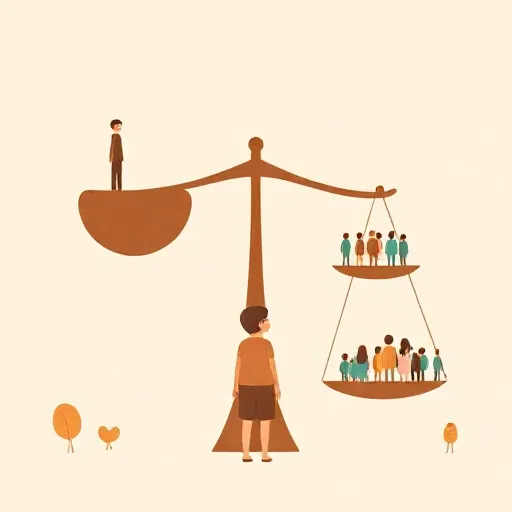
Both forms of deontology face a severe test: the paradox of deontology. If breaking a moral rule is a bad thing, then surely it’s worse when more such violations happen. Imagine a villain is about to kill five innocent people. You can stop him only by killing one innocent person yourself. Deontologists forbid you from killing the one. But that seems to allow more violations overall — the villain will still kill five. Why is it moral to let the world become (as far as violations go) worse?
Some deontologists try to escape by saying that numbers don’t simply add up when it comes to rights. A wrong done to you and a wrong done to me cannot be stacked into a single “bigger” wrong, because no single person experiences that total. But this leads to uncomfortable results in rescue cases: it would mean five deaths are not worse than one, so you could flip a coin to decide whether to save the five or the one. Most people reject that.
Many deontologists adopt a middle path called threshold deontology. They say that moral rules hold firmly up to a point, but when the consequences become truly catastrophic, the rules give way. A doctor may not torture one person to save two, but might do so to save a thousand if a threshold of awfulness has been crossed. The enormous difficulty, however, is explaining where exactly that threshold sits — why a thousand lives rather than nine hundred? And as you get closer to the line, bizarre paradoxes appear: you might be permitted to pull one more person into danger just to reach the threshold and then save everyone by killing someone.
These heated debates show that deontology is not a quiet set of rules; it’s a living, breathing argument about the shape of morality.
What This Has to Do With You

You will probably never stand at a trolley switch or peer into an operating room with a traveler’s life in your hands. But the clash between consequentialism and deontology lives inside every ordinary choice. When you lie to a friend to spare their feelings, you are weighing a little harm (dishonesty) against a big benefit (their happiness). When you break a promise to attend one event so you can go to another that “does more good,” you are doing a small consequentialist calculation. And when you refuse to cheat on a test even though it would raise your grade with no harm to anyone, you are standing with deontology — you accept that some actions are wrong even when the results look lovely.
The question isn’t which theory is “correct” once and for all. The real work is noticing the tug in your own gut. Sometimes you feel the pull of the best outcome; other times a quiet voice says, “Don’t do that — it’s just wrong.” Deontology gives that voice a name and a history; consequentialism names the drive to make things better. They are two languages your conscience speaks, and the hardest moral moments are the ones where they shout contradictory orders.
Think about it
- If you could help your best friend by telling a small lie that would never be discovered, would you do it? What if you had to tell the same lie ten times to help ten different friends — would that change your answer?
- A self-driving car must choose between hitting a pedestrian or swerving and injuring its passenger. Should the car’s software be programmed to save the most lives, or should it always protect the passenger who bought the car? Where would you draw the line?
- You learn that a classmate gets better grades by secretly using a study app that others can’t afford. Reporting them would get the app banned and make things fair for everyone, but it would hurt that classmate badly. Would you act like a consequentialist or a deontologist — and why?