Do You Owe Your Family More Than a Stranger?
The Raft in the Ocean
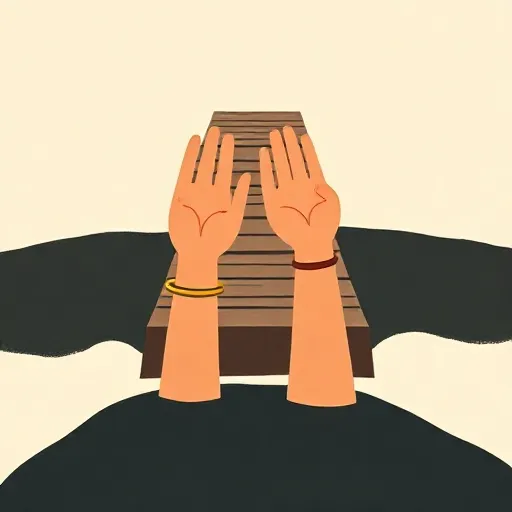
Imagine you are standing on a wooden dock. In the water, two people are struggling: your oldest, closest friend, and a complete stranger. You only have time to pull one person out. Unless you are a robot, you did not even hesitate. You reach for your friend. In your mind, this is not even a choice.
But here is the problem: why? Most people believe in being fair. Fairness usually means treating everyone the same. So why does your friend get to skip the line? This is the hard puzzle of special obligations — the moral duties we think we have to particular people, including our family, friends, and fellow citizens, simply because they stand in a special relationship to us.
If you want to be a consistent thinker, you must figure out whether these gut feelings are actual rules of the universe, or just a selfish glitch in your emotional code.
The Robot Who Learned to Love
One powerful moral theory says your friend does not get to skip the line. This theory is consequentialism. In its simplest form, it is the idea that the right action is the one that produces the greatest total amount of good for everyone, counting each person’s happiness equally.
Think of it like a cosmic scoreboard. If saving your friend adds 100 points to the world’s happiness, but saving the stranger (who might become a doctor and save hundreds) adds 101 points, the consequentialist says you must save the stranger. Your personal feelings do not add points to the board.
But wait! John Stuart Mill (1806–1873), a famous consequentialist, had a clever comeback. He said friendships are incredibly valuable institutions. If everyone broke their promises or ignored their friends, the whole system of trust and love would collapse. The world would suffer. Plus, your friend expects you to help. Breaking that expectation causes a special kind of intense pain.
So, a smart consequentialist concludes: save your friend! But note why: because doing so usually leads to the best long-term results. Philosophers call these derivative obligations. Your duty to your friend is real, but it is not the root of the tree — it is just a branch. If you could clearly see that saving the stranger would lead to a strictly better universe, your friendship duties evaporate instantly.
The Math Turns Cold
This is where common sense pushes back, hard. Imagine you give your friend a candy bar that makes them 10 happy, or give it to a stranger who would be 11 happy. Nobody is watching. The pure consequentialist says you are required to ignore your friend.
For most people, this feels completely wrong. It suggests that friendship has no independent weight. This is why philosopher Derek Parfit (1942–2017) made a crucial distinction between types of reasons.
An agent-neutral reason applies to everyone. Think: “There is a reason to stop a fire.” Anyone who sees it should try to put it out. An agent-relative reason, however, applies specifically to you. Think: “I have a reason to keep my promise.”
If I promise to help you, I have a reason to do it that a random billionaire standing next to me does not share. The defender of special obligations says that my friendship creates an agent-relative reason. It is not just a lazy shortcut for the universe’s math problem; it is a new rule written into the moral universe by the relationship itself.
You Did Not Pick Your Parents

Okay, so maybe we have special duties to friends because we chose them. But what about the people we did not choose?
This is the Voluntarist challenge, pushed powerfully by John Locke (1632–1704). A voluntarist argues that special obligations can only result from the voluntary actions of the agent. If I never signed up to be your friend, I owe you exactly what I owe any other human being.
But this creates a massive problem. You did not sign a contract to be born in your country. You did not sign a contract to be your brother’s sister. Does that mean you have no special duty to defend your country or care for your aging parents?
Locke knew this was an issue for political obligations, so he invented the idea of tacit consent. Basically, by living in a country and using its roads, you are silently agreeing to its rules. It is a bit like a gym teacher saying, “You walked into the gym, so you must have consented to do push-ups!”
Other thinkers, like Michael Sandel, pushed back against Voluntarism entirely. They say some relationships are constitutive commitments. They are not just hobbies you can cancel; they actually make up who you are. Asking you to ignore your duties to your parents, Sandel argued, is like asking a tree to ignore its roots.
Is Love Just Prejudice?
There is a darker shadow hanging over this whole debate. If we owe more to the people in our tribe, is this not exactly how extreme nationalism or deep prejudice works?
This critique is called the Distributive Objection. Special obligations tell us to help our poor, feed our citizens, and love our families — even if there are strangers who are more desperate and suffering more. It seems to justify a very unfair distribution of our time and love.
A hardcore consequentialist sees this as proof that special obligations are a moral mistake. Our evolutionary biology wired us to protect our genetic relatives, they say, so we feel like we owe them more. But in a global world, this ancient instinct often leads to injustice.
Defenders of special obligations have a reply. They say special duties do not mean we owe less to strangers; it means we owe more to our intimates. The philosopher W.D. Ross (1877–1971) argued that we carry a shopping bag of different duties. We pick up a general duty of kindness to everyone, but we also pick up special duties to friends and family. These duties do not cancel each other out; they just crowd together. The hard part is figuring out which one is heaviest when they crash into each other. Nobody has found a perfect scale for this yet.
Why It Matters When You Close Your Wallet
You might think this debate is just for professors in dusty offices. But you face this puzzle every single week. When you earn pocket money, do you owe it to your best friend’s birthday gift, or to a charity helping strangers across the world?
Every time you cheer for your hometown team instead of a foreign one, or stay up late helping your sibling with homework instead of volunteering for a distant cause, you are making a choice about special obligations.
The philosophers do not agree on the answer. Some say love is just a complex algorithm for maximizing the good. Others say love writes its own moral rules that are stronger than math. The only thing that is certain is that if you do not stop to ask why we owe people things, you are just running on instinct. And a life run on instinct is not really a choice at all.
Think about it
- If an alien ship announced it would save either your home city or your entire country, would it be wrong to beg them to spare your specific neighborhood?
- Do children owe more to parents who raised them with kindness, or is the debt to care for them in old age exactly the same even if the parents were cruel?
- Is it ever okay to break a promise to a friend if doing so allows you to help three other people you do not know? Where do you draw the line?