Could a Machine Think? Hobbes Said Yes, 300 Years Before Computers
A Book That Changed Everything
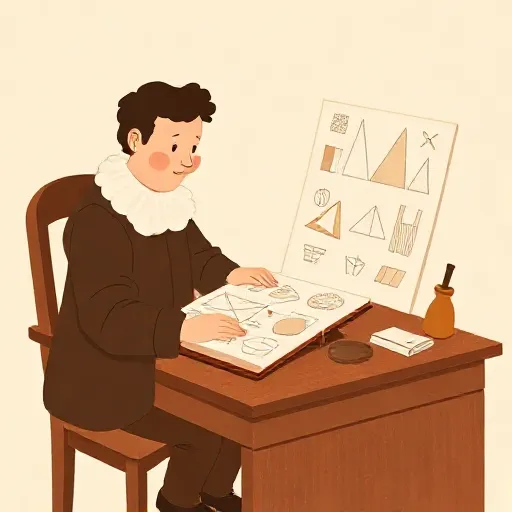
At age forty, Thomas Hobbes (1588–1679) opened a copy of Euclid’s Elements and found himself in a tangle. He read a proposition at random, doubted it, then traced the proof backwards through earlier theorems until he couldn’t deny it. The idea that hit him was lightning: all true knowledge might be built the same way, one firm step at a time, like adding and subtracting. That moment didn’t just turn Hobbes into a geometry fan—it planted the seed of a wild hunch. What if thinking itself is nothing but a kind of computation?
Hobbes was a man of restless curiosity. Born in Malmesbury, England, and educated at Oxford, he spent most of his life working for the wealthy Cavendish family as a tutor, secretary, and all‑around thinker. The job gave him books, travel, and entry into circles of scientists and philosophers. When civil war tore England apart in the 1640s, Hobbes fled to Paris. There he debated the biggest minds of his day—including René Descartes (1596–1650)—and published his masterpiece Leviathan in 1651.
But what truly set Hobbes apart was an idea most people found frightening: everything in the universe, including our minds, is just matter in motion. There is no invisible soul pulling the strings. If he was right, then understanding the mind meant explaining it with the same rules that explain falling rocks and beating hearts.
Everything Is Moving Matter
Hobbes was an empiricist—he believed that every idea you have starts with your senses. When you see a red apple, light from the apple makes pressure on your eye. That pressure sets off a chain of tiny motions inside you, all the way to your brain and heart. Then a kind of internal counter‑motion pushes outward, and that’s what makes you feel as if the redness is “out there” in the world. In reality, Hobbes said, redness is just motion inside you. The apple itself is just particles moving.
Once the apple is gone, you can still picture it vaguely. Hobbes called this fading sensation imagination, and he said it’s the same thing as memory—a decaying trace of sense. Because you’ve seen a man and you’ve seen a horse, you can mash those faded images together and picture a centaur. That’s your mind combining ideas, and it doesn’t need any special, immaterial power—just matter running through a series of motions.
Because Hobbes wanted to explain everything with matter, he had to tackle a huge question: are there universal things like “treeness” or “redness” floating around? He answered with a firm no. Nominalism is the view that only individual things exist—this oak, that pine, that maple—and that a word like tree is just a name we stick on all of them because they look similar. There’s no universal idea of a tree. When you think “tree,” you might picture a tall pine one day and a short beech the next. What matters is only that the sound “tree” reminds you of something in that group. Labels, Hobbes thought, are tools we invent to keep our thoughts organized.
The Mind as a Calculator
If ideas are just faded sensations and names are just labels, how does reasoning work? Here Hobbes’s love of geometry came roaring back. He declared that reasoning is computation—literally adding and subtracting. To compute, he wrote, is “to collect the sum of many things added together at the same time, or to know the remainder when one thing has been taken from another.” Forming the idea of a square? Add the ideas of a four‑sided figure, an equilateral figure, and a rectangular one. Making a proposition like “snow is white”? Hobbes saw that as adding the name “snow” and the name “white” (plus the little word “is,” which he thought you could just skip with a different word order). A syllogism—a three‑step piece of reasoning like “Every man is an animal; every animal is a body; therefore every man is a body”—was, for him, just adding names together with the help of a middle term.
Hobbes admitted you need rules for this kind of mental arithmetic, the same way you can’t just add any two numbers any which way. He knew that “Every man is an animal; some animal is a quadruped; therefore some man is a quadruped” doesn’t work. But he never spelled out exactly how the brain follows the rules. Still, his picture was bold: the thing we call understanding isn’t a ghostly mind peering at truths. It’s the material brain running through sequences of labels, like beads on an abacus. Much later, the philosopher Gottfried Leibniz (1646–1716) picked up this idea and tried to turn it into a universal language of thought, and some modern scientists even see Hobbes’s rough sketch as a distant ancestor of the computational theory of mind—the view that your brain is, at bottom, a kind of computer.
The Battle of the Minds: Hobbes vs. Descartes

The fiercest opponent of Hobbes’s materialism was Descartes. For Descartes, the mind is an immaterial substance—a thinking thing that has no size, shape, or location. A body is extended, made of matter, and follows the laws of physics. Mind and body, he argued, are utterly different kinds of stuff. In his Meditations, Descartes offered a famous argument that he could clearly and distinctly understand his mind apart from his body, and his body apart from his mind, and that if he could conceive them separately, they must be two distinct substances. In other words, the fact that you can imagine yourself thinking without any body shows that the thinking thing really can exist on its own.
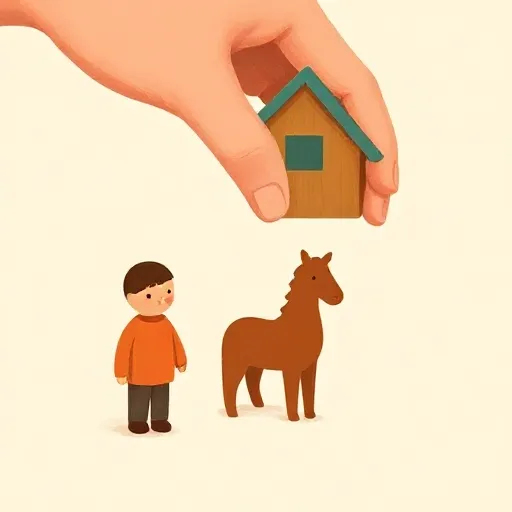
Hobbes fired back. The two men had exchanged objections and replies through a mutual friend, and once even met in person in 1648—it did not go well. Hobbes argued that Descartes’s move was a mistake. Just because you can think of A without thinking of B doesn’t mean A can exist without B. You can think of a horse without thinking of a rider; that doesn’t prove horses never have riders. Descartes had claimed that a special kind of clear‑and‑distinct conceivability makes the difference, but Hobbes found that suspicious. In his book De Corpore, he described a “gross error” where people treat something they can separate in thought as if it can exist separately in the world. Because we can talk about thinking without talking about a body, some philosophers leap to the conclusion that there is a thinking thing without a body. That, Hobbes said, is an illusion born of words.
Hobbes also went on the attack against the very phrase “immaterial mind.” He thought that combining those words was like saying “round square.” The term incorporeal substance, he insisted, is meaningless—a name made of two names that cancel each other out. His critics pointed out that this just assumes materialism from the start. And indeed, Hobbes’s own arguments often seemed to rely on the idea that all substances must be bodies. Yet he never quite proved it. What he did was offer a consistent, if incomplete, picture: every mental act, from the faintest memory to the most elegant proof, could in principle be explained by moving parts.
Why Hobbes’s Calculator Still Matters
Hobbes didn’t win the argument in his own time. Many readers were horrified by a world without souls. But his ideas leaked into the future. John Locke (1632–1704) and David Hume (1711–1776) built their own empiricist philosophies on ground Hobbes had cleared: that knowledge starts with the senses, that language can lead us into confusion, and that we should be humble about what we can know. Leibniz, even while objecting to Hobbes’s nominalism, couldn’t resist developing the thought that reasoning might be a kind of calculation.
Today, the hunch that first hit Hobbes while staring at a geometry book is no longer fringe. Artificial intelligence researchers ask whether a machine that adds, compares, and rearranges symbols can genuinely think—and whether our own brains are simply biological machines doing the same. Philosophers still wrestle with Descartes’s challenge: can you explain the feeling of what it’s like to be you with nothing but moving parts? Hobbes gave no final answer. But he dared to ask the question in a purely physical universe, and that question is now ours.
Think about it
- If a computer could combine and compare ideas exactly as Hobbes described, would you say it is really thinking? Where would you draw the line between a clever program and a mind?
- Hobbes thought a word like “tree” is just a label we slap onto similar objects. What would the world have to be like for a universal “tree‑ness” to really exist—something no human could rename or ignore?
- You can imagine a centaur by blending memories of a man and a horse. Can you think of an idea that seems not to come from your senses at all (for instance, infinity or perfect justice)? How might Hobbes try to explain it away?