Could a Windmill Ever Think? Leibniz’s 300-Year-Old Challenge
Inside the Machine

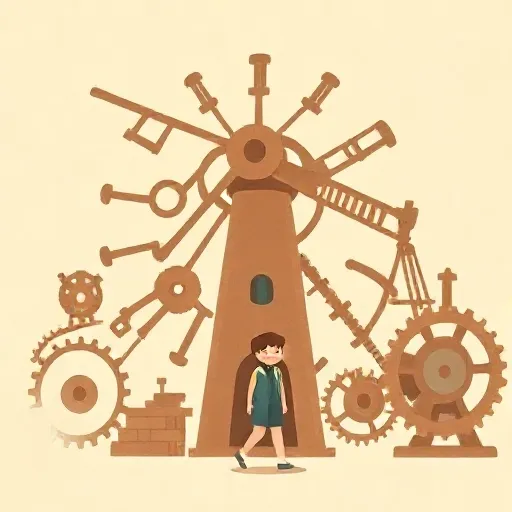
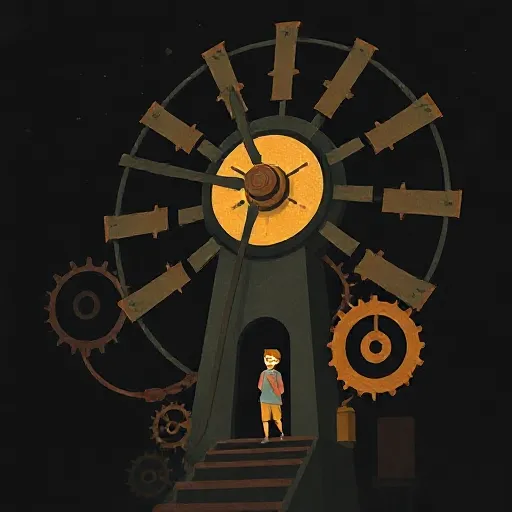
In 1714, the German philosopher Gottfried Wilhelm Leibniz (1646–1716) asked us to picture something strange. Imagine a machine built so cleverly that it seems to think, sense, and perceive—like a mechanical brain. Now imagine you could walk inside it, just like stepping into a giant windmill. You would see endless parts: cogs, levers, springs, wheels. Some push others, some turn together. But nowhere—no matter how deep you look—would you find a thought or a feeling. All you would see are bits of metal shoving one another.
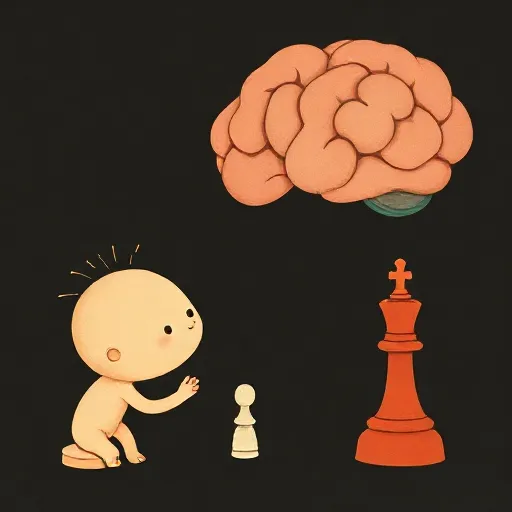
Leibniz believed this simple thought experiment showed that materialism could never be the whole story. Materialism is the view that everything that exists is physical stuff, and that mental states are just physical states. In his day, philosophers like Thomas Hobbes (1588–1679) argued that thinking was nothing but mechanical motion. Leibniz disagreed. He was convinced that consciousness contains something a machine can never produce.
Why Matter Can’t Make a Self

Leibniz’s deeper argument turns on what he called true unity. To be a perceiving, thinking “I,” you must be a single, indivisible being. If you were just a heap of many separate pieces, which one of those pieces would be you? None of them alone, and the heap still isn’t one single thing. A genuine self has to be a simple entity—something without parts.
Matter, Leibniz pointed out, is always infinitely divisible. You can divide a lump of clay into smaller lumps, and those into even smaller ones, at least in thought. So no material object can ever have true unity. But perception—seeing a sunset, feeling a pinch, tasting chocolate—requires one thing that holds all the parts of the experience together at once. Leibniz defined perception as “the expression of many things in a simple substance.” A variety of colors, shapes, and sounds are all represented in a single, undivided “I.” Since matter is never simple, it cannot be that “I.”
This led Leibniz to reject not only materialism but also dualism—the idea that there are two kinds of substances: physical stuff (your body) and mental stuff (your soul). René Descartes (1596–1650) famously held that view. Leibniz, however, argued that physical stuff doesn’t even qualify as a real substance. Extended material bodies are just collections of parts, and for Leibniz that what is not truly one being is not truly a being either. So bodies can only be well-founded phenomena—appearances that arise from something deeper.
A Universe of Mind-Like Things
So if the world isn’t made of material stuff, what is it? Leibniz’s answer: only one type of substance exists, but infinitely many of them. He called these substances monads. A monad is a simple, partless, unextended thing—like a soul or a tiny center of perception. Monads are the only entities with true unity, so they are the only real beings. Your body, your chair, the stars: all are aggregates of monads. They appear to us as physical objects, but ultimately they are composed of these immaterial, perceiving unities.
Not all monads have full-blown minds. Leibniz described a hierarchy. The lowest monads have only dim, unconscious perceptions. Animals have sensation and memory—he called them “souls.” Human minds are “spirits” capable of reason, self-reflection, and apperception (consciousness of one’s own inner states). Every monad, though, is essentially a perceiving and striving entity. It represents the entire universe from its own point of view and has an inner drive—appetition—that pushes it from one perception to the next.
The Clockwork of Mind and Body

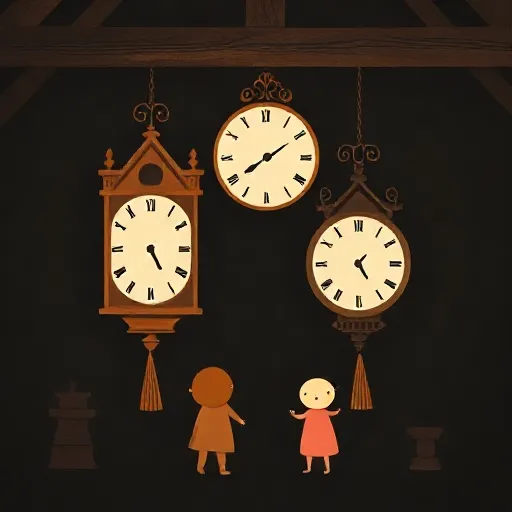
If everything is made of mind-like monads, how do your mind and body interact? Leibniz gave a surprising answer: they don’t. He denied that any created substance can truly cause a change in another substance. Instead, each monad is programmed from the moment of creation to unfold its perceptions in perfect coordination with every other monad. This is the pre-established harmony.
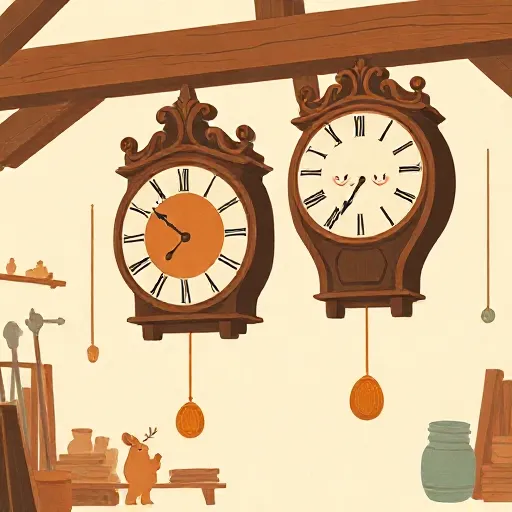
Imagine two clocks that keep exactly the same time. They tick in sync as if they were connected, but in reality, each was built so perfectly that it runs in parallel without any link. Leibniz rejected both Descartes’s idea that mind and body directly push each other and Malebranche’s view that God constantly intervenes to coordinate them. For Leibniz, when you decide to raise your arm, your desire and the motion of your arm arise together because both were pre-programmed to harmonize. Not a single particle of matter is ever pushed by a thought—and no thought is ever pushed by a particle. All causation happens within a single substance: each state of your mind is caused by a previous state of your mind, and likewise for your body.
The Dream of a Perfect Thinking Language

Leibniz was obsessed with the link between language and thought. Natural languages, full of vague words and ambiguities, are an imperfect mirror of the mind. So he dreamed up a universal characteristic—a perfect artificial language. All human ideas, he believed, could be broken down into a few primitive concepts, just as numbers can be built from digits. By assigning a unique symbol to each primitive and logical rules for combining them, we could create a language that mirrors the very structure of reasoning.
With such a language, any disagreement could be settled by calculation. Instead of arguing endlessly, people could say, “Let us calculate!” and the correct answer would appear. Leibniz even wrote that everything the mind does is a kind of computation. This vision—cognition as a symbolic, rule-governed process—is strikingly similar to how we think about computers and artificial intelligence today. He was not inventing a thinking machine, but he was imagining human thought in a deeply computational way.
The Unseen Depths of Your Mind

One of Leibniz’s most lasting insights is the idea of unconscious perceptions. Your mental life isn’t just the bright, loud thoughts you notice. There are endless petites perceptions (tiny perceptions) that you never become conscious of—what Leibniz called apperceiving. The roar of the sea is made of countless individual wavelets you don’t consciously hear. You don’t notice every stone on a beach, yet your mind registers them all behind the scenes.
Leibniz also applied this to appetitions, the inner strivings that move you from one perception to the next. You are often unaware of the tiny urges that steer your attention. A wild boar may only have a bare perception of a distant human until the human shouts—then it apperceives the person and charges. In the same way, many of your own reactions bubble up from perceptions and appetitions you never sensed. Leibniz insisted these insensible pushes and pulls are as important to understanding the mind as invisible particles are to physics.
Why It Still Matters
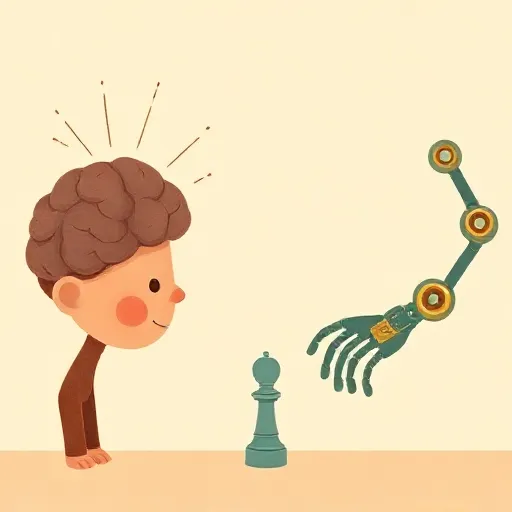
Why should a 300-year-old argument about windmills and invisible monads matter today? Because every time scientists debate whether artificial intelligence can be truly conscious, they’re stepping into Leibniz’s puzzle. Can a purely physical system, no matter how advanced, ever have a subjective inner life? Leibniz thought not, and his windmill thought experiment echoes through modern philosophy. Some contemporary thinkers propose scenarios remarkably similar to his—for instance, a scientist who knows all the physical facts about seeing red but has never experienced redness. They ask: would she learn something new? That is Leibniz’s old question in a new coat.
Leibniz also reminds you that your mind is far deeper than what floats on the surface. You carry a hidden ocean of tiny perceptions and appetitions that shape your moods, choices, and sense of self. So the next time your body flinches at a rustle before you realize you heard it, you’re touching the very depths Leibniz mapped. You are not a machine built from parts, nor a ghost trapped in a machine. You are, perhaps, a whole world of perceptions, harmonizing with the entire universe.
Think about it
- If a robot could laugh, cry, and hold a conversation just like a person, would that prove it was conscious? Why or why not?
- Leibniz believed you have millions of tiny perceptions you never notice. Can you think of a time your body reacted to something before you were aware of it? What does that tell you about how your mind works?
- If all your thoughts are just the result of previous thoughts inside your own mind (like dominoes), are you really free? Or is everything you think already determined by your past?