Can You Be Tricked Into Thinking You’re a Donkey?
The Day You Turn Into a Donkey

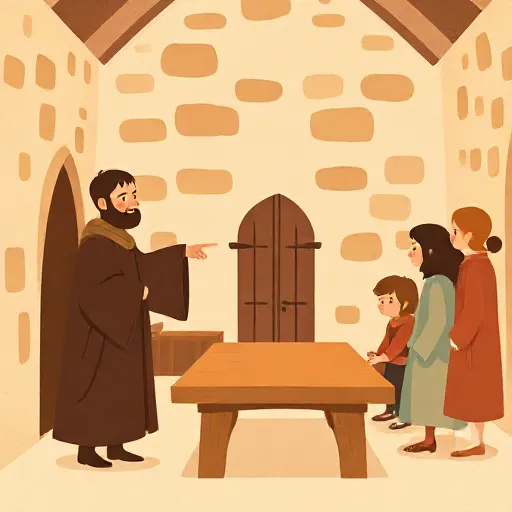
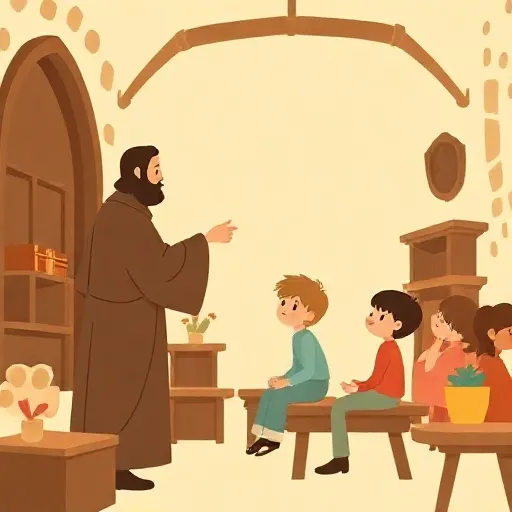
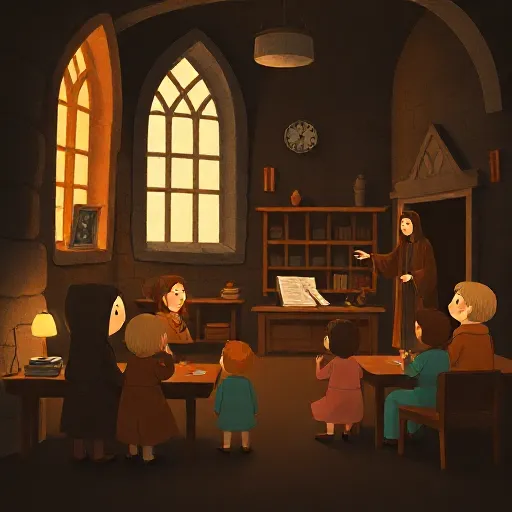
Picture yourself at Oxford University, around 1335. Your logic teacher, William Heytesbury (born before 1313, died 1372 or 1373), smirks and says, “I can prove you are a donkey.” He starts with a harmless sentence: “Every donkey is an animal. You are an animal. Therefore…” Wait, that doesn’t add up. Yet with a few twists of language, he seems to trap you. His puzzle, called a sophism, is a deliberate logical trick. But it is not just a joke. These tricks were part of a serious training program in clear thinking. Heytesbury was a leader of the Oxford Calculators, a group who used logic and mathematics to tackle questions about change, motion, and the limits of knowledge. Their games still shape how we think about puzzles and physics today.
A Game of “I Admit” and “I Deny”

Heytesbury invented a kind of logical duel called an obligation (obligatio). Two players — an opponent and a respondent — sit down. The opponent begins by laying down a starting assumption, a casus. It might be possible, like “The king is seated or you are in Rome.” It might even be impossible but still imaginable, like “The room is a total vacuum.” The respondent can admit the casus only if it is not obviously self-contradictory. Then the opponent fires off short statements, one by one. The respondent must answer each with “I concede,” “I deny,” or “I doubt.” Her only job is to stay consistent — no answer may clash with anything she has already accepted.
The clever part is how answers change mid-game. Imagine this sequence:
- Opponent posits: “The king is seated or you are in Rome.” You admit it — the casus is possible.
- Opponent asks: “The king is seated.” You have no idea about the king’s whereabouts, so you doubt.
- Opponent asks: “You are in Rome.” You know you are not in Rome, so you deny.
- Opponent returns to: “The king is seated.”
Now the situation has shifted. You have already admitted “the king is seated or you are in Rome,” and you have denied “you are in Rome.” Those two moves together logically force “the king is seated” to be true. So at step 4 you must concede. What looked like an innocent, unconnected statement earlier has become relevant — it is now locked into the web of things you have already accepted.
Heytesbury also allowed impossible but imaginable casus, as long as they were not overtly contradictory (a man being a donkey was ruled out — too absurd to be useful). This made obligations a laboratory for thought experiments, much like modern scientists imagine frictionless surfaces or massless ropes.
Words That Twist Themselves

The most famous medieval puzzles were insolubilia — self-referential paradoxes. The classic is the liar sentence: “This sentence is false.” If it is true, it says it is false, so it would have to be false. If it is false, then what it says (that it is false) is accurate, so it would have to be true. Round and round you go.
Heytesbury tackled the liar by looking at what a sentence really means. He argued that a paradoxical sentence does not simply say what it appears to say on the surface. It carries an extra, hidden meaning. In the liar’s case, the sentence “This sentence is false” secretly also signifies that it is true. A casus that assumed the sentence meant exactly and only its overt words would be flatly contradictory — so the respondent should not even admit it. But if the casus simply says the sentence means what its words ordinarily pretend (without claiming that is its whole meaning), then the game can proceed. The respondent concedes the sentence is false (because the casus forces that), but she denies that the sentence is true — that would be incompatible with the posited extra meaning. The paradox dissolves because the hidden layer prevents the ordinary back-and-forth from lining up neatly.
Heytesbury was honest: he admitted that no solution was perfect, and he told his students to move on to more useful work. But his idea — that self-reference introduces hidden implications — was a genuine philosophical advance. It made later logicians think hard about what sentences really commit us to.
When Does Something Start?

Heytesbury did not stop at logic puzzles. He wanted to understand change itself. If a stone begins to fall, is there a first instant when it is moving, or a last instant when it is still? He defined beginning in two ways: an object begins to be when it exists now and did not exist just before, or when it does not exist now but will exist immediately after. Ceasing works the same way backward. Using this, he constructed mind-bending cases. In one, Plato and Socrates both start moving from rest at the same moment, but Plato’s speed grows at a constant rate while Socrates’ speed starts from zero and climbs ever faster. Both begin “infinitely slowly,” Heytesbury concluded — but Socrates begins “infinitely more slowly” than Plato. Centuries before calculus, he was comparing orders of infinitesimal change.
He also tackled how to measure distance in accelerated motion. Imagine a cart that starts from rest and gains speed evenly. After ten seconds its speed is ten metres per second. How far has it gone? Heytesbury supplied a rule now called the Middle Degree Theorem: a uniformly accelerated body travels the same distance as a body moving at a steady speed equal to the middle degree of the acceleration. Here the middle is five metres per second. So the cart covers exactly as much ground as if it had cruised at five metres per second the whole time. This simple but powerful rule — often associated with the Merton College calculators — later became a stepping stone for Galileo’s laws of falling bodies.
Why Six Centuries Later You Still Play These Games

Heytesbury’s world seems remote. Yet his ideas echo in modern life. The obligation game is an ancestor of today’s dialogue logic — the kind of reasoning a computer uses to check whether a set of rules is consistent. The liar paradox still occupies philosophers, mathematicians, and computer scientists; every time you program a machine not to tie itself in knots, you are building on insights that started with insolubilia.
The Middle Degree Theorem belongs to the prehistory of physics. When a video game simulates a car accelerating or a ball bouncing, the underlying math relies on equations that assume, at some level, the relationship between speed, time, and distance that Heytesbury nailed down in the 1330s. And whenever you spot a sign that says “Ignore this sign” — a direct descendant of the liar — you are untangling the same self-reference that kept Oxford scholars up at night. The skills they practiced — separating what a word means from what it implies, catching hidden assumptions, and thinking clearly about change — are still the basic moves of a sharp mind.
Think about it
- If someone challenged you to a game where you must never contradict yourself, and their opening rule was “You owe me ten hours of chores,” how could you answer without losing — and without actually agreeing?
- A sentence that says “This sentence has five words” is self-referential, but it does not cause a paradox. Why does the liar sentence feel so much more dangerous?
- A race car accelerates steadily from a stop, while another starts at full speed. If you could only measure the final speed and the time, would you know which car was ahead halfway through? What else would you need?