What If You Had to Reason from a Lie? The Medieval Logic Game
A Game of Pretending

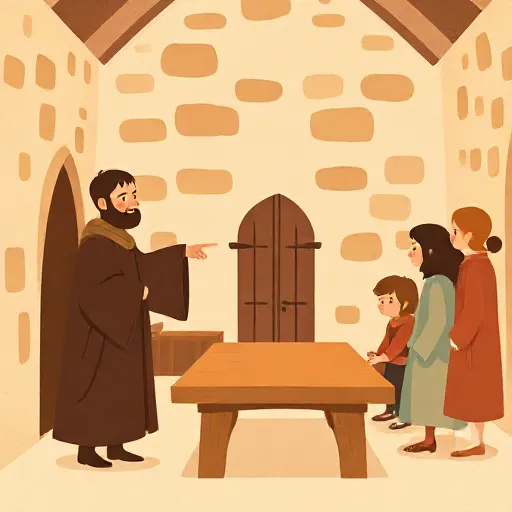
It is a chilly afternoon in Oxford, around the year 1302. Walter Burley (c. 1275–1344), a sharp-eyed master of logic, stands before his students. He announces a peculiar game. One student, the opponent, will put forward a series of statements. Another student, the respondent, must immediately grant or deny each one. But there is a twist. The opponent first gives the respondent a specific obligation — for example, an obviously false statement, like “You are a donkey.” The respondent must grant this false statement whenever it appears. Then the real challenge begins: the opponent fires off statement after statement, and the respondent must answer while staying as logically consistent as possible.
This kind of game, called obligationes, became a flourishing part of medieval logic from the thirteenth century onward. The most common variety was called positio, or “laying down.” In a positio, a false proposition — the positum — is laid down at the start. The respondent must grant the positum if it comes up, and then evaluate all later statements according to strict rules. Other varieties existed, like making the respondent always deny a certain proposition or always doubt it, but positio was the center of attention.
The core rules of positio can be boiled down to three simple commands: grant the positum when it is put forward; grant anything that follows from the positum; and deny anything that is incompatible with the positum. So if the positum is “Plato is running” (and in reality Plato is sitting), then “Plato is moving” follows and must be granted. “Plato is sitting” is incompatible and must be denied. The respondent’s job is to stay true to that false starting point, using logic alone. The game was not about finding truth — it was about mapping out what follows from an assumption, even a ridiculous one.
The Web of Relevance: How Order Traps You

Burley’s simple rules hide a powerful trap. Suppose the opponent posits something false: “A dragon is sleeping in this room.” The respondent must grant it. Then the opponent throws out a new statement: “No dragon is sleeping in this room or you are a knight.” In reality, there is no dragon, so the first part is true. That makes the whole disjunction true, even if the second part is false. This statement does not follow from the positum alone, nor does it contradict it. Burley called such a statement impertinens — irrelevant. For irrelevant statements, he gave a rule: answer based on what you know to be true or false in the real world. So the respondent, knowing there is no dragon, must grant the disjunction.
Now comes the twist. When the opponent asks next, “You are a knight,” something shifts. The respondent has already granted two things: the positum (there is a dragon) and the disjunction (no dragon or you are a knight). From these two, it logically follows that you are a knight. So the third statement is no longer irrelevant; it is pertinens — relevant — because it follows from the positum together with an earlier answer. The rules demand that anything relevant must follow its logical fate. The result? You must grant that you are a knight, even though you know perfectly well you are not.
Burley’s crucial insight was that relevance spreads. He defined pertinens as anything that follows from the positum combined with previously granted statements, or with the opposites of statements already correctly denied. Everything else is impertinens. The order in which statements come makes a huge difference. Burley even gave a “useful rule”: when a false contingent proposition is posited, you can force the respondent to grant any other false proposition that is compossible with it — meaning not directly contradictory. The game becomes an elegant demonstration that logic is not just a list of true facts; it is a web of commitments where one innocent-looking answer can drag in another, and another.
Kilvington’s Counterfactual Challenge

Not everyone liked Burley’s order-based tricks. Richard Kilvington (c. 1302–1361) argued that the respondent should not be trapped by the clever timing of statements. If the positum is “You are in Rome” (and you are not), he said, you should answer as you would if you really were in Rome. The positum puts you under an obligation to imagine a different situation — a counterfactual one. In that imagined Rome, a disjunction like “You are not in Rome or you are a bishop” would not force you into being a bishop, because in Rome the first part would be false, and you would have no reason to grant the second part. Kilvington insisted that the respondent must grant only those falsities that would be true if the positum were true.
An unknown author, probably writing in the 1330s, turned this idea into a full set of rules in a work called De arte obligatoria. The new rules said: never look backward at earlier answers. Instead, for each statement, ask yourself: if the positum were true, and if everything else that would then be true were also true, would this statement follow or would it be incompatible? Answer accordingly. This approach turns the game into a careful exercise in building a consistent imaginary world. Medieval logicians, however, mostly chose not to follow this path. They seemed to prefer obligations as a tool for studying logical relations between the very sentences being spoken, not for exercising the imagination.
Swyneshed’s Radical Move: Accepting Contradiction

Roger Swyneshed (fl. 1330s) took a third path, and it was the boldest of all. He simply rejected the idea that the order of propositions should matter. According to his rules, you must evaluate every statement only by whether it follows from the positum alone, or is incompatible with it, or neither — never by what you granted earlier. What counts as irrelevant stays irrelevant forever. The result is that you can end up granting a disjunction like “No dragon is in the room or you are a knight” (because it is true and irrelevant) while later denying “You are a knight” (because it does not follow from the positum). That means you grant a disjunction but deny one of its parts — something that would usually be a logical mistake.
Swyneshed went further and admitted that his rules can force a respondent to grant what we today would call a contradictory triad: three statements that cannot all be true. For instance, you might grant statement A, grant statement B, and also grant a third statement that says “A and B cannot both be true.” He did not think this broke the game. As long as the respondent never directly contradicted the positum, Swyneshed saw no disaster. This tolerance for inconsistency puzzled many later logicians, and Burley’s order-sensitive approach remained more popular in the fourteenth century. Still, Swyneshed’s willingness to rethink what “follows” and what counts as a mistake shows that the game was a living laboratory for ideas about logical consequence.
Why Play a Game of Lying? Lessons for Today

The obligationes game might seem like a dusty medieval curiosity, but its heart beats every time you play “what if.” When you and a friend imagine that dragons exist and then ask whether they could breathe fire or need wings, you are doing a mini obligation. You grant a false positum — dragons are real — and then you try to work out what follows, without breaking the internal logic of your story. If dragons can fly, you shouldn’t also claim they are too heavy to lift off. You keep the imaginary world consistent.
This skill matters far beyond a classroom game. In mathematics, proving something by contradiction starts by assuming the opposite and seeing if it leads to nonsense. In computer science, a program tests whether new data can be added to a database without creating contradictions. In law, a hypothesis is tested by following its logical consequences. In all these cases, you have to hold a claim fixed, even if you suspect it is false, and trace where it leads.
Medieval logicians described obligations as a subtler form of studying logical consequences. They wanted to understand not just single pairs of premises and conclusions, but how a whole web of statements hangs together when new claims keep arriving. That dynamic puzzle — how to update your commitments without tangling yourself in contradictions — is exactly what you face every time you reason your way through a story, a debate, or a science experiment. The game they refined in damp stone halls seven centuries ago is still being played every time someone says “imagine if…” and tries to think clearly about impossible things.
Think about it
- If you had to pretend that “all dogs can fly” is true, and a friend says “My dog Fido is a dog, so Fido can fly,” do you have to grant that? What if someone then points out that Fido is a bulldog and might be too heavy? How would you decide what to grant while staying true to the original claim?
- Swyneshed’s rules let you grant three statements that cannot all be true at once. Does that mean his game is broken, or just that it has different goals? Could a game with contradictory commitments still teach something about logic?
- Imagine you are designing a new “obligation” game for your classroom. What one rule would you add to make it more fun or more fair, and why?