The Donkey, the Liar, and the Flying Arrow
The Boy Who Shouted Himself into a Corner
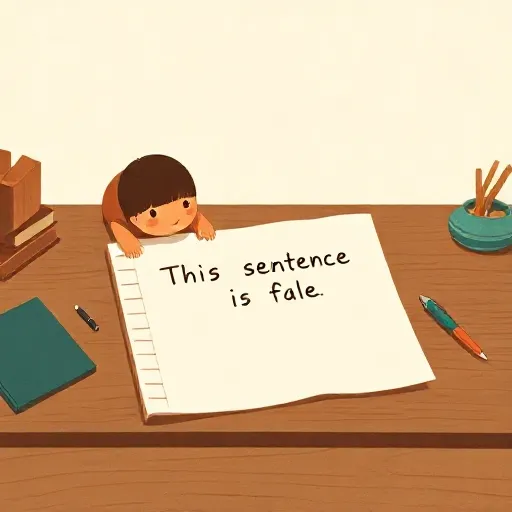
Imagine you walk into a room and announce, loudly: “Every single thing I am about to say is a lie.” Then you pause, smile, and add, “The sky is green.” Your friends stare. Was your first claim true? If it was, then everything you said afterwards must be false — but then “The sky is green” is false, which fits. So where is the trap? The trap is the first sentence itself. If it is true, then it must be a lie, because it says that everything you say is a lie. But if it is a lie, then maybe you really do speak truths sometimes — except you just said the sky is green … The whole thing loops and tangles.
A teacher in medieval Paris loved puzzles exactly like this. His name was John Buridan (c. 1300–c. 1358). He was not a famous theologian or a powerful churchman. He spent his whole career as a master of arts, teaching students how to read, argue, and think. Stories bubbled up that he was thrown into the Seine in a sack because of a scandal with the queen (probably not true), or that he once hit a future pope over the head with a shoe (also doubtful). The tall tales tell us one real thing: in the noisy lecture halls of the University of Paris, Buridan’s name crackled. He made logic feel alive and dangerous.
Because he was a secular cleric — not a member of a religious order — he was free to follow arguments wherever they led, without having to defend a particular doctrine. He did not move on to study theology like Thomas Aquinas (1225–1274) or William of Ockham (c. 1287–1347). Instead, he stayed with the “artists,” the arts masters who taught grammar, logic, and the philosophy of nature. And he insisted that philosophy begins with what is evident to the senses and the mind, not with articles of faith. That commitment forced him to take everyday talk extremely seriously — with all its slipperiness and confusion.
Words That Do Two Jobs
To understand why a sentence can tie itself in knots, Buridan said you have to watch how words point. He built on a tool called supposition, a way of tracking what a word stands for in a given sentence. Every meaningful word has a normal job: it points to a real thing in the world, like a person, a cat, or a stone. Buridan called this personal supposition. When you say “Socrates is a man,” the word “Socrates” personally supposits for that actual, barefoot Athenian who annoyed everyone.
But a word can also point to itself, not to any thing. That is material supposition. If you say “ ‘Socrates’ has eight letters,” you are not talking about an ancient philosopher; you are talking about the word “Socrates.” The term stands for the very marks on the page or the sound in your throat. Buridan thought this simple distinction could replace older, messier categories. He got rid of “simple supposition,” which was supposed to point to universal natures like “humanity” floating somewhere. For him, when we say “Man is a species,” we are using “man” materially — we are talking about the mental concept or the word, not a strange invisible item. Every term either points to things in the world (personal) or to something else, usually itself (material). That clarity gave him a knife for cutting through verbal fog.
When Sentences Attack Themselves

The trickiest sentences are the ones that turn inward and talk about themselves. Buridan tested his logic with a famous puzzle, the seventh sophism (a sophism is a brain‑bending statement). Picture this: all true sentences in the whole world have been erased, leaving only false ones behind. Then a character named Socrates speaks just one sentence: “Every proposition is false.” Is that sentence true or false?
One line of reasoning says it must be false. If it were true, it would claim that every proposition, including itself, is false — a contradiction. Impossible things cannot be true. So the sentence is false. The other line says, wait: if every proposition in the world really is false, then the sentence simply reports that fact, so it should be true. Its subject (“every proposition”) and its predicate (“false”) seem to match the situation perfectly. The puzzle bites.
Buridan’s solution added a hidden layer. He argued that every statement quietly implies another statement: “This sentence is true.” Even when you don’t say it aloud, that second claim comes along for the ride. For a statement to count as true, both the obvious claim and the hidden one must hold. In the erased‑sentences case, “Every proposition is false” passes the first test — all the things it points to really are false. But the hidden claim, “ ‘Every proposition is false’ is true,” fails, because that claim’s subject (“Every proposition is false”) does not match up with something true. So the sentence is false — not because of a logical trick, but because its own silent whisper undoes it. Buridan’s careful two‑step test let him face the paradox without tying language in a tighter knot.
Are “Redness” and “Roundness” Real Things?

If words mostly point to individual things, what about words like “redness” and “humanity”? Are there invisible universal items floating around that make a red apple red and a human being human? Many medieval thinkers said yes. Buridan belonged to the nominalist tradition, which held that only particular individuals exist — this apple, that person — and that universal terms are mental labels we invent to sort them.
But Buridan gave nominalism a sharp twist. He did not think our big concept “human being” was just a bundle of small accidental concepts, like “walks on two legs” plus “has a heart” plus “can laugh.” If it were, he argued, then the concept of a substance would be made entirely of accident concepts — which would mean we never truly grasp what a human is, only what a human does or looks like. That seemed absurd to him. He insisted that the mind can form a simple, substantial concept of a thing in one go, by abstracting directly from what we sense. When you look at a cat, according to Buridan, your intellect acquires a single idea of “cat” that reaches the real nature of the animal, not just a list of feline features. So while no universal “catness” hangs in the air, your mind can still latch onto what‑it‑is‑to‑be‑a‑cat. That essentialist strand made his nominalism more realist than Ockham’s, and much harder to knock over.
Why a Thrown Ball Keeps Going

Pick up a ball and toss it. Why does it sail through the air after your hand has let go? According to Aristotle, the air rushes around behind the ball and pushes it forward — a process called antiperistasis. Buridan thought that made no sense. He pointed to a simple experiment: you have a bellows whose spout is stopped up. No matter how hard you press the handles together, you cannot squash all the air inside into a tiny speck. It resists, not just because of its matter, but because the air has a fixed size, a quantity or magnitude that belongs to it as genuinely as its warmth or its color.
That observation led Buridan to a new idea about motion. He proposed that a thrower imparts a force — he called it impetus — directly into the projectile. The impetus stays in the object and keeps it moving until the surrounding air or some other resistance wears it down. In a vacuum, with nothing to fight it, the impetus would never fade; the ball would fly forever. Buridan was not Galileo, and he still believed that the earth sits at the center of a finite universe. But his impetus theory tore open a crack in Aristotle’s picture of nature. Later thinkers widened that crack into the physics we know today.
The Donkey Who Couldn’t Choose — And Why Buridan Would Not Starve
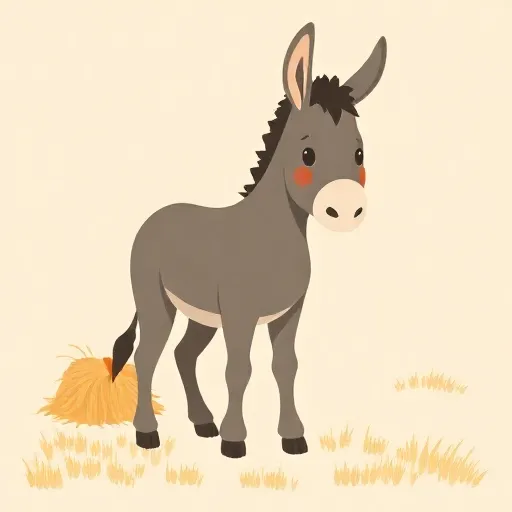
You may have heard the story: a perfectly rational donkey, placed exactly halfway between two identical piles of hay, starves to death because it has no reason to pick one over the other. People call it “Buridan’s Ass.” The strange thing is, John Buridan never wrote that story. It probably began as a joke made by later critics who wanted to make his ideas about free choice look ridiculous.
What Buridan actually believed was subtle. He thought the human will is drawn toward whatever the intellect judges to be the greater good. When two options look equally good, the will doesn’t just freeze — the intellect can judge that it is a good thing to think a little longer, so the will defers action for a moment. But that very judgment still steers the choice. Eventually, even if the two piles stay identical, the intellect will see that eating any hay is better than starving, and the will will move. Buridan’s donkey would munch contentedly. The parody stuck, though, because it captures a real worry: if your choices are always steered by what your mind sees as good, are you really free? That question is still wide open.
Think about it
- If a sentence said “This sentence is written in English,” would that create a paradox? What might Buridan’s two‑step test tell you about it?
- Can you come up with a word that stands for itself when you use it in a sentence, like “word” has four letters? Where does that lead if you try to build a sneaky self‑referential claim?
- If a perfectly logical robot knew all the facts and could calculate every consequence, would it ever get stuck like the donkey in the story? What would Buridan probably say?