
Is Your Brain Making It All Up? Hermann von Helmholtz's Big Idea
What’s Really Out There?

Grab a straw and a glass of water. Look from the side. The straw seems to snap into two pieces at the waterline, bent at a strange angle. Pull it out and it’s perfectly straight again. Your own eyes are playing a trick on you, and you can’t make the illusion go away—even when you know it’s a trick.
For centuries, people thought our senses worked like a stamp on warm wax: the world presses exact copies straight into our minds. But in the 1800s, a German scientist named Hermann von Helmholtz (1821–1894) argued something much wilder. He said your brain doesn’t just record. It actively builds your experience from tiny clues, like a detective solving a puzzle. His ideas shook up how we think about knowledge, and they still echo in science today.
The Old Idea: A Stamp on Wax

Helmholtz’s teacher, Johannes Müller (1801–1858), noticed problems with the old “stamp” idea—called the projection theory. According to projection theory, a stimulus causes a direct, faithful response in your nerves. A tree, for example, would carve an exact tree-shape onto your retina.
But Müller saw puzzles that projection couldn’t explain. First, light entering your eye actually projects an upside-down image on the retina, yet you see the world right-side up. Second, you have two eyes, and each gets a slightly different flat picture—yet you see a single, deep, three-dimensional world. How can two pictures merge into one? If vision were just stamping, these things would be impossible. Müller knew the brain was doing something extra.
Radio Stations in Your Nerves
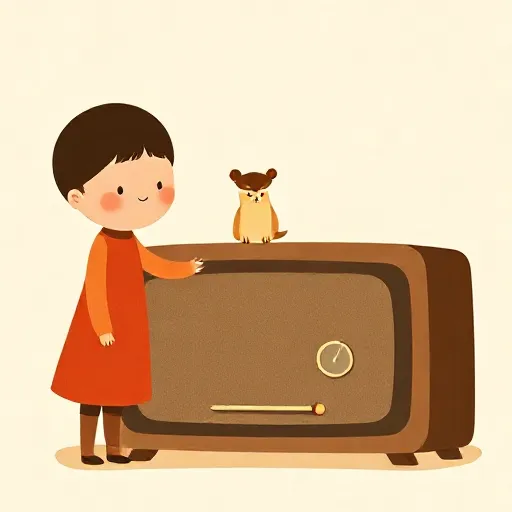
To fix these problems, Müller proposed a new idea called the law of specific sense energies. He said each nerve in your body is tuned to receive a particular kind of signal—almost like an old radio tuned to one station. A nerve in your eye can’t pick up sounds, and a nerve in your ear can’t pick up light. The nerve’s own “energy” shapes what you experience.
Müller explained stereoscopic vision (seeing depth from two eyes) by saying that every point on your left retina is matched to a single point on your right retina. The brain combines the two signals into one point in your perception, which is why you don’t see double when you look at something. Still, Müller believed this matching ability was built into the nervous system from the start—you’re born with it. That’s where Helmholtz began to disagree.
Helmholtz’s Secret Code: Signs, Not Copies

Helmholtz thought Müller’s tuning idea was clever, but he pushed further. He proposed a sign theory. Sensations, Helmholtz said, are not copies of objects. They are signs or symbols, like the word “cat” stands for a furry animal—the word doesn’t look like a cat, but it points to one. Your perceptions are the same: they point to the world without resembling it.
How do you learn what the signs mean? Helmholtz’s answer: unconscious inferences—mental adjustments your brain makes automatically, below your awareness, based on past experience. Imagine you close your eyes and touch a pen held between two fingers. Each fingertip feels only the part of the pen touching it. You’d feel exactly the same sensations if you were touching two separate pens. Yet you know it’s one pen. Helmholtz said you make an unconscious inference: your fingers are close together, so only one pen can fit. You learned that from moving your fingers around objects since you were tiny.
Or think about tapping your fingers across a table. As your hand moves, you feel a steady sequence of sensations. Helmholtz argued that you learn the table’s shape—its spatial order—from noticing what stays the same no matter which finger is touching. Your experience of space itself is built from these patterns.
The Great Debate: Born to See or Learning to Look?
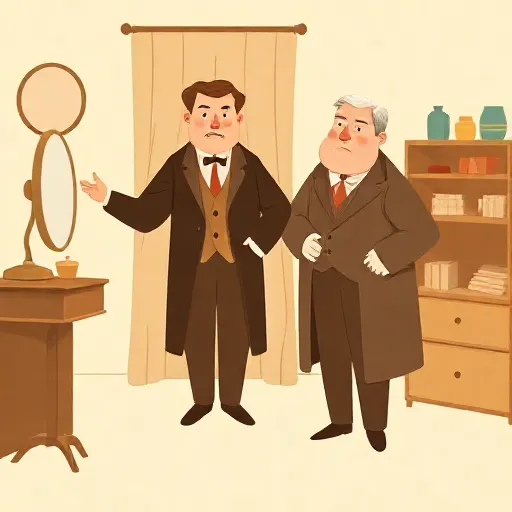
Helmholtz’s view sparked a huge debate with another scientist, Ewald Hering (1834–1918). Hering defended nativism: the idea that certain abilities, like seeing depth and knowing where things are in space, are inborn. They might mature as a child grows, but they aren’t learned—they are like a heartbeat, automatic and involuntary.
Helmholtz took the opposite side, called empirism. He believed that many of our spatial skills are learned through experience. The two scientists disagreed about a puzzle called the horopter. When you focus your eyes on a single point, nearby objects that are actually on a curved line can appear to sit on a straight line, equally far from you. Both eyes feed slightly different pictures to your brain, yet you see one smooth scene. Hering said the brain resolves these differences using inborn wiring. Helmholtz said the brain learns to adjust through countless tiny unconscious inferences.
Helmholtz’s favorite example: learning to shave in front of a mirror. When you raise your right hand, the reflection seems to raise its left. You have to practice to get your movements right. Helmholtz said this skill is clearly not something we’re born with—you learn to reinterpret the reversed signals. Hering doubted that such basic perception could depend on learning.
Your Brain as a Detective: Why It Still Matters

So why should you care about an argument from over 150 years ago? Because Helmholtz’s detective story is basically the story of your brain every waking second. That bent straw? It’s a clue that your brain applies automatic rules—rules you learned long before you could talk—to make sense of light and water. When you catch a ball, your brain isn’t seeing a direct copy of the ball; it’s predicting where the ball will be, using fast unconscious inferences built from past experience.
Even weirder, Helmholtz applied this thinking to space itself. He argued that the rules of geometry aren’t something your mind is forced to use like a cage. Instead, you learn them from moving around and measuring. He thought you could even grow up understanding a curved, strange space if all your early experiences happened there. Today, some scientists who study artificial intelligence build “Helmholtz machines”—computer programs that learn to see by making guesses and learning from mistakes, just as Helmholtz imagined.
The big question Helmholtz leaves us with hasn’t gone away: if your brain builds your world from signs and guesswork, can you ever know what’s really out there, unfiltered? You can’t step outside your own head to check. But that creative, puzzling, guessing brain is exactly what lets you make your way through the world—and call it your own.
Think about it
- Close your eyes and touch an object with one fingertip. You feel one thing. But if your brain is always interpreting signals, could you ever be absolutely sure you’re not touching two separate things, and your brain just made them feel like one?
- If you had lived your whole life inside a curved fun-house room, do you think your brain would learn to see that curved space as completely normal? Would you even be able to imagine flat space?
- A scientist builds a robot that learns to see by guessing what’s around it, just like Helmholtz described. If the robot says, “I see a tree,” does it really see, or is it just running a program? What would it take for you to say it truly “sees”?