

Is Your Mind Secretly Shaping Every Experience You Have?
The Ball That Made a Philosopher Scratch His Head

You pull your leg back and kick a soccer ball. The ball rolls away. You never doubt that your kick made it move. But why are you so sure? You didn’t see something called “causation” flying from your foot. You just saw one thing, then another. The link between them—the invisible power that made it happen—never showed up.
For centuries, philosophers thought cause and effect were obvious features of the world. Then, in the 1700s, David Hume (1711–1776) pointed out a problem that shook philosophy. If all your knowledge comes from what your senses tell you, can you really know that one thing causes another? That simple question launched a debate that still hasn’t ended.
Hume’s Challenge: You Can’t See the Cause
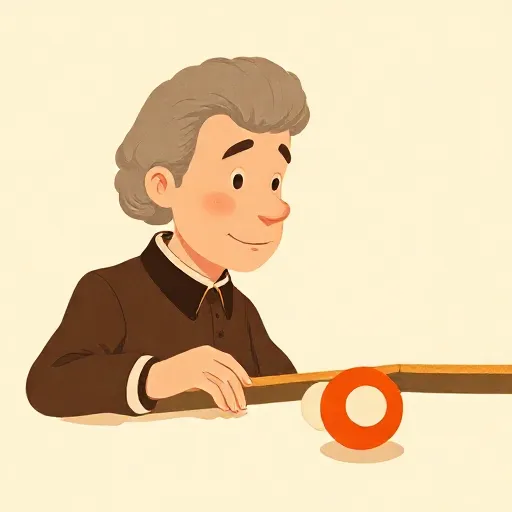
Hume’s starting point was strict. Every genuine idea, he said, must come from a sensory impression—something you directly see, hear, or feel. Ideas are just faded copies of impressions. So if a concept doesn’t come from any impression, it’s meaningless or unjustified.
Hume examined the idea of causal power. He watched a billiard ball hit another and the second move. He saw the first ball, the collision, then the motion. But no matter how hard he looked, he could never find an impression of the power that forced the second ball to move. All he ever witnessed were events happening one after another.
Because the impression of a necessary connection was missing, Hume concluded that our idea of cause is just a habit. After seeing A followed by B many times, the mind learns to expect B when A appears. This mental association, which Hume called associationism, makes us feel like there’s a real link. But the habit gives us no proof that the world actually works that way. Concepts like cause, substance, and even the self therefore lack objective validity—they don’t necessarily apply to the objects we experience.
If Hume was right, the most basic concepts you use every day are only psychological shortcuts without any real backing. That was a devastating challenge.
Kant’s Big Idea: The Mind Has a Toolbox

Immanuel Kant (1724–1804) said that Hume’s problem woke him from a dogmatic slumber. But instead of giving up, Kant made a radical move. What if the mind isn’t a blank slate that just receives sense data? What if it comes with its own built‑in tools that shape every experience we can ever have?
Kant set out to prove this in a long argument called the Transcendental Deduction. The name sounds fancy, but the goal is simple: to justify using a set of basic concepts (the categories) by showing they are necessary for any possible experience. The categories include cause, substance, unity, and others—exactly the ideas Hume doubted.
Kant agreed with Hume that you can’t prove these concepts by pointing to sensory experiences. That would be an empirical deduction, and it fails. Instead, Kant offered a transcendental argument: start with a fact about experience that no one seriously denies, and then show that fact is possible only if the categories really do apply to the objects we experience.
Kant’s first key fact was apperception, or self‑consciousness. You can attach the thought “I think…” to every single one of your mental states. Whether you see the ball, remember the kick, or feel excited, it’s always the same “I” that does the thinking. Kant argued that this ability—to be aware that all your thoughts belong to one identical self—requires a special mental activity called synthesis.
Synthesis is like weaving separate threads into one fabric. Your mind doesn’t passively receive a jumble of impressions. It actively connects them. For instance, to see a ball as a single object, you must combine different views of its roundness, color, and motion into one unified experience. Kant claimed this synthesizing work must use the categories. Without them, you couldn’t have a single, ongoing “I” that holds your mental life together. So even the unity of your own self forces you to rely on concepts like cause and substance.
Why Your Experience of Objects Demands Rules

Kant didn’t stop with self‑consciousness. He also launched an argument from below, focusing on how we experience ordinary objects. He noticed that our experience isn’t a chaotic stream—it has universality and necessity.
Picture walking around a house. You see the front, then the side, then the back, one view after another. Yet you don’t think the house is a series of disconnected snapshots. You know all its parts exist at the same time. Now imagine watching a boat drift downstream. You see it at point A, then B, then C. This time, you recognize the boat’s positions are objectively successive—they really happen one after the other.
In both cases, your mind orders the raw input in a rule‑governed way. Under normal conditions, you must experience the house parts as simultaneous and the boat positions as successive. This kind of necessity and universality can’t be explained by association alone. Association works like word games: one person hears “cat” and thinks “dog,” another thinks “whiskers.” There’s no guarantee everyone will connect ideas the same way. But our experience of objects is strikingly uniform across all people and times.
Kant concluded that the mind’s synthesizing activity uses a priori concepts to give experience its stable, objective character. The category of cause, for example, is what lets you see the boat’s motion as a necessary sequence, not a random movie clip. That meant the categories are objectively valid—they really do apply to the world as you experience it.
But What About the World Outside Your Mind?

If your mind shapes every experience, a new worry appears: is there anything real outside your mind at all? Kant took this skepticism seriously. He called it problematic idealism—the view that the existence of physical objects is “doubtful and indemonstrable.” To fight it, he added a section called the Refutation of Idealism to the second edition of his main work.
Kant began with something even a skeptic would accept: you can be aware that your own mental states happen in a specific time order. You remember eating breakfast, then brushing your teeth, then heading to school. To determine that order, you need something permanent to measure against. But your inner mental life offers no such clock. Thoughts flicker and vanish. And time itself is invisible—you can’t sense “a moment.”
Kant’s suggestion was that the only possible permanent reference is something outside you in space—a physical object like a clock, the sun, or even the steady beat of your own heart detected through touch. So to be conscious of your mental timeline, you must perceive real, persisting objects in space. He hoped this proved an external world exists, at least as a necessary condition of self‑awareness.
Critics quickly found problems. Couldn’t a dreamed‑up clock or a hallucination serve the same role? And what if your memories are completely false? Many philosophers think Kant’s argument doesn’t fully defeat the skeptic. Still, it remains a landmark attempt to answer the “maybe I’m just a brain in a vat” worry.
Why This 250‑Year‑Old Fight Still Matters
You’ve probably never doubted that kicking a ball makes it move, or that a house exists all at once. But Hume and Kant were wrestling with a question that quietly shapes how you see everything: how much of reality is “out there,” and how much is something your mind brings to the party?
In the 20th century, philosophers like P. F. Strawson (1919–2006) revived transcendental arguments to challenge modern skeptics. They tried to show that being able to label your experiences as your own logically forces you to believe in a world of physical objects. Others have used similar reasoning in ethics, arguing that if you value anything at all, you must value your own rational nature.
The idea that some features of your mind might be necessary conditions for having any experience at all hasn’t faded. Psychologists investigate whether babies are born with a built‑in sense of cause and effect. Robot designers wonder what basic rules a machine needs to learn about the world. And every time you stop and realize that your experience feels orderly and predictable, you’re stepping into a debate that began when a Scottish thinker couldn’t find the “power” in a bouncing billiard ball. Kant didn’t win the argument—Hume still has defenders—but together they forced us to ask a deeper question: What must our minds be like for the world to make sense?
Think about it
- If you were born with categories like cause‑and‑effect built into your mind, could you ever discover they were wrong? How?
- Imagine a world where events happen with no cause at all—things pop into existence unpredictably. Could a mind like yours ever make sense of it?
- You probably trust your memory to put yesterday’s events in the right order. Could you think about your past without relying on something outside your mind, like the position of the sun or a clock?