Is Your Brain Editing Reality Right Now? Ernst Mach Said Yes
A Whistling Tube and a Mind That Questioned Everything
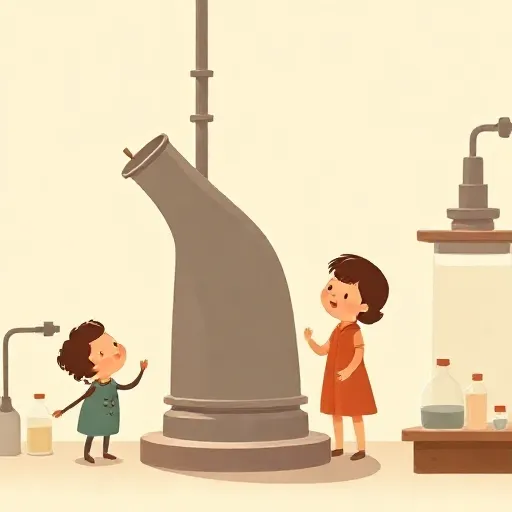
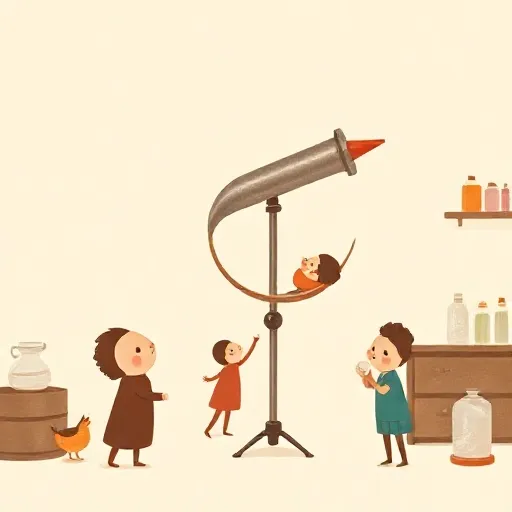
In the 1860s, a young physicist named Ernst Mach (1838–1916) built a strange device: a six-foot tube with a whistle at one end, mounted so it could spin around in a vertical circle. When someone stood in line with the axis of rotation, the whistle’s pitch sounded steady. But if you moved to the side, the pitch wobbled up and down as the whistle whirled toward and away from you. Mach had just proved that the Doppler effect — the way sound waves stretch and squash based on motion — works exactly as predicted. It was his first big scientific splash, but it was only the start of a much deeper puzzle he wanted to solve.
Mach had been a bookish teenager in Moravia, and when he was fifteen, he picked up his father’s copy of Immanuel Kant’s Prolegomena to Any Future Metaphysics. The book hit him like a thunderclap. A few years later, walking outside on a bright summer day, he suddenly felt that the whole world — including his own “ego” — was really just one connected mass of sensations, only a little tighter inside his head. This flash of insight never left him. It set him on a path to ask: what if all our knowledge, including science itself, isn’t a mirror of a hidden reality, but something our senses and brains actively build?
Mach studied physics and math at the University of Vienna, but he also signed up for medical classes in physiology and chemistry. He was fascinated by the new science of psychophysics, which tried to measure how the outside world gets turned into inner experience. Over the next decades, he would become a physicist, a psychologist, and a philosopher all rolled into one — and he would argue that the wall between mind and matter is an illusion.
The Eye Has a Mind of Its Own: Mach Bands
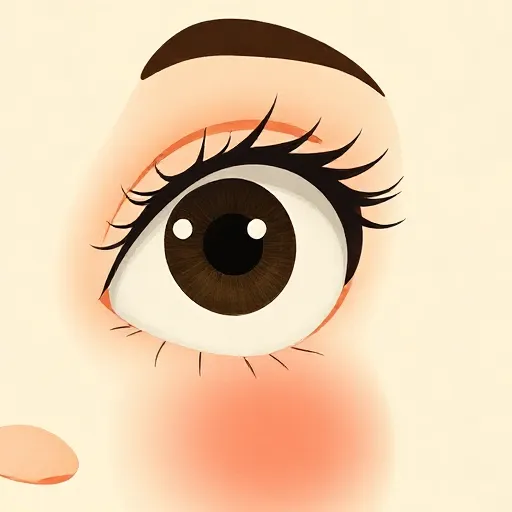
Look at the image of Mach bands (the illusion in the section picture). The strip fades evenly from dark to light, but your eye sees a thin dark line on the dark side of the border and a thin bright line on the light side. Those lines don’t exist in the actual shading — your retina is adding them. Mach discovered this effect in 1865 and showed that our senses don’t just pass along raw data to the brain. The eye itself does a kind of editing before the information even leaves the eyeball.
This is called lateral inhibition: when one part of your retina is stimulated, it dampens the response of its neighbors. The result is that our visual system exaggerates differences — it makes edges stand out and ignores constant, unchanging patches. Mach realized this isn’t a mistake. It’s a built-in survival trick. If you were a creature that saw absolute light levels instead of contrasts, a cloud passing over the sun would make the whole world look different, and you might not recognize a predator or a piece of food. By seeing relations between stimuli instead of raw stimuli, you get a stable world picture.
This discovery undercut a popular idea called direct representationalism — the view that our senses give us a faithful, point-by-point copy of reality. Mach argued that what we see is always a construction, shaped by the needs of the organism. The eye, he said, “schematizes and caricatures.” It’s like a political cartoonist picking out the most useful contrasts. And this process, Mach believed, is not unique to vision: it’s the basic pattern of all mental life, from perception to scientific theory-building.
How Evolution Wrote the Rules of Thought
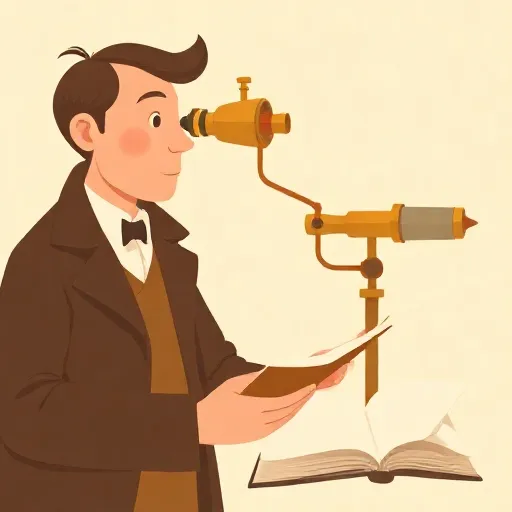
Mach’s biggest inspiration was Gustav Fechner, a German scientist who in 1860 published The Elements of Psychophysics. Fechner had figured out that the relationship between how hard a stimulus hits your senses and how strongly you feel it follows a mathematical law: you need more and more extra stimulation to notice a difference as the background sensation gets stronger. It was the first time anyone had measured the bridge between the physical world and the inner world of experience. Fechner used the neutral word elements for the basic units that could be described either physically (as nerve signals) or psychologically (as sensations). Mach grabbed hold of this term.
For Mach, these elements weren’t little copies of objects in a mind; they were the one stuff — neutral and monistic — that everything is made of. Physics and psychology just look at the same elements from different angles. And evolution was the engine that built minds out of them.
Consider that chick that hatches and immediately knows to peck at food. It doesn’t have to learn from scratch; its brain comes pre-wired. Mach said this pre-wiring is a kind of a priori knowledge — knowledge that seems built in and not learned from experience. But crucially, what is a priori for the individual was a posteriori for its ancestors — learned, hammered in by millions of years of trial and error, then passed down. The mind, Mach wrote, is a product of evolution, and our memory — even cultural memory passed through language — stretches our mental reach across time and space. Science, then, is just the latest chapter in this ancient story: “Scientific thought arises out of popular thought, and so completes the continuous series of biological development.”
The Economy of Thought: Why Science Simplifies
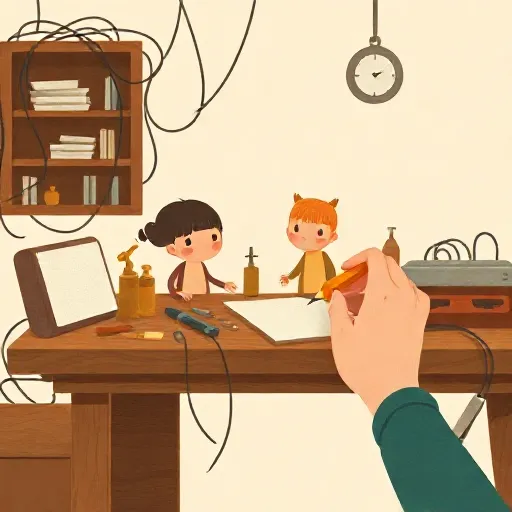
Why do we do science at all? Mach’s answer is starkly biological: to survive more effectively. Science replaces slow, costly trial-and-error with fast mental rehearsal. Instead of actually putting your hand in the fire, you build a theory about heat and avoid the burn. This is what Mach called the economical function of science. A good theory is like a mental Swiss Army knife: it packs the maximum orienting power into the simplest package. “It is the object of science to replace, or save experiences,” he wrote, “by the reproduction and anticipation of facts in thought.”
If economy is a law of biology — nature hates waste — then science must be economical too. A theory that ties physics to psychology with one set of concepts is better than two separate theories, because your brain can’t orient itself with two different maps of the same territory. That’s why Mach spent so much energy trying to unify the sciences under a single framework of elements. He thought the split between the “physical” and the “psychical” was artificial, created by our habits of thought rather than by the world itself.
This biological perspective also explains why Mach refused to treat space and time as absolute, God’s-eye-view containers. Physiological space — the space you feel with your body — is finite, uneven, and emotionally charged: a tiger two steps away is not just a geometric distance. Geometrical space is an intellectual smoothing-out of that messy sensation-based space. Physics, Mach insisted, can never cut itself free from its roots in our senses because all measurement is just comparing one sensation to another.
Atoms, Disbelief, and a Feud with Max Planck
Mach is often called an anti-realist about unobservable entities — meaning he doubted we should believe in things like atoms just because they made our equations work. His stance came straight from his biological picture of knowledge. If science is a tool for organizing experience, he reasoned, then talking about atoms as real little billiard balls goes beyond what we can actually experience.
In the late 19th century, atomism was still hotly debated. Some physicists, like Ludwig Boltzmann, championed the kinetic theory of gases, while Mach pushed for a “phenomenological” physics that stuck closely to what could be measured — heat, pressure, volume — without inventing hidden mechanisms. The tension came to a head with Max Planck (1858–1947). Planck argued that physics had outgrown its psychological infancy and could now build on universal constants — like the speed of light — that are true for any possible mind, even an alien one. Mach replied that those constants were still ultimately tied to our human way of sensing and comparing. As for atoms, he said he had no doubt that if atomic theory fit the facts, it would be useful, but he refused to join “the communion of the faithful” who treated them as unquestionable realities. He preferred freedom of thought.
Later, Einstein’s explanation of Brownian motion in 1905 would make molecules hard to resist. But Mach’s stubbornness served a purpose: it forced physicists to be clear about when they were describing experience and when they were adding metaphysical extras.
Why It Still Matters: Your Brain as Editor

So why should a twelve-year-old today care about a physicist who argued with Planck and studied whistles? Because every time you flinch at a jump-scare in a video game or instantly recognize your friend’s face in a crowd, you’re living inside Mach’s world. Your brain isn’t showing you what’s really out there in all its chaotic detail; it’s serving up an edited highlights reel optimized for action.
Mach’s big idea — that perception, learning, and even science are extensions of the same evolutionary process of adapting and economizing — resets how you think about truth. It doesn’t mean truth is fake; it means truth is something living systems build by engaging with the world, not by opening a window to a ready-made reality. The challenge he left us is this: if our minds carve the world at joints that helped our ancestors survive, how do we know when we’re seeing a genuine joint and when we’re just seeing a useful carving? That’s a question you can start asking right now, looking at your own hand, hearing the whir of a fan, feeling the edges of a screen.
Think about it
- If your senses evolved to highlight what helps you survive, what might they be hiding from you right now?
- Mach said science is a tool for getting around the world, not a mirror of reality. If you can never see the world as it truly is, does that make science less trustworthy or more impressive?
- Could there be a creature with completely different senses that lives in a completely different “reality” — and would either of you be more correct?