Does Your Body Shape How You Think?
When a Robot Moves Without a Brain

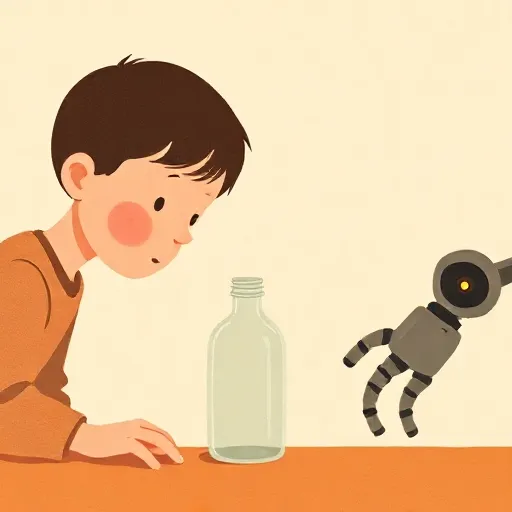
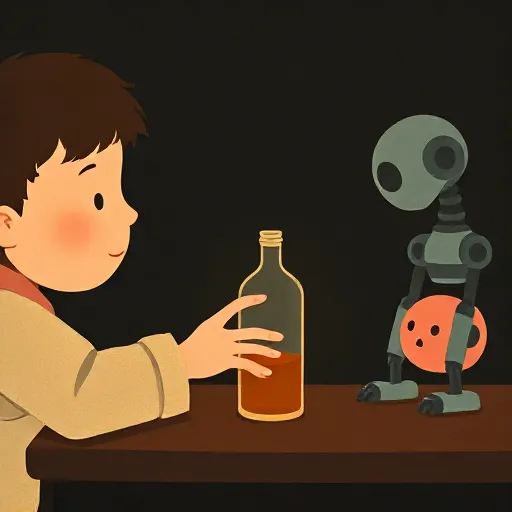
In the 1960s, at a Stanford research lab, a robot named Shakey tried to find its way around a room. Shakey had a camera and a computer brain. It would snap a picture, build an internal model of the walls and blocks, plan a path, then take a tiny step. Then it would do it all again. A simple journey across the room could take days.
Twenty years later, a roboticist named Rodney Brooks (b. 1954) built a very different kind of machine. His robot Allen had no internal model of the world, no grand plan. Its sensors connected directly to its wheels. One layer of instructions told it to avoid obstacles, another to wander randomly, a third to explore toward a target. These layers competed with each other, and out of that competition came surprisingly clever, flexible behavior — without any heavy reasoning inside a computer.
That clash between a slow, mental-map robot and a fast, body-driven robot captures the big question that embodied cognition asks: is your mind a computer locked inside your skull, or does your whole body — and even the world around it — do the thinking?
The Mind as a Computer: A Once-Dominant Story
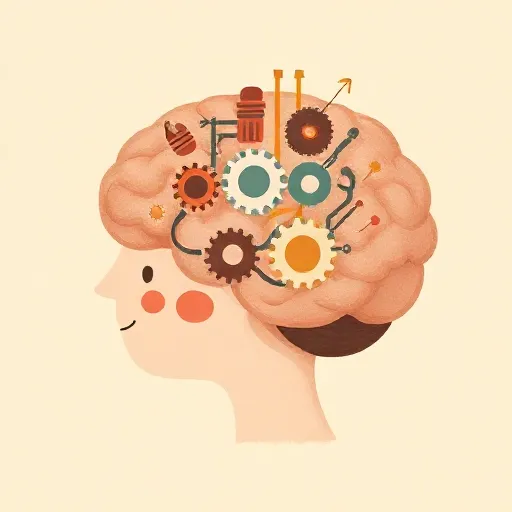
For most of the late twentieth century, cognitive scientists pictured the mind as a kind of computer. The brain receives raw data from the senses, translates that data into a symbolic code — a “language of thought” — and then manipulates those symbols using rules, just as a CPU runs a program. Seeing a cat, remembering your locker combination, or choosing between two desserts were all thought to be the result of computation: step-by-step operations on internal representations.
One big reason scientists held this view was the problem of impoverished stimuli. The light hitting your retina is just a flat pattern. A square block and a diamond block could, from a certain angle, cast the same shape on your eye. How do you instantly see the difference? The computational answer was that your brain uses unconscious background knowledge to make an inference — a kind of guess, based on clues, about what is really out there. The linguist Noam Chomsky (b. 1928) made a similar argument about language: children hear too little language to simply “absorb” grammar, so they must have built-in mental rules for decoding it.
This computational picture was powerful and explained a lot. But to some researchers it seemed to leave out something obvious: you have a body, and you move.
Gibson’s Challenge: The World Is Not Impoverished

The psychologist J.J. Gibson (1904–1979) thought the “impoverished stimuli” idea was backwards. He argued that the world is actually richly packed with information — if you look at the whole moving animal, not just a static eye. Gibson called his view ecological psychology.
When you walk toward an object, the shape it projects to your eye shifts in a precise, lawful way. A square’s edges create different patterns of change than a diamond’s edges. You don’t need to store a rule for “squareness” and then infer it from a snapshot. The information is already there, in the way the stimulation transforms as you move your body. Perception, Gibson said, is not an inference inside the head; it is the direct detection of these invariants — the features that stay the same across your movement.
This was explosive. If perception works without internal guesses and rule-based computation, maybe all cognition does. Gibson’s ideas planted a seed: the body is not just an input device. It is part of the cognitive loop.
How Your Body Shapes Your Concepts

Even if perception doesn’t need inference, could the very concepts we think with be shaped by our bodies? The linguist George Lakoff (b. 1941) and the philosopher Mark Johnson (b. 1949) argued yes. Many abstract ideas, they claimed, grow out of metaphors borrowed from physical experience.
Imagine explaining what an election is to a child. You might say “it’s like a race.” Candidates are runners, they can stumble, they need stamina, there will be winners and losers. That metaphor gives the child a scaffolding. But where do the most basic, literal concepts — like up, forward, push, pull — come from? Lakoff and Johnson said they come straight from having a human body that stands upright, moves forward, and grabs things. Because concepts like up are rooted in our motor programs for standing, concepts that build on them (like happiness as “feeling up”) carry a bodily stamp.
Later experiments made this idea vivid. Psychologists Lera Boroditsky and others have shown that when you read the word “kick,” the motor areas of your brain that actually control your leg become active. In one famous study (Tucker and Ellis, 1998), people judged whether a frying pan was right-side-up. If the pan’s handle pointed to the right, they pressed a button faster with their right hand than with their left — even though the handle direction had nothing to do with the task. The body was automatically “preparing” to grasp the object.
This suggests that concepts aren’t pure, abstract symbols like the 1s and 0s in a computer. They are modal — they keep traces of the senses and movements that built them. Critics warn that we still need to distinguish a concept’s core meaning (a bachelor is an unmarried male) from fleshy extra associations (bachelors might be young and messy). And what about truly abstract ideas like justice or democracy? How they get a bodily grip is still fiercely debated. But the evidence makes one thing plausible: the specific body you have might make your concepts different from those of a creature with a completely different body.
Can We Throw Away the Computer? The Replacement View

If concepts are body-shaped, do we still need the old idea of the mind as a rule-following computer? Some embodied cognition researchers say no — we should replace the computer metaphor entirely.
Their poster child is a piece of 18th-century machinery: the centrifugal governor invented by James Watt. It keeps a steam engine from spinning too fast. No symbols, no plans. The faster the engine spins, the higher the flyballs rise, which closes a steam valve. The slower it spins, the balls drop, opening the valve. The system continuously adjusts through feedback — no internal model required.
Dynamical systems theorists argue that cognition works the same way. The brain, body, and world couple together like the governor’s parts. A famous mathematical model, the Haken-Kelso-Bunz equation, captures how your two index fingers wag in-phase or out-of-phase, and how one pattern abruptly flips to the other as speed increases. The model describes without a single representation of a “goal” or “finger plan.” Some scientists, like Esther Thelen (1941–2004), showed that even infant stepping and reaching could be explained as the unfolding of body-world dynamics, not the execution of stored motor programs.
Rodney Brooks’s robots pushed the replacement idea furthest. Allen didn’t build a model of its world; it used the world as its own model. The loop of move-sense-move meant it never needed a detached mental picture.
But can all thinking work this way? Critics point out that imagining a unicorn or wondering what would happen if you sawed through a branch in a certain direction requires thinking about things that aren’t present. These are representation-hungry tasks. Dynamical explanations that treat the organism as in constant contact with the world stumble here. So the replacement view remains bold but incomplete — many cognitive scientists hold that we need both dynamics and some form of representation.
Is Your Mind Out in the World? The Extended Mind

Perhaps the most startling idea is that thinking doesn’t just happen in your head. The philosopher Andy Clark (b. 1957) and his collaborator David Chalmers (b. 1966) proposed the extended mind thesis. Imagine two people: Inga, who remembers where the Museum of Modern Art is by storing the address in her biological memory, and Otto, who has Alzheimer’s and always writes important facts in a notebook he carries everywhere. When Otto looks up “MoMA is on 53rd St.,” his notebook plays exactly the same role as Inga’s hippocampus. Clark and Chalmers argued that, by the parity principle, the notebook should count as part of Otto’s cognitive system — his mind extends into the world.
Not everyone bought this. Philosophers Fred Adams and Ken Aizawa (20th–21st c.) argued that genuine mental states must have intrinsic content — meaning that isn’t just borrowed from someone’s interpretation. The scribbles in Otto’s notebook get their meaning only because Otto (or a reader) gives it to them; brain states, they claimed, carry their meaning in themselves. They also worried that mixing notebooks, iPhones, and pencil marks into a single science of cognition would create a hopeless scientific mishmash.
Another philosopher, Robert Rupert (20th–21st c.), suggested a more conservative picture: the brain simply uses tools as stores to offload work — like an axe, the notebook is a tool, not a part of the cognitive system. Clark replied that the brain is “cognitively impartial” about where operations happen. Yet some embodied-cognition advocates, like Lawrence Shapiro (20th–21st c.), noticed a tension: if a notebook counts as part of the mind because it performs a computational function, then the body’s specific physical details might not matter after all — which is the opposite of what embodied cognition originally emphasized.
So while the extended mind offers a powerful lens — your smartphone or your notes might be part of your thinking — many mainstream cognitive scientists still treat the skull as the boundary of the mind.
Why It Matters: Feeling Right and Wrong
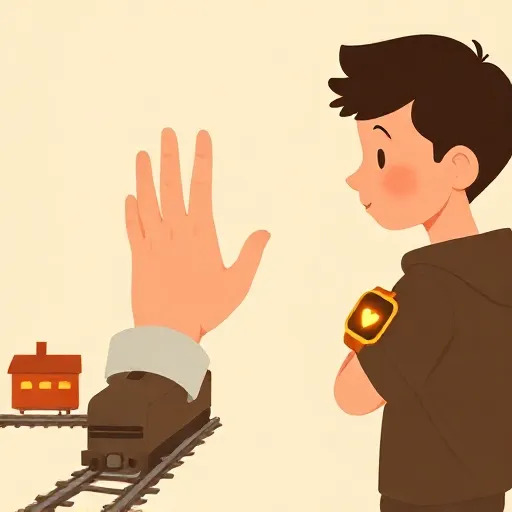
These debates are not just about robots and notebooks. They change how we see ourselves. Take social cognition — the way you understand other people. Embodied researchers like Shaun Gallagher (20th–21st c.) argue that you don’t usually guess hidden thoughts by running a mental logic. Instead, you rely on primary intersubjectivity: you read intentions directly from a face, a posture, a tone of voice. Even as a baby, you could follow a gaze or mimic a grin without forming theories about other minds.
And what about your moral compass? According to embodied moral cognition, many of your judgments start with gut feelings, not abstract reasoning. Psychologist Jonathan Haidt (b. 1963) showed that people often feel strongly that a harmless action — say, cleaning a toilet with the national flag — is wrong, but they can’t explain why rationally. The disgust comes first; the reasoning follows. Neuroimaging studies find that when your heart races or your palms sweat while imagining pushing someone off a footbridge to stop a runaway trolley, that bodily reaction strongly shapes your decision that it would be immoral, even when the math of lives-saved is the same.
Such findings matter for you right now. They suggest that your body, your environment, and your habits are not just background scenery for a brain-mind. They are active partners in what you know, who you understand, and what you feel is right. As you navigate dilemmas — from sharing cookies to standing up for a friend — your body’s subtle nudges might be part of the deliberation, not just a distraction from it. That makes the philosophy of embodied cognition a very personal science indeed.
Think about it
- If a robot like Allen has no inner map and still roams freely, does it have anything you would call a mind? Why or why not?
- Suppose you discover that a bad smell in the room makes you give harsher judgments about a person’s action. Would you then distrust that judgment, or is the feeling a legitimate part of your moral thinking?
- Could the fact that you have two hands, walk upright, and feel your heartbeat shape your idea of what is fair? Try to think of a moment when a physical sensation changed your sense of right and wrong.