
Is a Golden Mountain Really Golden? John Findlay’s Answer
The Golden Mountain and the Non-Existent
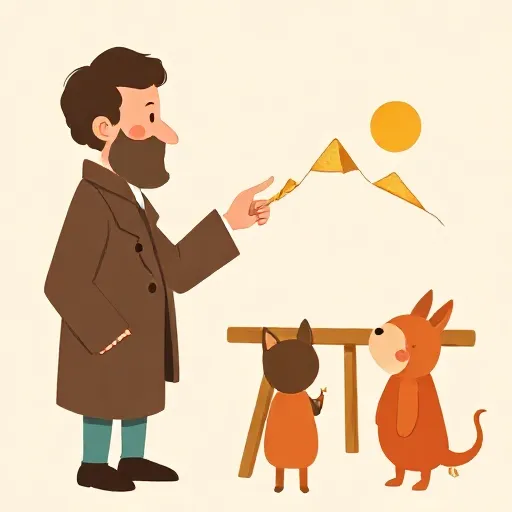
Imagine you’re drawing a mountain made entirely of gold. In your picture it rises into the sky, gleaming. You can describe it: the gold reflects sunlight, the slopes are steep. But does your mountain exist? Obviously not — it’s just an idea. Most people would say you can’t say anything true about something that isn’t real. In the early twentieth century, a South African philosopher named John Niemeyer Findlay (1903–1987) disagreed loudly.
Findlay was a thinker who loved swimming against the tide. Born in Pretoria, he became a vegetarian at age seven because he believed consciousness gives animals a moral status, not just the ability to suffer. He learned languages, acted in Chekhov plays, and was fascinated by theosophy and Buddhism. At Oxford he discovered Bertrand Russell’s new logic and decided almost everything his professors believed was too narrow. Findlay then went to Germany and studied a forgotten Austrian philosopher, Alexius Meinong (1853–1920), who had made a startling claim: non-existent objects — things like golden mountains, chimeras, and even round squares — are genuine subjects we can talk about truly.
Bertrand Russell (1872–1970) had attacked Meinong’s idea with a few sharp sentences. Russell argued that if you say “the golden mountain is golden,” you’re forced to admit there exists a golden mountain. That offends what Russell called our “robust sense of reality.” Worse, if the golden mountain is both golden and a mountain, then the round square must be both round and square — a clear contradiction. Russell thought these absurdities showed we must stop pretending non-existent things have any properties at all. Instead, we should analyze sentences about, say, “the present King of France” as complicated statements about properties, not about a king who isn’t there.
Findlay wasn’t convinced. In his 1933 book Meinong’s Theory of Objects, he argued that Russell had punched a straw man. Meinong never said the round square exists. It lives in a special realm he called Aussersein — beyond being and non-being. The round square is round, yes, and it is also non‑round. Yet that doesn’t produce a logical contradiction, because from “the round square is non‑round” you can’t infer “it is not the case that the round square is round.” Those are two different facts, both true of the same impossible object. It’s a bit like a character in a story: Hermione Granger is a witch and also Muggle‑born; both are true about her even though she doesn’t exist anywhere outside the page. Findlay believed our minds can reach beyond what actually exists and make honest‑to‑goodness true statements about what doesn’t.
Russell’s trick of replacing talk of non‑existents with talk of properties didn’t satisfy Findlay either. Imagine a childless woman who wishes for a child. She isn’t wishing to be the mother of one of the children already in the world; she is wishing for a child that is not yet actual. Her thought points straight at something that is, at the moment, purely non‑existent. Findlay insisted that this kind of intentional reaching teaches us something important about the mind: it is never chained to the furniture of the actual universe.
A Logic for Time, Not Just Dates

Findlay didn’t stop at non‑existent mountains. He also rethought how we talk about time. Suppose you say, “Archduke Ferdinand was assassinated.” Philosophers once treated that sentence as incomplete: it’s neither true nor false until you replace the tense with a fixed date — “Archduke Ferdinand is assassinated on June 28, 1914.” But a date alone doesn’t tell you the event has already happened. The feeling of pastness would be lost.
In 1941, Findlay published a paper with a tiny footnote that changed the history of logic. Instead of scrubbing tenses away, he proposed treating tense as a separate logical ingredient, an operator you can attach to a description of an event. Instead of “is assassinated at time t,” you would write something like Past(Archduke Ferdinand being assassinated). Then you could lay down laws for how these operators behave: if something is present, it will be past; if something will be present, it is presently future. These rules look obvious, but once they are written down as a formal system, you can start reasoning rigorously about change and time.
The footnote caught the eye of Arthur Prior (1914–1969), who later built the first full tense logic. Prior called Findlay “the founding father of modern tense logic.” Findlay himself kept probing the mysteries of time. He noticed a strange asymmetry: we know vastly more about the past than about the future, even though the basic laws of physics run the same way forward and backward. His guess was that past events leave concrete traces in the present — things bump, collide, and leave marks — whereas future events haven’t yet collided with anything to announce themselves. In a world of clashing particles, the past writes itself into the now, while the future stays silent. That, Findlay argued, is why we have memories and records but no precognition.
Escaping the Cave: Findlay’s Ultimate Vision

Findlay’s biggest ambition went far beyond golden mountains and tense logic. In his Gifford Lectures, delivered in Scotland in the 1960s, he laid out a complete picture of reality. He borrowed Plato’s old image of a cave: we are chained inside, watching shadows flicker on a wall and mistaking them for the real world. For Findlay, our everyday world — with its space, time, and solid bodies — is that cave.
Look closely, he said, and the cave tears itself apart. Things are supposed to be separate individuals, yet they can’t avoid touching and affecting one another. Space must be both an empty container and a medium that bodies push through, which is a contradiction. Bodies have qualities like color or warmth, but those qualities seem to float somewhere between the body and our minds. Even science’s clean picture, with atoms and forces, inherits the same puzzles. Findlay thought these antinomies were symptoms of a deep flaw: separateness itself is an illusion.
If we are inside a cave, there must be an outside. Findlay followed the ancient philosopher Plotinus (204–270 CE) in imagining a “hemisphere” where all individuals are like lines running from the equator to a single pole. As you travel upward, the differences between things slowly vanish, yet each individual is still fully itself — just in a perfected, united way. At the very top pole there is the absolute, a sort of divine light in which everything fits together without contradiction. In Findlay’s translation of Plotinus, the inhabitants of that realm are “transparent”: they see themselves in others, and nothing is dark or resistant.
Findlay was careful to say this wasn’t the God of ordinary religion. He had written a famous paper asking “Can God’s Existence Be Disproved?” and was deeply suspicious of monotheism. Yet he confessed that even he sometimes slipped into a depressed materialism, seeing the universe as a senseless jumble of accidental facts. The vision of the Plotinian hemisphere was his hope — a hope that the absurd mess around us is not the final story.
Why Findlay’s Rebel Ideas Still Matter

Findlay spent his whole career as a contrarian. He threw Husserl at Frege, Meinong at Russell, Brentano at Wittgenstein. He didn’t win over the mainstream, but he forced it to take its own hidden choices seriously. Today, philosophers still argue about whether we can talk about fictional characters or impossible objects without tying ourselves in knots. Computer scientists and linguists use tense logic descendants every time they design a system that “thinks” about past and future events. And the big metaphysical question Findlay asked — Is the world we see all there is? — still nags at anyone who has ever felt that reality might be larger and stranger than it looks.
When you daydream a golden mountain, or wish for a better world, or puzzle over how you can remember yesterday but not tomorrow, you are standing squarely in Findlay’s territory. He showed that a sharp mind can cling to these ordinary mysteries and turn them into rigorous philosophy, without ever pretending the mysteries will vanish.
Think about it
- If you say “Sherlock Holmes is a detective,” is that true even though Sherlock never existed? Why or why not?
- Can you think of a statement about the future that is true right now, even though the event hasn’t happened yet? How would you test it?
- If someone told you the world we see is just a shadow and a perfect world exists beyond, what would you ask to figure out if they’re right?