Can a Round Square Be Round? The Impossible Idea That Makes Sense
A Classroom Riddle: Can You Think About Something That Isn’t There?

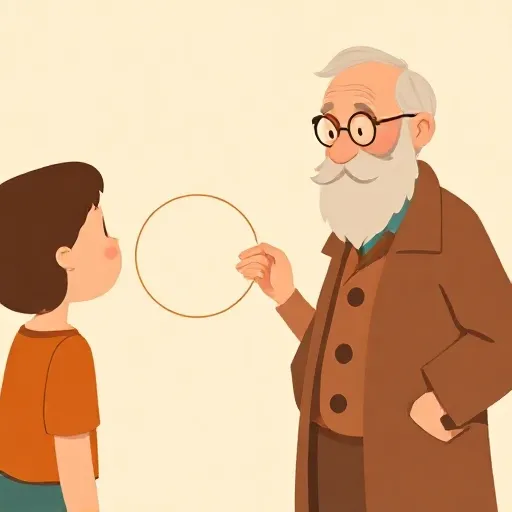
In a university town called Graz, around the year 1900, a philosophy professor named Alexius Meinong (1853–1920) walked into his lecture hall and asked his students a strange question: “Is a round square round?” Most of us would say there is no such thing as a round square. But if nothing is a round square, can a round square have any properties at all? Meinong argued that it does. He claimed that the round square really is round — and really is a square — even though it cannot possibly exist. That puzzle leads straight into one of the boldest ideas in philosophy: that the things you think about don’t have to be real.
Meinong was a careful, music‑loving professor who had been nearly blind from childhood, yet he built Austria’s first psychological laboratory and spent his career dissecting how the mind works. What made him famous was his theory of objects (Gegenstandstheorie), a science of absolutely everything you can direct your mind toward. That includes chairs and stars, but also golden mountains, the number seven, unicorns, and impossible shapes. Whether an object exists or not, for Meinong it is still an object — something you can think about, describe, and argue over.
So-Being vs. Being: Why a Golden Mountain Is Golden

To make sense of all these objects, Meinong drew a sharp line between two things. An object’s so-being is its nature — the properties it has, what it is like. An object’s being is whether it actually exists or happens in the world. His most famous claim is the principle of independence: an object’s so-being does not depend on its being. The golden mountain is golden and is a mountain, whether or not there is one in reality. The round square is round and a square, even if that is impossible. You can say perfectly true things about its so-being without ever claiming it exists.
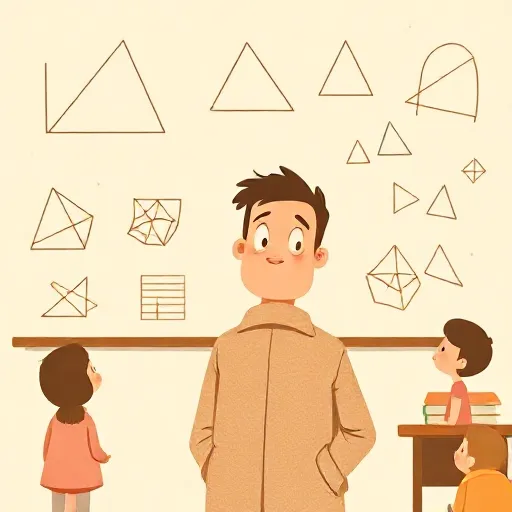
This leads to a second principle. Meinong said that “the pure object stands beyond being and non‑being.” He called this outside-being (Außersein). Every object you can think about — a dragon, a perfect pizza, a biangle — is already an object in this sense, before you even decide whether it is real or not. Out of this toolbox he built a whole map of objects. Some, like your own desk, are completely determined: for every property, they either have it or they don’t. But many objects we think about are incomplete. “The triangle as such” has three angles and three sides, yet it is not colored, not heavy, not drawn in any particular place. You can reason about triangles without having a complete one in front of you precisely because the incomplete object lacks those extra determinations. Incomplete objects also let us talk about possibility: the idea of a fair die that hasn’t been thrown yet is incomplete enough to make sense of the chance that it will show a three.
How Your Mind Plays Pretend: Assumptions and Fantasy
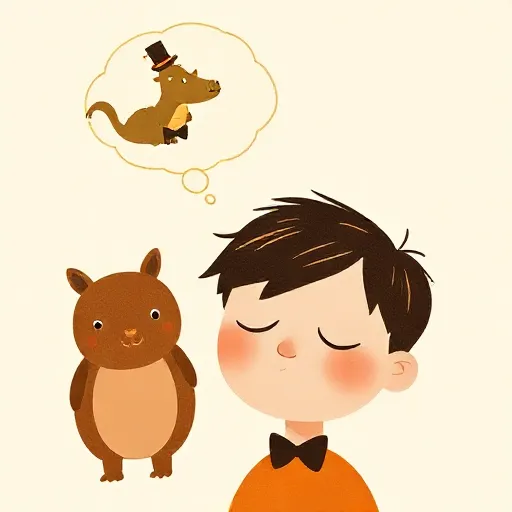
Meinong saw that a mind can do much more than believe facts. He sorted mental acts — representing, judging, feeling, desiring — and then split them into a pair that changes everything: serious experiences and fantasy experiences. A serious judgement is when you are convinced something is true (you believe your chair is brown). A fantasy judgement is when you merely entertain a thought without any conviction; Meinong called this an assumption (Annahme). When you read “the troll guarded the bridge,” you don’t actually believe in trolls — you assume the thought. The same goes for feelings: your heart may race during a scary movie, but your fear is a fantasy feeling, not the real‑life terror of being chased.
Assumptions give our minds an extraordinary power. Meinong proposed a principle of unrestricted freedom of assumption: you can assume anything — any object, any state of affairs, even impossible ones. You can assume that squares are round, that a biangle exists, that gravity is purple. Of course, once you assume several things together, logical rules still apply (you cannot consistently assume a biangle has exactly two angles and also has three). But the raw freedom to entertain ideas is what lets us write stories, plan the future, and do thought experiments.
Bertrand Russell Pushes Back: Logic Says No

Not everyone was happy. The British philosopher Bertrand Russell (1872–1970) argued that Meinong’s world of beingless objects leads straight into contradictions. Take the round square. If it really is round and really is square, then the same thing is both round and not‑round — and logic demands that nothing can be both true and false at the same time. Russell also worried about objects like “the existent golden mountain.” According to Meinong’s characterization principle, that object has the property of being existent — so it seems to exist, yet it doesn’t. That looks like a mess.
Russell’s alternative was to deny that descriptions like “the round square” point to any object at all. In his famous 1905 essay On Denoting, he argued that when we say “The present king of France is bald,” we are not naming a mysterious non‑existent king. We are really saying something like, “There is exactly one person who is now king of France, and that person is bald” — and since there is no such person, the whole claim is simply false. No spooky objects needed.
Meinong was not defenseless. He replied that impossible objects don’t obey the law of non‑contradiction in the usual way. He drew a line between two kinds of negation: narrow, predicate negation (“the round square is non‑round”) and wide, sentence negation (“it is not the case that the round square is round”). The round square, he said, is round and non‑round, but he could still deny that it is both round and not‑round in the sentence sense. As for “the existent golden mountain,” Meinong insisted that “being existent” is simply a property of its so‑being, not the same as actually existing. The object has that property written into its description, but that doesn’t make it pop into reality.
Many later logicians found that Meinong’s ideas, once tidied up, actually solve problems that Russell’s approach cannot. For example, when we say “Meinong believed that the round square is round,” that sentence seems true — but Russell’s theory would treat it as false because there is no round square. The debate never really ended; it quietly shaped modern logic, language theory, and the study of fictional characters.
Why It Still Matters: From Superheroes to Science

You might think a round square is just a funny puzzle. But the question behind it appears every day. When you say “Sherlock Holmes lives at 221B Baker Street,” you aren’t lying — but Holmes never existed. When a mathematician talks about the square root of a negative number, they treat it as a real object that helps solve equations, even though it’s “impossible” in ordinary arithmetic. When you plan your weekend, you think about events and feelings that don’t exist yet. All of these cases work because our minds can reach beyond what is real, and Meinong’s theory of objects was one of the first serious attempts to explain how.
He didn’t convince everyone, and philosophers still argue about whether non‑existent objects should be taken so seriously. But by insisting that what we can think about is every bit as important as what actually is, Meinong gave us a way to talk about dragons, numbers, future choices, and even nicely round squares. The next time you dream up a story or imagine something impossible, you’re following a path that a half‑blind professor in Graz cleared more than a century ago.
Think about it
- If you write a story about a city that doesn’t exist, is that city an object with properties? Does it matter whether anyone ever reads your story?
- Can a number like “the biggest number” be an object, even though it’s impossible? What does your answer say about how imagination works?
- If a scientist could predict every thought you’ll ever have, would the things you imagine still count as “objects” in Meinong’s sense?