
Why There's No Such Thing as a Golden Mountain
The Boy Who Wanted Absolute Certainty

In 1883, eleven-year-old Bertrand Russell (1872–1970) sat down with his older brother Frank and received his first geometry lesson. For the shy, intensely curious boy, it felt like stepping into a new world. From a handful of simple starting points, you could build proofs that had to be true—no guessing, no fumbling in the dark. That hunger for absolute certainty never left him. He grew up to become one of the most famous philosophers of the twentieth century, convinced that logic could solve deep puzzles about language, knowledge, and even religion.
Russell’s quest took him to Cambridge University, where he startled the mathematical world by discovering a mind-bending flaw in the foundations of mathematics—the Russell paradox, a snarl in set theory that sent mathematicians scrambling for a fix. He then joined forces with Alfred North Whitehead to attempt a staggering goal: showing that all of mathematics could be reduced to pure logic, a project they called logicism. But Russell never locked himself in an academic tower. He was imprisoned for protesting World War I, he campaigned against nuclear weapons, and he wrote books for ordinary readers that changed how millions thought about knowledge and God. Through it all, his method stayed the same: take a tangled sentence or a cloudy idea, chip away at it with logic, and see what real facts remain.
The Golden Mountain That Wasn’t There

One of Russell’s most dazzling logical tools was his theory of definite descriptions. Imagine someone tells you, “The golden mountain does not exist.” You might think there is a problem: to say the sentence at all, you first have to talk about “the golden mountain” as if it were some kind of thing—yet the whole point is that there is no such thing. For centuries, philosophers twisted themselves into knots over puzzles like this.
Russell’s solution was to look beneath the surface of the sentence. He argued that ordinary language hides the real logical form of what we are saying. The phrase “the golden mountain” is not a name that points to a mysterious, non-existent object. Instead, the whole sentence is shorthand for a complicated claim: “It is not the case that there exists something which is both golden and a mountain.” That claim can be perfectly true without any phantom golden mountain floating anywhere.
Russell used this trick to crack several classic puzzles at once. For instance, if “the present King of France is bald” and “the present King of France is not bald” are both false, how can the law of logic that says either a statement or its opposite must be true hold up? The answer, he showed, is that the negation can take a different scope: you can say “there is no present King of France who is bald” without assuming any king exists. And if someone insists that “Scott” and “the author of Waverley” name the same person, Russell could explain why you can be interested in one without caring about the other: the logical forms are entirely different. By treating phrases like “the golden mountain” as incomplete symbols that mean nothing by themselves, Russell showed how logic can stop language from tricking us.
A World You Build from Tiny Bits of Experience

If language needs careful analysis, Russell thought knowledge needs an even firmer anchor. He became famous for a theory called logical atomism, the idea that the world is made of simple atomic facts—little bundles like a flash of red here, a ringing sound there, or a cat sitting on a mat. These basic facts combine in logical ways to form everything more complex, just as tiny LEGO pieces snap together to make a castle. In Russell’s picture, the most solid facts are the ones you are directly aware of: the sense data that flood your mind right now—the warmth on your skin, the whine of a mosquito, the patch of blue in your vision.
This led Russell to draw one of his most important distinctions: knowledge by acquaintance versus knowledge by description. You have acquaintance with something when you are face-to-face with it in immediate experience—the taste of a strawberry or the ache in your knee. But you know most things only by description. You know “the tallest girl in class” or “the prime minister of Japan” through words, not through direct contact. Russell believed that all our secure knowledge must start from acquaintance; anything we only know by description is built from those direct building blocks, and we should be careful not to imagine we know more than we do.
Russell’s famous supreme maxim of scientific philosophizing captured this attitude: whenever possible, replace something you only guess at with a logical construction from what you actually experience. Instead of saying “there is a solid table,” Russell would say something like “there is a series of visual and tactile sensations that hang together in a certain lawlike way.” The world becomes a little less mysterious—and a lot more honest.
The Teapot That Orbits the Sun
Russell didn’t stop with tables and golden mountains; he turned the same sharp method onto the biggest question many people ever ask—whether God exists. His weapon was a plain idea: the time to believe something is when you have actual evidence for it, not when nobody can disprove it.
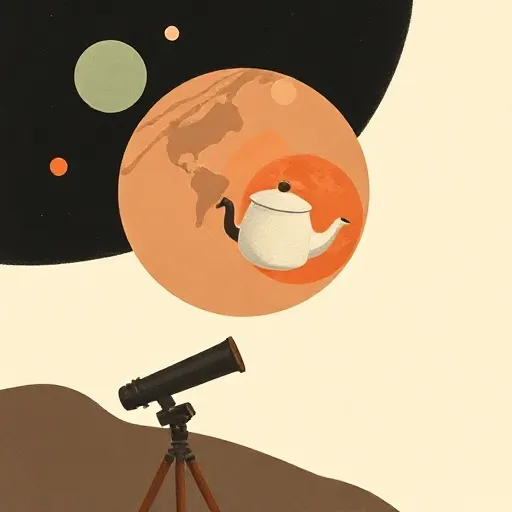
To make the point unforgettably, Russell imagined a tiny china teapot orbiting the sun between Earth and Mars, too small for any telescope to spot. Nobody can prove it isn’t there. Yet if someone insisted you must believe in the teapot because it appears in ancient books and is taught in school, you would laugh—and rightly so. For Russell, the same went for religious claims. The fact that a supernatural being cannot be disproved does not make belief reasonable.
Russell then marched through the traditional arguments for God and dismantled them with patient logic. To the First Cause Argument—the idea that everything must have a cause, so there must be an uncaused God—he replied that if God can exist without a cause, perhaps the universe can too. And if each part of the universe has a cause, it doesn’t follow that the whole universe needs one, just as each human having a mother doesn’t mean the entire human race has a mother. To the Design Argument, he pointed out that Darwin had already shown how living things could become suited to their environments without a designer. And to the Moral Argument that right and wrong must come from God’s commands, Russell borrowed a question from ancient Greece: does God command things because they are good, or are they good because God commands them? In either case, morality doesn’t ultimately depend on God’s say-so.
Russell was no ice-blooded calculator. He freely admitted that religion also works as a way of feeling—a response to fear, loneliness, and the vast cold universe. He himself described three great passions that steered his life: a longing for love, the search for knowledge, and an unbearable pity for the suffering of humankind. That pity drove him to prison twice—once for opposing World War I and again, at the age of 89, for anti-nuclear protests. He never wanted to tear down people’s need for meaning; he wanted to replace blind faith with a courage that faces the world as it actually is.
Why Russell’s Logician’s Eye Still Matters
Russell’s way of thinking changed philosophy forever. His insistence that we examine the hidden logical form of sentences gave birth to much of modern analytic philosophy, the tradition that still dominates English-speaking universities. His bold linking of knowledge to experience forced generations to ask: what can I really know for sure? And his conviction that no authority, sacred text, or tradition gets a free pass from logical scrutiny helped create the skeptical, evidence-loving culture we live in today.
But you don’t need to be a professor to use Russell’s toolkit. The next time you read a politician’s promise that sounds grand but means nothing, you are doing Russell’s work. When a friend insists something is true because “you can’t prove it isn’t,” you can remember the teapot. And whenever you catch a sentence like “the best school in the world” and realize there is no such single thing—just lots of schools with different strengths—you are following the trail Russell blazed.
Russell once wrote that philosophy should teach us how to live in uncertainty without being paralyzed by it. He didn’t promise easy answers. He promised something better: a method of cutting through fog, of asking what the evidence really supports, and of refusing to pretend we know what we do not know. That kind of courage is still rare—and still worth wanting.
Think about it
- If someone tells you there is an invisible unicorn in your house that no test can detect, should you believe it? Why or why not?
- You know a historical figure like Cleopatra only through books and stories. In Russell’s terms, do you have knowledge by acquaintance or knowledge by description? Can that be enough to trust what you “know”?
- Is there anything you know for absolutely certain without using your senses at all? If so, what makes it certain?