Are You Your Body? The Feminist Fight Over a Simple Question
London, 1792: The Mind Fights Back

Mary Wollstonecraft (1759–1797) was furious. All around her in London, she watched middle‑class girls being turned into living dolls. They were squeezed into tight clothes, told to sit quietly, and taught that their only power was to look beautiful enough to catch a husband. Meanwhile, their brothers ran, climbed, and shouted. Wollstonecraft looked at this and saw a trap — the trap of the body.
For her and other early feminists, the solution seemed obvious: focus on the mind, not the body. If people could just see that women had the same rational abilities as men, the body would stop being a cage. As the French thinker François Poullain de la Barre had written back in 1673, “the mind has no sex.” That idea was electrifying. It meant that what made you you was your thinking, not your shape, your skin color, or whether you could have babies.
That way of seeing the world is called dualism — treating the mind and body as two totally separate things, with the mind as the real, important one. Wollstonecraft, along with later writers like Harriet Taylor Mill (1807–1858), bet hard on dualism. Their bodies felt like a problem to be managed: a source of illness, the risk of pregnancy, a thing that had to be decorated and sold in the marriage market. If they could just convince the world that women’s minds were equal, maybe the body’s power would fade.
Becoming a Woman: Simone de Beauvoir’s Big Idea

A century later, the French philosopher Simone de Beauvoir (1908–1986) tore that dualism apart. In her 1949 book The Second Sex, she agreed that women’s bodies were being used against them — but she refused to pretend the body didn’t matter. Instead, she insisted that the self is a body, just not only the one you read about in biology class.
Beauvoir drew a sharp line between the body as an organism — the one described by bones, muscles, and hormones — and the lived body, the body as you actually experience it from the inside. From the moment you’re born, she argued, you don’t simply have a body; you live your body, and you live it inside a particular situation. And for girls, that situation was very different from boys’.
She described how little girls were trained to be passive. While boys were encouraged to climb trees and wrestle, girls were told to treat their whole person like a delicate object. Beauvoir observed that girls are taught they must be as pretty as a picture to be pleasing. The result was what she called an inhibited intentionality — a hesitation, a holding back, a feeling that your body is something to be looked at, not something you do things with.
Puberty only made it worse. Where a boy’s changing body might be a source of pride, a girl’s was often presented to her as something shameful or faintly disgusting. Beauvoir didn’t think any of this was fixed by anatomy. She pointed out that in the animal kingdom you could find males that cared for the young, species that were hermaphroditic, and plenty of ways of living that had nothing to do with human gender roles. “Society alone is the arbiter” of what biological differences mean, she wrote. The famous line “One is not born, but rather becomes, a woman” wasn’t a denial of bodies — it was a claim that what we make of them is up to us.
But Which Body? Race, Class, and the Great Interruption
Beauvoir’s portrait of girlhood was sharp, but it had a blind spot: it assumed a single, universal story. In 1851, long before The Second Sex, a Black woman named Sojourner Truth (1797–1883) had already blown that assumption apart. Speaking to a convention of white women campaigning for the vote, she rolled up her sleeve and demanded, “I have ploughed, and planted, and gathered into barns, and no man could head me! And ain’t I a woman?”
Truth’s body told a completely different story. She had not been coddled into fragility; she had been forced into hard labor. Her back bore the scars of the whip. The idea of being a delicate ornament was a white, middle‑class ideal — it made no sense for a Black enslaved woman whose body was treated as someone else’s property.
This insight grew into what we now call intersectionality, a term coined much later by the legal scholar Kimberlé Crenshaw (born 1959). Intersectionality means that you cannot understand a person’s experience by adding “being a woman” and “being Black” together as if they were separate ingredients. They mix and change each other from the ground up. A Black woman does not experience racism plus sexism; she experiences something shaped by both at once, and the result is not the same as what a white woman or a Black man goes through.
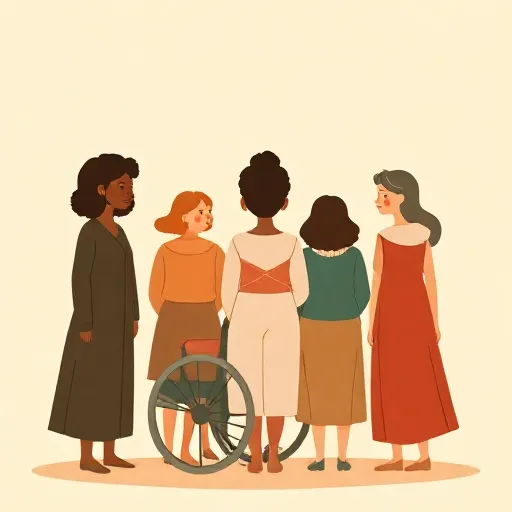
The same is true for disability. Feminist disability theorists like Rosemarie Garland‑Thomson point out that being a “woman” looks very different when you use a wheelchair or live with chronic pain. The norms of beauty and usefulness that shape so many girls’ lives often exclude disabled bodies entirely — or treat them as problems to be fixed. Intersectionality forces philosophy to stop talking about “the” female body and start listening to many bodies.
Is Gender Just an Act? Judith Butler and the Performance

If Beauvoir said you become a woman, the American philosopher Judith Butler (born 1956) asked a wilder question: what if there is no solid “woman” underneath the performance at all? In her book Gender Trouble (1990), Butler introduced the idea of performativity. We usually think gender expresses some deep, natural truth about us. Butler turned that upside down. She argued that gender is something you do, not something you are — and by doing it over and over, you create the illusion that it was always there.
Imagine a baby is born and the midwife says, “It’s a girl!” For Butler, that sentence is not just a report. It is part of the act that makes the baby into a girl. From that moment, people dress her in certain colors, speak to her in a certain tone, expect her to sit and play in certain ways. Again and again, through words and gestures, the label “girl” becomes real. And because everyone keeps repeating these acts, we forget they are acts at all.
Butler does not deny that bodies have weight, flesh, and pain. She calls this process materialisation — the way repeated social performances carve what we count as “natural” bodies. The body does not sit outside language like a silent rock; we can’t even think about it without some cultural frame. But it also exceeds any description we give it. That excess is where change becomes possible.
For Butler, the people best placed to shake the system are those whose bodies don’t fit the binary — trans people, non‑binary people, queer people. Their very existence shows that the link between a particular anatomy and a particular gender is just a norm, and norms can be unravelled. At the same time, Butler warns that performances are risky: dressing in drag can mock a stereotype or reinforce it, and we can’t always control which one happens.
Why Your Throw Matters: The Science of the Lived Body

In 1980, the American philosopher Iris Marion Young (1949–2006) published an essay called “Throwing Like a Girl.” She was not interested in mocking anyone. She wanted to know why, in study after study, women and girls tended to use less of their body’s physical possibility — tucking in their elbows, hesitating, acting as if their own strength might break them.
Young’s answer drew directly on Beauvoir and on a French philosopher named Maurice Merleau‑Ponty. She said women in many cultures learn to live their bodies as objects — things that are looked at, evaluated, and protected, not sources of power. This shapes the most ordinary actions. It isn’t about muscles. It’s about an acquired sense that you should not take up too much space, that you should be careful, that your body is more of a burden than a tool.
Philosophers call this the body image or body schema — the way you feel your own shape and possibilities from the inside. It is not a photograph in your head; it is more like a felt map that guides every movement. And that map is partly drawn by other people’s eyes. The philosopher Linda Martín Alcoff shows how the same thing happens with race. Your nose, your hair, the color of your skin — these features become loaded with social meanings that you feel in your bones, even if no one says a word aloud. A face can feel “wrong” because it does not match the pictures of ambition or beauty you have learned to recognize.
This is why many feminists now talk about the bodily imaginary — the web of images, stories, and feelings that coat certain bodies in shame, pride, or invisibility. The good news is that imaginaries can change. When an author lovingly describes a body that the world has ignored or despised, they are not just being kind — they are rewiring a shared way of seeing.
So What? Redrawing the Map of the Body
These old philosophical fights are not dusty museum pieces. They are playing out in your school hallway, your social media feed, and the laws your country writes. When you feel that your body is “wrong” — too big, too dark, too weak, too hairy — you are living inside a story that was built by other people. And the question feminists have been asking for centuries is: can we rewrite it?
Beauvoir wanted to change the situation so that girls would not have to hate their own skin. Intersectional thinkers demanded that the story make room for every kind of body, not just the ones that already held power. Butler argued that even the categories “male” and “female” were shakier than they looked. Young showed that something as small as the way you throw a ball could reveal an entire invisible training in shame.
Philosophers today talk about the ethics of embodiment — the question of what we owe one another as vulnerable, flesh‑and‑blood creatures. Rosemarie Garland‑Thomson uses the word misfitting to describe what happens when a body and its world don’t align: a wheelchair user on a staircase, a tall girl in a desk built for someone else, a pregnant teenager in a school uniform policy. Those misfits are not just inconveniences; they expose who the world was designed for and who it forgot.
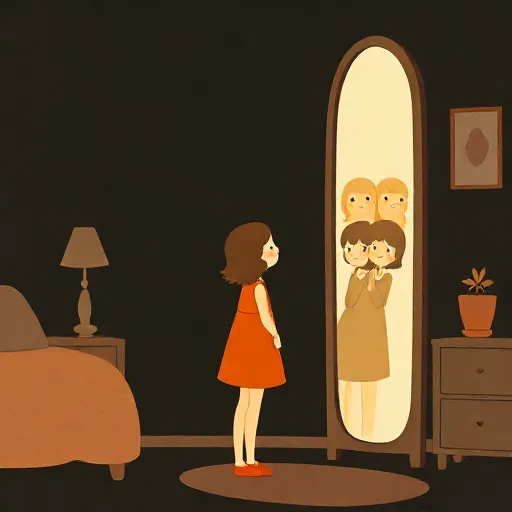
Recognizing that bodies are shaped by norms — and that those norms are not natural facts — doesn’t mean you can simply float free of your body. It means you can start asking better questions. Why is this shape praised and that one hidden? Who decided that a real man walks a certain way, or that a real woman smiles softly? And what would it take to look at your own reflection and see not a problem to be solved, but a self to be known?
Think about it
- If you woke up tomorrow in a completely different body, would “you” still be the same person? What would have to stay the same for you to remain you?
- A boy and a girl both throw a ball. If their throws look different, how could you investigate whether the difference comes from biology or from the way they were raised?
- When you post a photo of yourself online, are you showing who you really are, or are you performing a version of yourself? Is there a difference?