Can Words and Ideas Really Fight for Survival?
A Struggle for Life Among Words
Picture a new slang word spreading through your school. At first only a couple of kids use it. But it catches on—maybe because it’s short, funny, or fills a gap no other word quite covers. Soon everyone’s saying it, while older words that mean the same thing quietly fade away. The winning word didn’t plan its success, but it behaved almost like a living thing fighting to survive.
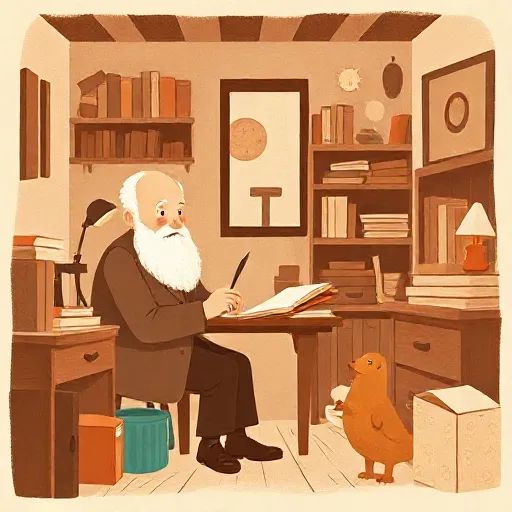
Charles Darwin, the 19th-century naturalist, noticed a similar pattern in languages. In his book The Descent of Man (1871), he agreed with the scholar Max Müller that a “struggle for life” goes on among words. Shorter, easier forms constantly gain the upper hand, Müller said, because they are simpler to say and remember. Darwin insisted this was no mere metaphor. He called it natural selection—the same process that, he argued, shapes the bodies and behaviors of plants and animals.
Many people think natural selection requires genes and DNA. But Darwin’s core idea is actually more abstract. For natural selection to happen, you only need three ingredients: variation (some things are different from others), heritability (offspring resemble their parents in some way), and competition (some variants help their bearers survive or reproduce better than others). The mechanism doesn’t specify why offspring resemble parents—it could be genes, learning, or something else. Darwin himself realized this means natural selection can act on things other than organisms. Words, for example, are learned from speakers around you, and those that are easier or more useful tend to multiply. That is, he said, genuine natural selection.
Memes: Ideas as Replicators
In 1976, biologist Richard Dawkins pushed the analogy a big step further. He coined the term meme for any cultural unit that spreads by imitation: tunes, catch-phrases, fashions, ways of making pots. Just as genes replicate themselves through reproduction, Dawkins argued, memes leap from mind to mind by being copied. A catchy song that lodges in your brain, or a clever idea that you can’t stop telling friends, is a meme that has succeeded in “infecting” you.
Dawkins focused on the idea of a replicator—a unit that makes high-fidelity copies of itself. In biology, genes are the replicators. In culture, memes play that role. They vary (some songs are catchier than others), they are inherited by social learning, and those that are better at getting copied spread more widely. A simple, elegant scientific hypothesis might spread through a research community while a clumsy one dies out. From the meme’s-eye view, the ideas themselves are competing, using human minds as hosts.
This view offers a strong, clean analogy between biological and cultural change. If it works, we could borrow many tools from evolutionary biology—like mathematical models of population genetics—to explain why certain beliefs, technologies, or fads succeed and others vanish. And it draws attention to a striking fact: cultural traits, like organisms, often seem exquisitely well-fitted to their “environments.” A well-designed cooking pot or a persuasive political slogan looks almost as if it had been crafted by selection.
Why Memes Might Not Work
Many researchers, though, think the meme idea is too simple. They point out three serious problems.
First, copying fidelity is low. When you hear someone sing a song and then try to sing it yourself, you’ll likely change it a little—maybe the pitch, rhythm, or even some words. With genes, molecular machinery copies DNA with extreme accuracy. Cultural transmission is far messier. If you taste a friend’s Victoria sponge and then bake one from memory, you’ll probably produce something similar but not identical; your recipe might miss an ingredient or alter the proportions. Real cultural learning often involves guessing and reconstruction, not faithful duplication.
Second, we often reconstruct rather than copy. Suppose you already know how to make a good dal because you grew up cooking Indian food. When you taste a new dal at a friend’s house, you don’t magically extract their precise recipe. Instead, your own existing knowledge fills in the gaps. The dish you end up making resembles theirs because both of you share a background of familiar ingredients and methods. Anthropologist Dan Sperber calls this cultural attraction. Shared patterns of thought act like dimples on a board—marbles rolling across it tend to settle into the same dimples without anyone precisely imitating a previous marble. So stable cultural forms can appear even without literal copying.
Third, ideas don’t come in neat, independent chunks like genes. A belief in God is tangled up with beliefs about forgiveness, love, and other concepts. You can’t isolate a single “God gene”—or a “God meme”—because ideas form webs. And you rarely inherit an idea from just one source. Your religious outlook might be shaped by parents, friends, a charismatic speaker, and a book. In genetics, we can trace a new gene copy back to a single parent gene. In culture, traits often have multiple fuzzy “parents,” making family trees hard to draw.
These worries don’t prove culture can’t evolve at all, but they suggest the strict meme-replicator model may not be the best way to understand it.
A Looser Story: Dual-Inheritance Theory
Instead of the rigid meme approach, many researchers use a framework called dual-inheritance theory, developed by Robert Boyd and Peter Richerson in the 1980s. This approach doesn’t insist that culture works exactly like genes. It simply asks: how does the fact that we learn from others affect the way our species evolves? It builds models where cultural traits spread through populations based on realistic learning rules.
Two important rules are prestige bias and conformist bias. Prestige bias means copying successful or admired individuals. If you move to a new school and notice that the most popular kid wears a certain style, you might adopt it too—not because you know it’s “fit,” but because success seems contagious. Conformist bias means an exaggerated tendency to do what most others do. When you’re at a potluck and everyone avoids a weird-looking dish, you probably avoid it too, even if you know nothing about it. These learning shortcuts help groups hold onto useful information.
But can these sloppy processes still produce cumulative culture—the ability to build better tools, stories, and systems over many generations, like a ratchet that clicks forward and resists slipping back? Traditional thinking suggested you need high-fidelity copying for that. However, mathematical models by Joe Henrich and Boyd showed something surprising. Even when individuals are poor at copying exactly, strong conformist bias at the group level can preserve good ideas across generations. If most people tend to stick with the majority view, the population as a whole can retain a useful innovation long enough for someone to improve it later. So cumulative culture is possible without meme-like replication.
This doesn’t mean cultural evolution produces perfect adaptations. Just as genetic evolution can accumulate neutral or even harmful traits due to chance or linked genes, cultural evolution can spread fads that aren’t particularly useful. But the key point is that a looser, population-level analogy can still generate powerful explanations of how human groups change over time.
Why This Matters for You
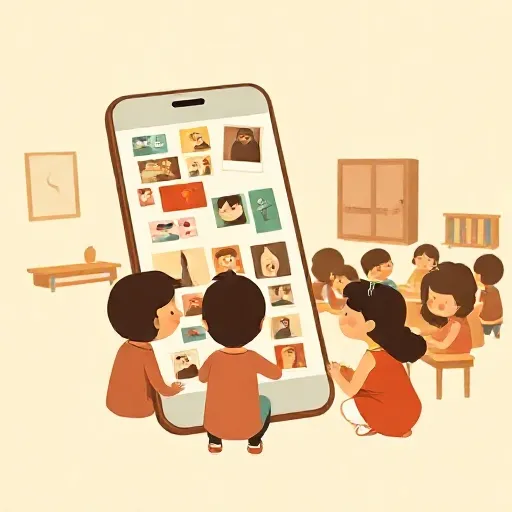
So, does culture really evolve? The debate isn’t just about words. It helps explain something unique about us: why humans, unlike any other animal, build ever-more-complex tools, art, and knowledge systems. Chimpanzees use sticks to fish for termites, but they never refine that stick over many generations into a multipart fishing kit. Our ability to learn from others—and to selectively copy the most successful variations—allows ideas to accumulate, resulting in smartphones, symphonies, and science.
Next time a dance craze sweeps your school or a catchphrase pops up everywhere, you’re watching the process: variation (different versions of the phrase), competition (some versions are funnier or catchier), and inheritance (you pick it up from others). But unlike a virus, ideas change as they move, shaped by the minds they pass through. Are they truly evolving by natural selection, or is something else going on? The answer affects how we understand creativity, free choice, and even what counts as “evolution” in the first place. Philosophers and scientists are still hard at work trying to decide just how far the analogy can be pushed.
Think about it
- If a slang word spreads through your school because it’s short and funny, is that natural selection? Or are people just choosing to use it for their own reasons?
- Imagine you learn to bake by watching three different relatives. Can you trace your recipe back to a single “parent” idea, or is it a blend? Does that matter for understanding how the recipe evolved?
- Bowerbirds collect blue objects to decorate their nests, and this behavior can change over time. Does that count as cultural evolution? Why or why not?