Why Did Darwin’s Idea Terrify Everyone? The Fight Over Evolution
The Mystery of Mysteries
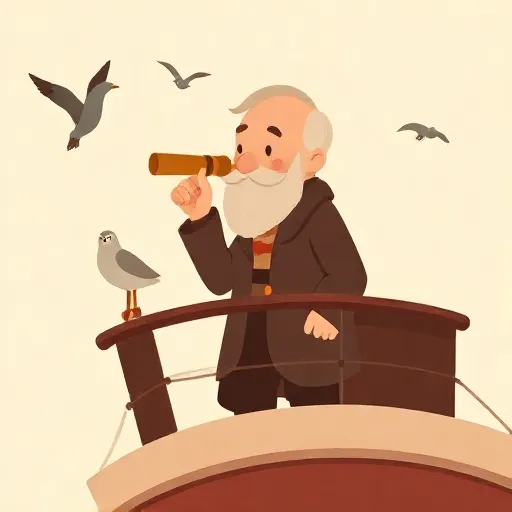
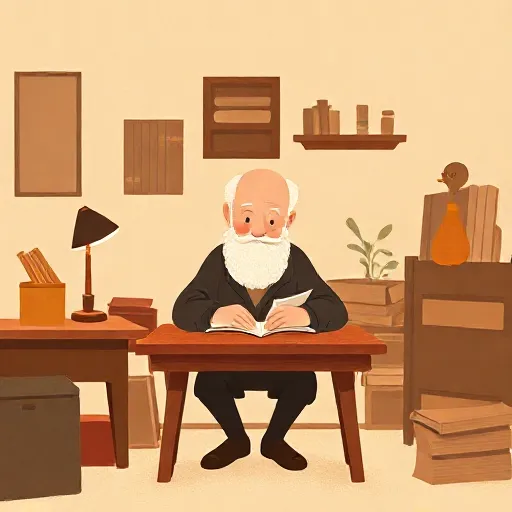
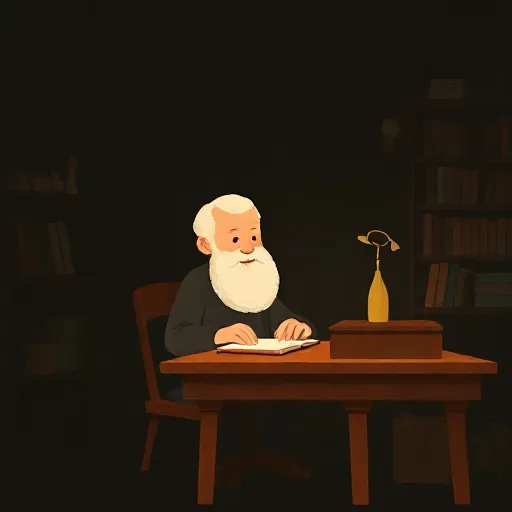
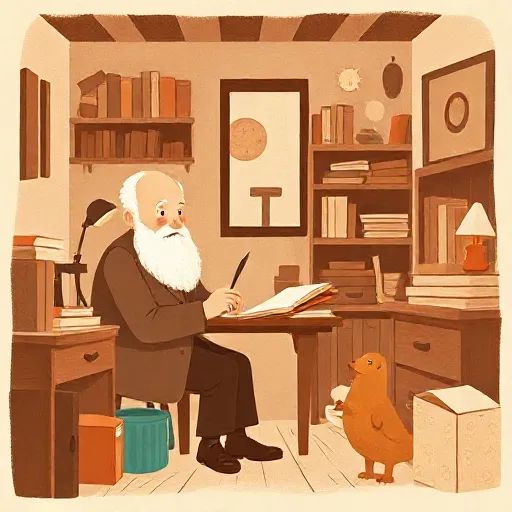
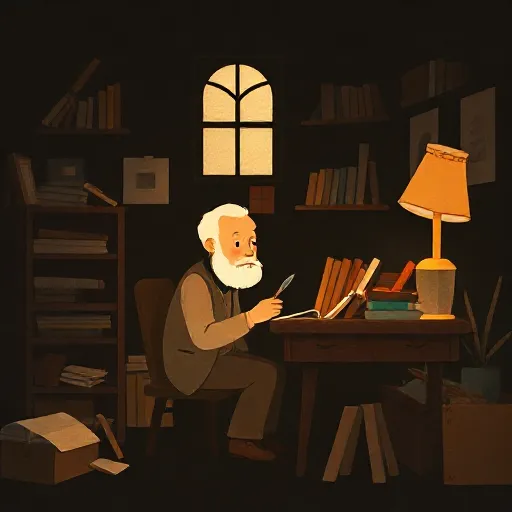
In March 1837, a young Charles Darwin (1809–1882) was alone in his London study, scratching notes into a little brown notebook. He was reading a book by the mathematician Charles Babbage, and inside it he found a letter from one of his heroes, the astronomer John Herschel. Herschel called the origin of new species “that mystery of mysteries.” He didn’t just want to describe it — he demanded a natural, testable cause. Darwin underlined the phrase “intermediate causes” and wrote a single word next to it: Hurrah.
At that moment, Darwin already knew he had a secret. During a five-year voyage around the world on H.M.S. Beagle, he had collected thousands of specimens and filled notebook after notebook with observations. He had seen fossils of giant extinct sloths in South America, finches with wildly different beaks on the Galapagos Islands, and plants and animals that seemed to shift into new forms as you moved across a landscape. The patterns, he was convinced, could only be explained if species changed over time. But how? He needed a theory that met Herschel’s challenge — a cause that was happening right now, not a miracle.
Darwin’s Big Idea: The Engine of Life
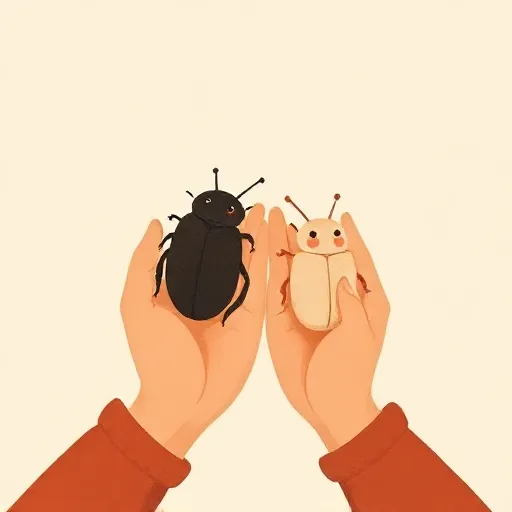
Darwin’s answer was a simple chain of reasoning. Every group of living things, he noticed, shows variation — offspring are never exact copies. In each generation, far more are born than can possibly survive. Resources are limited, so a struggle for existence is unavoidable. If some small variation gives an individual even a tiny edge — a slightly sharper beak, a little more speed — that individual is more likely to survive and leave offspring. Since offspring tend to inherit those variations, the helpful ones will become more common over time. Darwin called this process natural selection.
The theory had no need for a divine hand guiding it. It worked through causes that could be observed and measured. But even Darwin’s closest scientific allies bristled. John Herschel privately called it “the law of higgledy-piggledy,” because the theory seemed to rely so heavily on chance. And that was just the beginning of the trouble.
The Law of Higgledy-Piggledy: Chance in Evolution
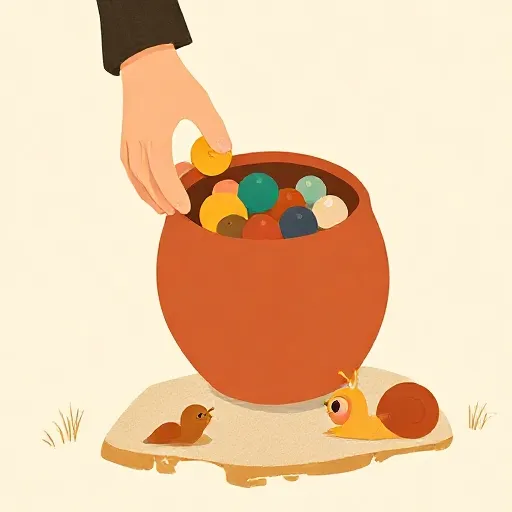
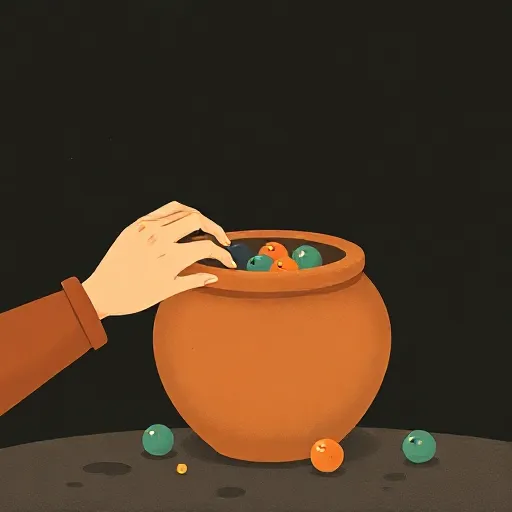
If helpful variations appear by accident — not because the organism needs them — then chance sits at the heart of evolution. Darwin didn’t claim chance caused the variation; he only said we don’t know the cause, but the effect is still a roll of the dice. Later, in the 20th century, biologists built mathematical models that treat evolution as a statistical process. The statement “the better-adapted organism will probably leave more offspring” is exactly the kind of soft, probabilistic claim that made Herschel squirm.
Today, the role of chance is hotter than ever. One modern camp, the neutralists, argues that most DNA changes don’t affect fitness at all — they drift randomly through a population. In small groups, this genetic drift can even overpower natural selection. That’s a genuine threat to the idea that selection is the main engine of evolutionary change. Darwinians reply that drift may sculpt some details, but the big patterns — beaks, wings, eyes — are carved by selection.
Is Nature Really Designing Things? The Problem of Purpose
Darwin once wrote that natural selection works solely for the good of each being. That sounds like a master planner at work. Even today, biologists say a trait is an adaptation because it helps the organism survive or reproduce. But when you say “the guppy has red spots because they attract mates and are invisible to the local prawn predator,” you seem to be giving a reason for the sake of the outcome — and that looks very much like teleological explanation, an explanation in terms of goals or purposes.
Some philosophers argue this is only appearance: selection simply favors whatever works; the “goal” is just a metaphor. Others insist that Darwinian explanations are genuinely teleological because the trait’s value — its benefit — does real causal work by explaining why it persists while alternatives vanish. This debate matters because it touches whether life can be understood purely mechanically. Darwin’s own mentor, the geologist Charles Lyell, and his American friend Asa Gray both tried to keep God in the process by imagining that variations were guided. Darwin refused. The variation, he said, is unrelated to need; selection does the sorting. Nature doesn’t care, but it produces spectacular results anyway.
What Is a Species, Anyway? Darwin’s Radical Answer
Before Darwin, most naturalists believed species had hard boundaries — a fox is one fixed kind, a dog another. Lyell said species have “fixed limits” beyond which they could never change. Darwin flipped this. For him, species were simply the current snapshot of a constantly shifting river. A variety today, more stable, becomes a subspecies tomorrow, and eventually a new species. He said, with some pleasure, that we should treat species the way we treat genera: convenient labels, not eternal truths.
This touched off a war that still rages. In the 20th century, the biologist Ernst Mayr defined a species as a group of organisms that can actually or potentially interbreed in nature — the biological species concept. That made species real in a new way: not fixed archetypes, but historical and reproductive units. Yet other biologists respond with dozens of competing concepts. Are species individuals, like branches on a family tree, or just useful categories? There’s no sign of a truce, and Darwin himself would probably recognize both sides of the fight.
Why Do We Help Strangers? Darwin’s Struggle with Morality
Darwin couldn’t avoid one final puzzle: how does natural selection explain kindness? In a struggle for existence, selfless behavior should be weeded out. Yet in his later book The Descent of Man, Darwin suggested that a tribe with many brave and faithful members would beat a tribe of egoists. In other words, groups with cooperative traits might replace groups without them — an early form of group selection.
This is still one of the most explosive ideas in biology. Most neo-Darwinians argue that apparent altruism reduces to kin selection: you help your relatives because they share your genes. But an influential minority, including the late Stephen Jay Gould, insisted that selection can operate on whole species or groups, not just on genes or individuals. The debate doesn’t just shape textbooks — it shapes how we think about human nature. Are we genuinely generous, or secretly selfish? Darwinism gives a stage for that question, but it doesn’t give an easy script.
Why Darwinism Still Matters (And Still Fights)
Two hundred years later, Darwin’s name is still the banner for a way of thinking about life. New ideas — niche construction, developmental bias, epigenetics — claim they require a rebuilt “extended evolutionary synthesis.” Others counter that the core Darwinian logic is flexible enough to absorb them. The terms have changed, but the arguments feel straight out of Darwin’s letters: What counts as selection? How much does chance matter? Are species real? Why does altruism exist?
These aren’t just questions for laboratories. When you wonder whether your choices are free or just the product of ancient drives, you’re wading into the same waters. When you ask if humans have an essence or if we’re just one twig on a giant tree, you’re joining a conversation Darwin started. He never claimed to have the last word; he claimed to have a better way of asking the questions. And that may be the most Darwinian thing of all.
Think about it
- If every trait you have — from your sense of humor to your fear of heights — was shaped by natural selection, does that change how you see yourself?
- Imagine you could restart Earth’s history a million times. Do you think intelligent, self-aware creatures like us would appear each time, or was it a lucky accident?
- If kindness helped your ancestors survive as a group, is it still real kindness, or just a survival trick?