Could a Species Really Turn Into Another? The Long Fight Before Darwin
An Ancient Poem Sparks a 2,000-Year Argument
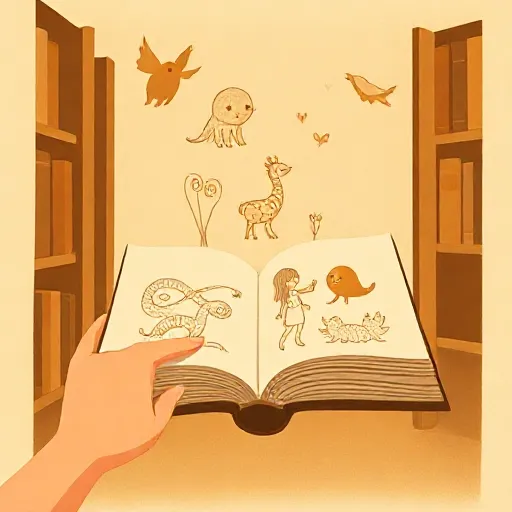
In 1417, an Italian book hunter named Poggio Bracciolini pulled a dusty manuscript from a monastery shelf. It was a poem by the Roman writer Lucretius (99–55 BCE), dead more than 1,400 years. The poem, On the Nature of Things, claimed that everything was made of tiny particles called atoms. Lucretius described a world where living things slowly formed from a chaos of atoms, long ago. Forms that fit their surroundings survived; the rest died out. This was shocking: species might not be fixed forever. They might arise and change through blind, natural processes.
But this idea was even older. In the 5th century BCE, the Greek thinker Empedocles imagined that chance combinations of body parts produced whole creatures, and only the workable ones lasted. The Atomists—followers of Democritus—said that everything, including life, came from atoms moving in empty space. These early speculations set up a question that would burn for millennia: do animal and plant kinds stay the same forever, or can they turn into new ones?
Plato (427–327 BCE) gave a powerful reply. In his dialogue Timaeus, he told of a divine Craftsman—the Demiurge—who shaped the world using perfect, eternal blueprints called Forms. Every species was modeled on one of these Forms. Plato argued that living things could not have arisen by accident. Their intricate design pointed to an intelligent maker. This idea of teleology—purposeful design by an external mind—became a huge obstacle for anyone who later wanted to say that species change on their own.
Aristotle (384–322 BCE), Plato’s student, took a different path. He believed the world was eternal—it had no beginning. He rejected an external designer. Instead, each living thing had an inner soul (psuche) that acted as its form and purpose. This soul was passed down through reproduction, like a baton in a relay race. For Aristotle, a species was not a label we slap onto similar creatures. It was the endless chain of parents and offspring, each passing on the same form. Species could never go extinct or change into something else. But he allowed that surface traits, like fur color, could vary with the environment.
These ancient views planted two deep roots. One said species could emerge by chance. The other insisted they were fixed—by divine design or by an inner eternal principle. For more than a thousand years, the second root grew stronger.
How the Middle Ages Made Species Seem Impossible to Change
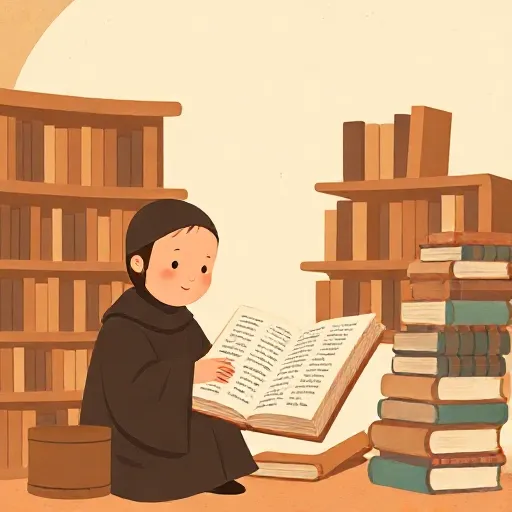
When Aristotle’s writings were translated into Latin in the 12th and 13th centuries, Christian, Jewish, and Islamic thinkers had to weave his ideas together with their own creation stories. Thomas Aquinas (1225–1274) combined Aristotle’s eternal species with the biblical picture of a divine creation. He and others suggested that God might have created the original kinds through primeval seeds—an idea from Augustine (354–430). These seeds held the potential for each species to unfold later, but the core forms could never change. Once a donkey, always a donkey. Even extinction was seen as impossible, because the form would always be passed on through generation.
This view might sound flexible, but by the 1600s a much harder stance took hold. The new mechanical philosophy—the idea that nature works like a giant clock—ran into trouble. How could a machine-like embryo build itself from scratch? René Descartes (1596–1650) tried to explain the origin of the Earth and solar system by natural laws, but he skipped over how life began. Others attempted to fill the gap and failed. So many scientists turned to a startling theory: pre-existence. Every organism that would ever live had already been created, in miniature, at the original beginning of the world.
Some thought these tiny, pre-formed creatures were stored in the female’s ovaries (Ovism). Others believed they were packed inside the male’s sperm (Vermism). In both versions, the new organism did not really develop—it simply unfolded and grew when conditions were right. This view, championed by Nicolas Malebranche (1638–1715), made species permanence absolute. Since every individual had been created at the start, no new species could appear, and none could ever change.
Pre-existence theory struggled with obvious puzzles, though. It could not easily explain hybrids like mules, or why offspring resemble both parents. And it clashed with growing evidence from geology that the Earth’s surface had altered dramatically. By the mid-1700s, a dramatic shift was brewing—and it would come from a man who ran a royal garden in Paris.
Buffon Says a Species Is Not What You Think
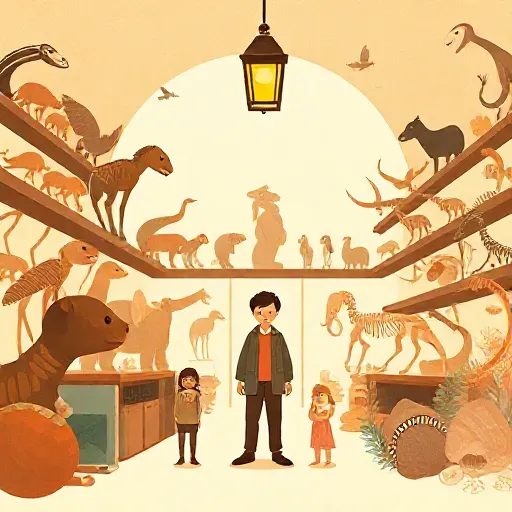
Georges-Louis Leclerc, Comte de Buffon (1707–1788), took over the King’s Garden and Natural History Cabinet in Paris in 1739. He turned it into the greatest center for comparing animal bodies and collecting specimens in Europe. Buffon wanted to ground natural history not in abstract classification but in the concrete, material links between living things. He called this search for physical truth.
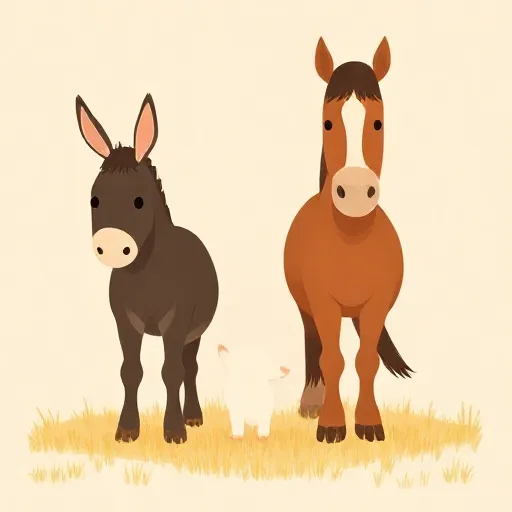
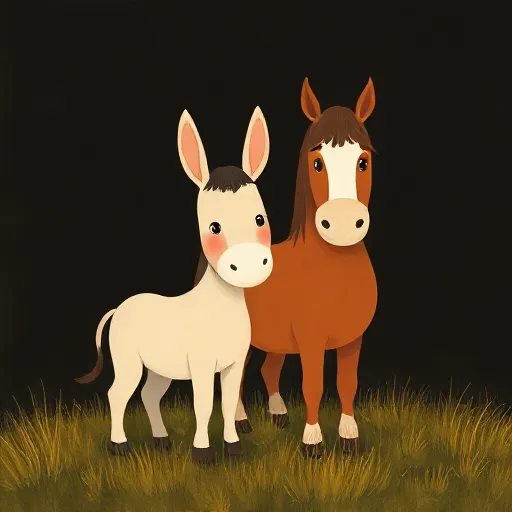
His first target was the word “species.” For centuries, most naturalists had used it as a mental category—a set of similar individuals. Buffon said that was wrong. He gave a bold new definition: a species is the continuous chain of individuals linked by reproduction over time. What makes all dogs one species is not that they look alike (a bulldog and a greyhound look very different) but that they can interbreed and produce fertile offspring. The same barrier separates the horse and the donkey. They look similar, but their offspring are almost always sterile, so they belong to different species.
Buffon explained how the chain kept going with an internal mould (moule intérieur)—an invisible organizing force that shaped organic molecules into the right body plan each generation. The internal mould acted like a recipe, not a miniature body. It built the organism step by step. If something disturbed the mould or the molecules—a change in climate or diet—then the species might slowly degenerate, Buffon’s term for a lasting shift away from the original form. Over many generations, a single parent species could give rise to distinct races and even new species.
Buffon himself often pulled back from saying one species truly turned into another, but he opened the door wide. In his late work The Epochs of Nature (1778), he stretched the age of the Earth to at least 75,000 years (privately, he thought it might be millions) and sketched a history in which life emerged from cooling matter, with simpler forms appearing first. He had placed species in a timeline, and that made genuine transformation thinkable.
Lamarck’s Ladder: Worms Climb Toward Complexity
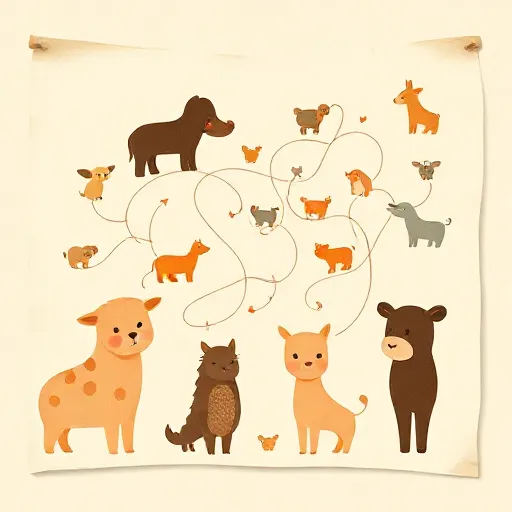
The first full theory of species change over time—what the French called transformism—was built by Jean-Baptiste Lamarck (1744–1829). Lamarck worked at the same Paris museum, in charge of the messy collection of “worms” (invertebrates). As he tried to arrange them, he realized that the simplest animals, like hydras and microscopic infusoria, might be the oldest. More complex ones could have descended from them in a long, branching chain.
Lamarck proposed two main engines of change. The primary force was a built-in tendency for life to climb toward greater complexity, from simple polyps all the way up to mammals. He thought subtle, active fluids—heat and electricity—animated living matter and drove this upward march. The secondary force was the famous inheritance of acquired characteristics. If an animal used an organ a lot, that organ grew stronger, and the change could be passed to offspring. If a part was neglected, it shrank. Giraffes stretching for leaves got longer necks over many generations. But this local adaptation only fine-tuned forms; it did not power the main ascent.
Lamarck’s picture was not a single straight line. His 1809 diagram shows multiple lineages branching apart, with some groups arising from separate origins. He even suggested that humans might have descended from apes through the combined effects of use, disuse, and an internal will. Lamarck’s transformism, laid out in his Zoological Philosophy (1809), was the first coherent, professionally argued account of species change. Yet it met fierce resistance from his colleague Georges Cuvier.
Cuvier’s Four Blueprints and the Great Debate
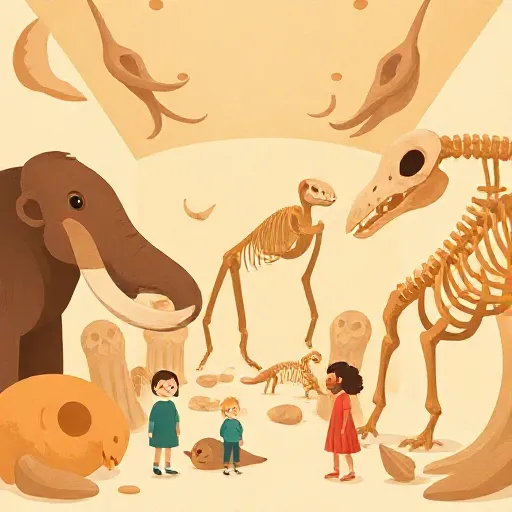
Georges Cuvier (1769–1832) was the master of comparative anatomy. He insisted that every part of an animal fits so tightly with every other part for a specific way of life that you could reconstruct a whole creature from a single bone. He called this the law of the correlation of parts. A carnivore’s teeth, claws, and digestive system are all locked together; you cannot change one piece without breaking the whole machine.
Cuvier also argued that the animal kingdom falls into four fundamentally distinct embranchments (body plans): Vertebrates, Mollusks, Articulates, and Radiates. There was no gradual bridge between a mollusk and a vertebrate. Moreover, fossils clearly showed that whole communities of species had been wiped out by sudden geological revolutions—later called “catastrophes.” New species then appeared, but Cuvier never explained how. He turned extinction from an unthinkable idea into a scientific fact, and he used it as powerful evidence against Lamarck’s gradual transformism.
Cuvier’s great rival was another museum colleague, Étienne Geoffroy Saint-Hilaire (1772–1844). Geoffroy focused on similarities across very different animals—the same bones in a bat’s wing, a whale’s flipper, and a human hand. He called this the unity of type. For Geoffroy, this hinted that all vertebrates shared a common plan, perhaps even a common ancestor. In 1830, the two men clashed in a famous series of public debates. Cuvier’s functional logic won the day in France, and French science remained hostile to transformism for decades.
Across the Channel, the ideas filtered in. The geologist Charles Lyell (1797–1875) spent much of his Principles of Geology attacking Lamarckism, arguing that the fossil record was too patchy to prove progression. In London, the comparative anatomist Richard Owen (1804–1892) developed the concept of an archetype—an ideal blueprint that explained why all vertebrate skeletons share the same basic pattern. Owen introduced the crucial distinction between homology (the “same” part in different creatures) and analogy (parts that serve similar functions but are not structurally the same). His branching diagrams showed how vertebrates could diverge from a common archetypal form over time. Yet Owen, like Cuvier, denied that species actually turned into one another; the archetype was a law of organization, not a real ancestor.
Why This Old Fight Still Echoes in Biology Class
You might think this ancient argument ended with Darwin’s On the Origin of Species in 1859. Darwin certainly transformed the question, proposing natural selection as the engine of change and common descent as the historical fact. But many of the puzzles that swirled around Buffon, Lamarck, and Cuvier never went away.
What exactly is a species? Is it a class defined by a checklist of traits, or a living, changing lineage tied together by reproduction—the Buffonian view? Biologists still debate this “species problem.” The clash between Cuvier’s emphasis on function and Geoffroy’s unity of type echoes in modern discussions of how development constrains evolution (evo-devo). And the tension between seeing life as a chain of progress versus a tree of branching divergence shapes how we picture the history of life.
Even in everyday conversation, you hear echoes. When someone says, “It’s just a theory,” they are stepping into a debate that began centuries before Darwin, when people first asked whether the living world is a fixed creation or a long, slow unfolding. The history you have just read shows that this question was never simple. It took thousands of years, countless specimens, and some very sharp arguments just to make it possible to think that a donkey might, in the immensity of time, turn into a horse.
Think about it
- If you could travel back in time and meet Buffon, what would you show him from today’s biology to defend or challenge his idea of a species as a chain of interbreeding individuals?
- Cuvier believed that animal body parts are so tightly coordinated that you cannot change one without breaking the whole—like a perfectly designed machine. Can you think of a living thing today that seems to break that rule, or a technology that gets better when pieces are gradually tweaked?
- Many people in Lamarck’s time resisted the idea that species could change because they feared it would make life seem meaningless. What makes the idea of a slowly changing world satisfying—or unsettling—to you?