Can Space Really Bend? How Geometry Lost Its Certainty
The Certainty That Broke

In the 1800s a well-known trick proof claimed that every triangle is isosceles — that any triangle must have two equal sides. It began with a simple sketch of a triangle, a couple of angle bisectors, and a perpendicular line. Following the picture, the logic looked watertight. But the reasoning was secretly stealing information from the diagram that the rules of geometry never guaranteed. A point that the picture showed inside the triangle was, in fact, on the outside. The mistake was invisible until you stopped trusting the drawing.
For two thousand years, such trust had felt safe. Euclid’s Elements, written around 300 BCE, was the gold standard of human knowledge. It started from a handful of statements that seemed obviously true — draw a straight line between any two points, all right angles are equal — and built up layer after layer of theorems by careful deduction. Even the skeptical philosopher David Hume (1711–1776) insisted that Euclid’s truths “would for ever retain their certainty and evidence” whether or not a perfect circle ever existed in nature. And Immanuel Kant (1724–1804) argued that our knowledge of geometry was not learned from the senses but was built into the very structure of our minds — a kind of knowing he called synthetic a priori.
Yet one of Euclid’s starting points, the parallel postulate, had long felt less obvious than the others. It said, in effect, that if two lines are crossed by a third, and the inside angles on one side sum to less than two right angles, those two lines will eventually meet on that side. Put more simply: in a flat plane, parallel lines never meet. But why must that be true? That question would start an earthquake.
The Postulate That Wouldn’t Go Away
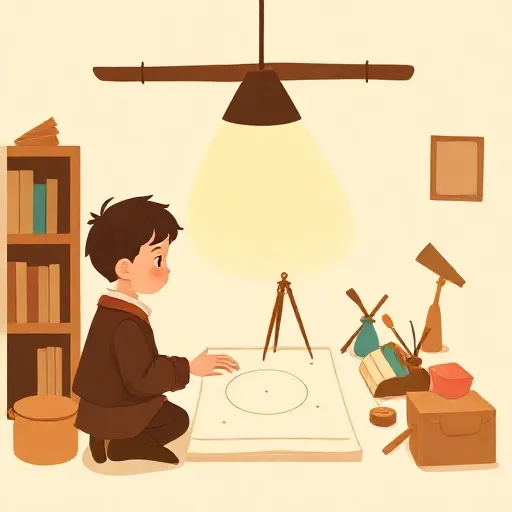
For centuries, some of the finest mathematical minds tried to prove the parallel postulate from Euclid’s simpler axioms. They almost succeeded. John Wallis (1616–1703) showed that if you allowed triangles to be copied at any size, the postulate followed. Others constructed elaborate arguments that always, when examined closely, smuggled in an assumption equivalent to the very thing they were trying to prove.
Georg Klügel examined dozens of these attempts in 1763 and concluded that none worked; the best mathematicians were, in essence, no further ahead than Euclid himself. Then, in the early 1800s, a pair of thinkers decided to see what would happen if the postulate was simply false.
The Hungarian János Bolyai (1802–1860) and the Russian Nicolai Lobachevskii (1792–1856), working independently, replaced Euclid’s assumption with a daring one: through a point not on a given line, there are many lines that never meet it. From that single change they built an entire, consistent geometry. In their world, triangles had angle sums less than 180°, and the familiar theorems of Euclidean space simply did not hold. Lobachevskii even tried to test the shape of real space by measuring giant astronomical triangles — his results were inconclusive, but the door had been kicked open. Geometry was no longer necessarily unique.
Curves in a Flat World: Gauss and Riemann
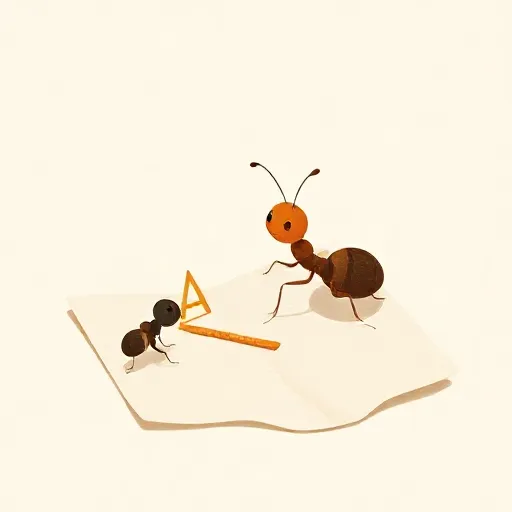
Long before Bolyai and Lobachevskii published, the great Carl Friedrich Gauss (1777–1855) had already been thinking about curved surfaces in a revolutionary way. He discovered that some properties of a surface — most famously its Gaussian curvature — can be detected entirely from within the surface, without ever imagining it embedded in a higher dimension. Imagine you are a tiny ant on a crumpled but unstretched sheet of paper. If you draw a triangle and measure its angles, the sum will be 180° if the paper is flat, more than 180° if it is shaped like a sphere, and less than 180° if it is saddle-shaped. The ant never sees the paper from above, yet it can deduce the surface’s shape.
Gauss opened the door; his student Bernhard Riemann (1826–1866) walked through it and rebuilt the whole house. In an 1854 lecture, Riemann proposed thinking of space as a manifold — roughly, a smooth blob of points that can have any number of dimensions — and equipping it with a flexible rule for measuring distances. Depending on that rule, the space could be flat (Euclidean), uniformly curved like a sphere (positive curvature), uniformly saddle-shaped (negative curvature), or something even stranger where curvature changes from point to point. Euclidean geometry was not the necessary shape of reality; it was just one possible choice among infinitely many.
Soon afterwards, Eugenio Beltrami (1835–1900) showed that Lobachevskii’s non-Euclidean geometry was perfectly consistent by mapping it onto the interior of a disk with a cleverly distorted ruler. The last refuge of Euclidean certainty — the worry that non-Euclidean logic was secretly contradictory — collapsed.
The Battle for the Mind
If many geometries were logically possible, what did that do to our knowledge of space? Kant had claimed that we cannot even imagine a non-Euclidean world; the structure of our minds forces space to be Euclidean. Many late-19th-century thinkers agreed and dismissed Lobachevskii’s ideas as unvisualizable nonsense.
The physicist Hermann von Helmholtz (1821–1894) pushed back. He argued that our sense of space comes from moving rigid bodies around and noticing which motions leave shapes unchanged. From that starting point, he showed experimentally why we might expect to find Euclidean geometry — but he also admitted, after a correction from Beltrami, that a non-Euclidean world was just as conceivable and could even be visualized with practice.
Then Henri Poincaré (1854–1912) delivered the most provocative argument of all. He described a giant disc populated by creatures who shrink as they move away from the centre, along with all their rulers and measuring tools, because of a uniform temperature field. The inhabitants would, on their own measurements, discover that their space is hyperbolic — they would say triangles add up to less than 180°. We, standing “outside,” would say the space is really flat but the tools are distorted. According to Poincaré, no experiment can decide who is right. Geometry is not forced upon us by the world; it is a convention we choose for its simplicity and usefulness. We grow up moving in a world where Euclidean motions feel easiest, so our minds settle on that convention. Another species, shaped by a different environment, might settle on a different one.
Critics like Federigo Enriques (1871–1946) objected that if a distortion is exactly the same for all possible measurements and can never be varied, it is more reasonable to say that space itself is curved. The debate was alive and intense — and it still echoes today.
Why Your Video Game World Is Not Flat

The revolution that began with Gauss and Riemann did not stay inside lecture halls. In the early 20th century, David Hilbert (1862–1943) developed geometry as an abstract game of symbols, where diagrams and intuitions were replaced by purely logical rules. That move helped give birth to modern mathematics and computer science. Around the same time, Albert Einstein’s general theory of relativity used Riemannian geometry to show that gravity is the curvature of space‑time — real, physical space is non‑Euclidean.
So what does all this mean for you? It means that the geometry you feel — the flat‑earth intuition in your head when you walk across a room — is not a window onto absolute truth. It is one excellent model among many, shaped by your brain and your daily experience. Virtual‑reality worlds can be programmed with hyperbolic or spherical geometry, where “straight ahead” curves back on itself; your mind can adapt. The 2,000‑year reign of Euclid as the only possible geometry taught us something deeper: the most obvious “facts” about reality can turn out to be choices — and understanding that is the beginning of real philosophy.
Think about it
- If you lived on a huge sphere, would you say that space is curved or that the rulers are straight and you just keep coming back to your starting point? How could you test your belief?
- Imagine a civilisation that grew up in a saddle-shaped room. Do they “discover” a different geometry than you, or do they simply agree on a different convention? Could both sides be right?
- Why do you think humans seem to have a built‑in feeling that space is flat? If you had been born in a strongly curved environment, would it feel just as natural?