What If Triangles Didn't Add Up to 180°?
The One Annoying Postulate
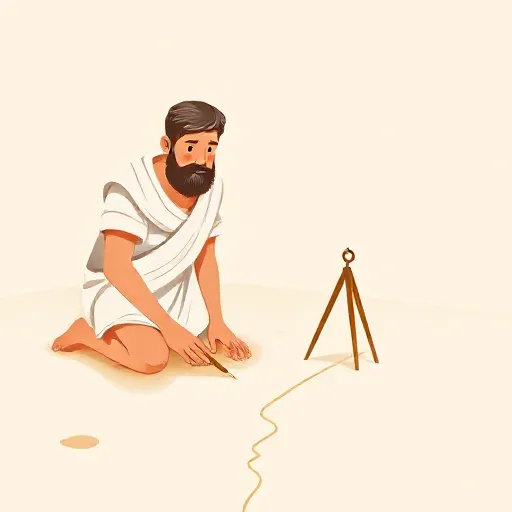
It is 300 BCE, and a man named Euclid is putting together all the geometry known to the ancient Greeks. He writes a book called the Elements, which will become the most successful textbook of all time. Euclid begins with five foundational rules, or postulates—things you are allowed to assume without proving them. The first four are short and easy: you can draw a straight line between any two points; you can extend a line forever; you can draw a circle with any center and radius; all right angles are equal.
But the fifth postulate is different. It says something like: If a straight line crosses two other straight lines, and the interior angles on one side add up to less than two right angles, then those two lines, if extended, will eventually meet on that side.
For over two thousand years, mathematicians tried to prove that the fifth postulate wasn’t really a separate rule—that it could be deduced from the other four. They tried and failed. Some even believed it was a necessary truth about space, like “the whole is greater than the part.” Yet look at railroad tracks: they seem parallel, never meeting. The fifth postulate says they would meet if they leaned just a little, even if that meeting point is unimaginably far away. That didn’t feel obvious.
The Outsider Who Dared to Disagree

By the 1820s, a young Russian mathematician named Nikolai Lobachevsky (1793–1856) decided to try something no one had seriously attempted before: what if the fifth postulate is false? Not just unproven, but actually false. He imagined a world where, through a point not on a given line, you could draw infinitely many straight lines that never meet the original—not just one parallel, but a whole fan of them.
Lobachevsky didn’t just daydream. He carefully built a whole new geometry using this idea, proving theorem after theorem. He called it “imaginary geometry.” Others, like János Bolyai (1802–1860) and Carl Friedrich Gauss (1777–1855), had similar thoughts around the same time, but Lobachevsky published first. So we call it Lobachevskian geometry.
In this new space, the old parallel rule is gone. For any point and line, there are countless lines through the point that never meet the original. The boundary lines that just barely avoid meeting are called parallels. The angle they make with a perpendicular depends on the distance—the farther the point from the line, the smaller that angle. It never reaches zero.
The World Without Rectangles
Lobachevskian geometry is full of surprises that sound like they belong in a dream. Here are a few:
- The three interior angles of a triangle add up to less than 180 degrees. The larger the triangle, the smaller the total. A huge triangle might have angles summing to only 100°.
- Because the missing angle (the defect) is proportional to area, two triangles with the same angles must have the same size. In ordinary Euclidean geometry, you can enlarge a triangle and keep its angles; here, you can’t. All similar triangles are congruent.
- If you try to make a four-sided shape with three right angles, the fourth angle will always be acute—less than 90°. That means there are no rectangles in Lobachevskian geometry. A perfect right-angled box is impossible.
- The area of triangles has a finite maximum. You can’t inflate a triangle forever; eventually the angles would shrink to nothing.
These facts aren’t mistakes. They follow logically from the axioms Lobachevsky chose. And he even showed that if his geometry contained a contradiction, then ordinary Euclidean geometry would too. So the two geometries are equal in logical standing.
One Geometry or Many? Klein’s Big Idea
Now that mathematicians had at least two different geometries—Euclid’s and Lobachevsky’s—they began to wonder: how many could there be? And what makes a geometry “true”?
Enter Felix Klein (1849–1925). He proposed a fresh way of thinking about geometry altogether. Instead of studying points and lines as fixed things, geometry is the study of properties that remain unchanged when you move figures around in certain ways. Those ways of moving form a group of transformations—like rotations, reflections, or special mappings. For instance, in Euclidean geometry, the distance between two points stays the same no matter how you slide or rotate the whole figure. In projective geometry, not even parallelism is preserved; instead, a more subtle “cross-ratio” of four points remains unchanged.
Klein used this group-theory approach to classify geometries. He showed that Euclidean, Lobachevskian, and a third one called elliptic geometry are all just different groups of transformations acting on a space. In elliptic geometry, every straight line meets every other, and triangle angles sum to more than 180°. Klein demonstrated that you can get each of these metric geometries by focusing on a particular conic section and measuring distance with a special formula.
From this viewpoint, no geometry is more “real” than another. They are different ways of organizing spatial relations. As the French mathematician Henri Poincaré (1854–1912) later said, the truth of Euclid’s geometry is not incompatible with the truth of Lobachevsky’s, because the existence of one group isn’t incompatible with the existence of another.
The Curved Universe and the End of “Obvious” Space
This explosion of geometries shook philosophy. Immanuel Kant (1724–1804) had argued that our knowledge of space must be based on a built-in mental template—an innate form of experience—and that Euclidean geometry was the only possible one. But if alternative geometries are logically consistent, Kant’s claim looked shaky. Space might be something we discover through experiment, not something we know just by thinking.
Around the same time, Bernhard Riemann (1826–1866) pushed the idea of variable curvature: space might be flat in some regions and curved in others. His work would later provide the mathematics for Albert Einstein’s general theory of relativity, which says that gravity is the curvature of spacetime. Suddenly, non-Euclidean geometry wasn’t just a logical game; it was a tool for describing the actual universe.
Poincaré took a more radical stance. He argued that geometry is a convention—a freely chosen framework for making sense of measurements. One group of transformations may be simpler for describing how solid objects behave; that’s why we tend to pick it. But the choice isn’t true or false; it’s practical.
Why It Still Matters: The Shape of Everything
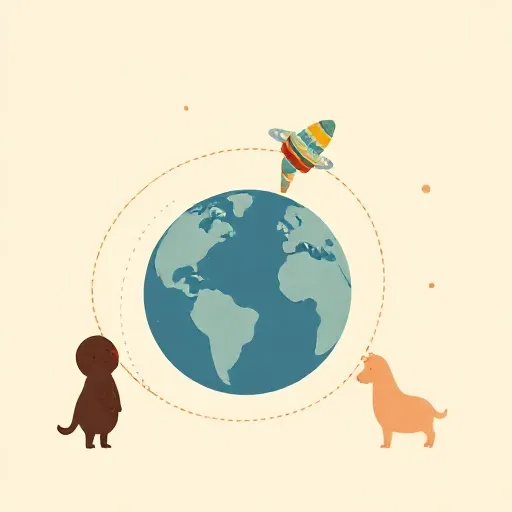
Today, Lobachevskian and Riemannian geometries are everywhere in science. GPS systems must correct for the curvature of spacetime predicted by general relativity. The shape of the whole universe—whether it’s flat, positively curved, or negatively curved like Lobachevsky’s space—is a real scientific question measured with telescopes.
And the idea that we can have multiple consistent, useful geometries shapes everything from video game graphics (impossible spaces) to our understanding of truth itself. Next time you draw a triangle on a piece of paper, remember: you’re working in a flat, Euclidean world. But take that same triangle out into the real, gravitational universe, and the rules might change. The geometry you think is “obvious” is actually a choice—a powerful one we made centuries ago, but not the only one.
If the laws of geometry can change depending on your starting assumptions, what does that say about other “obvious” facts in your life?
Think about it
- If you had grown up in a world where all surfaces were gently curved, would you still think a triangle’s angles should add up to 180°? Why might it feel just as natural to you as flat space does now?
- Poincaré said geometry is a convention, like choosing a language. Could the same be true for numbers or logic? What would it mean for something to be “mathematically true” if we could pick different starting rules?
- If astronomers someday measured the universe and found it to be Lobachevskian, would that change how you think about everyday directions, shapes, or the space you move through—or would it just be a distant fact that doesn’t touch your life?