
Could Geometry Suddenly Contradict Itself? Hilbert vs. Frege
A Monument, a Lecture, and a Bold Idea

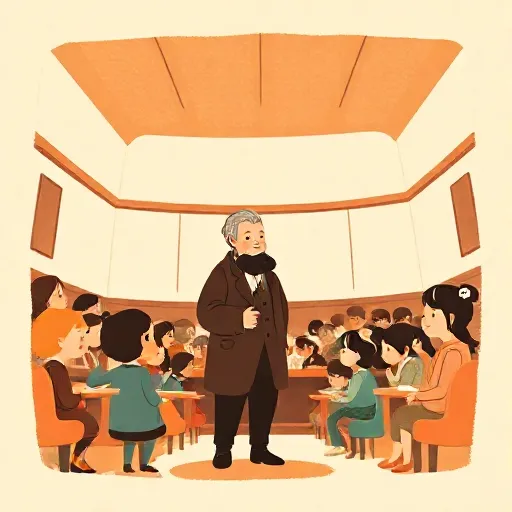
In June 1899, a crowd gathered in the German town of Göttingen. They were there to see a new monument honoring two old giants of math, Carl Friedrich Gauss and Wilhelm Weber. The ceremony included a talk by a rising mathematical star, David Hilbert (1862–1943). He spoke about the foundations of geometry. What he said that day would change how people think about proofs, rules, and what math really is.
Hilbert had been working on a problem that had bothered mathematicians for centuries. Euclid, the ancient Greek, had built geometry out of a handful of starting sentences called axioms — sentences you just assume, like “only one straight line can pass through two points.” Everyone trusted those axioms, but could you ever be sure they didn’t hide a secret contradiction? A contradiction is a pair of claims that can’t both be true at once, like “this shape is a circle” and “this shape has corners.” If the axioms ever let you prove a contradiction, all of geometry would be broken.
Hilbert had a plan. He wanted to prove beyond any doubt that Euclidean geometry was consistent — that no contradiction could ever be proved from its axioms. And he wanted to show that certain axioms were independent, meaning you couldn’t prove one from the others. This wasn’t just about shining old truths; it was about inventing a whole new way to test the safety of mathematical systems.
Swapping “Point” for “Love and Chimney‑Sweep”

Hilbert’s method was startlingly simple. To prove that a set of axioms is consistent, he would reinterpret the words. Instead of letting “point” mean a tiny location in space, he would make “point” stand for a pair of real numbers, like (3, 7). Instead of “line,” he would use a ratio of real numbers. “Lies on” would become a fancy algebraic relation between numbers and ratios. Under this new labeling, each geometric axiom turned into a statement about numbers — and those statements were already known to be true, because mathematicians trusted the arithmetic of real numbers.
So if the geometric axioms hid a contradiction, that contradiction would have to pop up in the number‑theory sentences too. But since the number theory was assumed to be consistent, the geometry must be safe. Consistency was relative: if the background theory of real numbers is consistent, so is Euclidean geometry.
Hilbert saw axioms not as deep truths about a single world, but as empty frames you could fill with different stuff. He once joked to his critic Gottlob Frege that you could use the system: love, law, chimney‑sweep — and then all the theorems of geometry would still hold for those things. The underlying structure, the logical skeleton, was all that mattered. This view later became known as structuralism in math: a theory doesn’t describe a fixed collection of objects; it describes a pattern that many different collections can fit.
Independence worked the same way. To show that one axiom couldn’t be proved from the rest, Hilbert would give an interpretation where all the rest came out true but that one came out false. For example, he famously proved that Euclid’s parallel postulate — “through a point not on a line, exactly one parallel line can be drawn” — was independent of the other axioms. He did it by building a weird non‑Euclidean world inside the real numbers, where your so‑called “point” and “line” behaved properly for the other axioms, but many parallels existed.
Frege’s Shout: You Can’t Just Change the Subject!
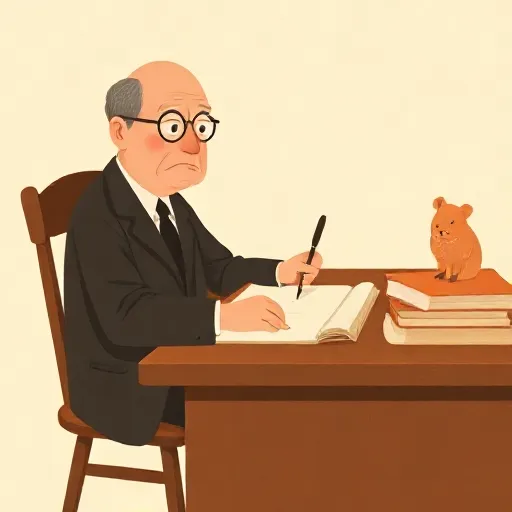
Not everyone was cheering. Gottlob Frege (1848–1925), a meticulous logician, read Hilbert’s work and nearly threw his quill across the room. Frege believed that math was about fixed, real subject matters. Geometry was about actual space and points; arithmetic was about actual numbers. The sentences of a theory expressed thoughts — non‑linguistic meanings — and those thoughts are either true or false of that subject matter. You can’t just flip the meanings of words with a hand wave and still be talking about the same thing.
For Frege, when Hilbert reinterpreted “point” as a pair of numbers, he was simply changing the topic. The consistency of those number‑thoughts says nothing about the consistency of the original geometric thoughts. Imagine someone worried that their friend’s story about a trip to the moon is contradictory. Saying “Look, if we replace ‘moon’ with ‘kitchen’ and ‘rocket’ with ‘bicycle,’ it’s a perfectly normal story” — that doesn’t prove the moon story is safe. The moon story might still be full of nonsense.
Frege also insisted that true axioms don’t need a consistency proof — truth already guarantees no contradiction. But Hilbert didn’t treat axioms as guaranteed truths; they were just the rules you start with. And Frege drew a sharp line: you can’t jump from “this shape of symbols is consistent” to “the objects described really exist.” After all, the sentence “A is an intelligent, omnipresent, omnipotent being” is consistent in Hilbert’s sense, but that doesn’t mean such a being exists.
At bottom, the two men had radically different pictures of math. Frege thought proofs rely partly on the meanings of words like “point” or “number.” If a concept hides a secret complexity — the way “nightmare” secretly contains “dream” — then a proof might turn up only after you analyze that concept into simpler parts. Hilbert’s reinterpretation method ignored all that hidden content, so from Frege’s viewpoint, it simply couldn’t settle real questions of consistency and independence.
What Makes a Proof Work? Form vs. Meaning

To see why this debate still matters, try a tiny example. Consider these two sentences:
Jones had a nightmare.
Jones did not have a dream.
If you treat “nightmare” and “dream” as just empty labels — N and D — the pair is totally consistent. You can easily pick a world where some object is N and not D. But as soon as you know what the words mean, trouble appears. Part of the meaning of “nightmare” is “a disturbing dream.” So the pair is really saying “Jones had a disturbing dream” and “Jones did not have a dream.” That is a contradiction, hidden just beneath the surface.
Hilbert’s method can’t catch this kind of hidden clash because it treats all non‑logical words as interchangeable tiles. Frege’s method, on the other hand, says that the consistency of a set of thoughts depends on the full content of the terms, not just on their surface shape. That’s why, for Frege, no amount of clever relabeling could ever prove that the real geometric axioms are safe.
Historians still argue about exactly how much Frege’s complaint was justified. Some say Frege simply failed to grasp that Hilbert had invented a new, stricter idea of consistency — one that deliberately ignores content to get a crisp mathematical tool. Others think Frege was pointing to a genuine gap: the world of pure form never fully captures the world of meaning. What’s fascinating is that even Frege, near the end of the debate, sketched a method of his own that looked suspiciously like Hilbert’s reinterpretation strategy. He never finished it, leaving us with a puzzle about whether he had changed his mind.
Why It Still Matters: The Game of Rules

Hilbert’s side won the history of math. When today’s mathematicians say a theory is “consistent,” they typically mean what Hilbert meant: there’s no formal contradiction using only the logical shapes of the axioms. Model‑checking software, the artificial languages of logic, and even the way we design computer programs all lean on the idea that you can test safety by swapping symbols for objects in a different domain. Hilbert gave us a tool so powerful it practically built modern logic.
But Frege’s ghost still haunts the classroom. Whenever you learn a new concept — like “force” in physics or “fairness” in a game — you run into the tension. Do the rules alone define it, or is there a deeper meaning you’re trying to catch? When you write an argument for a debate, is it enough that the sentences follow a valid pattern, or do you have to keep checking that the words mean the same thing all the way through? Hilbert and Frege’s clash isn’t just a dusty museum piece; it’s a live question about how thought, language, and the world fit together.
Think about it
- If a computer checked the rules of a game and found no contradiction, would you still worry that the game might be nonsense because of what the pieces are supposed to represent? Why or why not?
- When you and a friend argue about what “being fair” means, are you really just arguing about words, or about something in the world that the words point to?
- Can you invent a set of perfectly consistent sentences that becomes instantly contradictory as soon as you learn what the silly‑sounding terms actually mean? Try it.