Is There a Pure Moment, or Is Everything Already a Trace?
A Boy, a Forbidden Language, and a Big Question

In 1942, in the French colony of Algeria, a twelve-year-old boy named Jacques Derrida (1930–2004) was kicked out of school. The reason? He was Jewish, and the French Vichy government had passed anti-Jewish laws. Around the same time, officials also banned the Berber language, which many Algerians spoke at home. Derrida never forgot those attempts to make a community “pure” by excluding certain people and certain words. He later called the language ban “unforgettable and generalizable.”
When Derrida grew up and became a philosopher, this early experience stayed with him. He spent his life asking: What happens when we try to make something absolutely pure—a language, a secret, a nation, a decision? Is purity even possible? Or is everything already mixed, split, and contaminated by what it tries to keep out? His answers led to some of the most surprising ideas in modern thought.
The Present Is Never Just the Present

Derrida’s big move was to look closely at the most basic thing we all share: the experience of right now. Think about listening to a melody. In any single moment, you hear one note, but you also hold on to the note that just faded and you already expect the next note. The “now” is never simply now—it always contains a little bit of the past and a little bit of the future.
The philosopher Edmund Husserl (1859–1938) had described this “thick” present long before Derrida. Husserl called the memory of the just-past retention, and the anticipation of the just-about-to-come protention. Derrida studied Husserl carefully, but then he pushed further. He noticed that if every experience of the present is built from these two non-present pieces, then nothing is ever fully, purely present to us. There is always a tiny gap inside the moment.
That gap is what Derrida named the trace. A trace is a mark of what is no longer here and also a hint of what is not yet here. The trace is not a thing; it’s more like a movement that splits every “now” from within. Derrida also invented a word to capture this double movement: différance (spelled with an a). In French, différer can mean both “to differ” (to be unlike) and “to defer” (to put off). Différance is the process that produces differences and also delays any final, complete meaning. Because of différance, nothing ever arrives in a pure, self-contained moment.
This idea also applies to auto-affection—the way you relate to yourself. Derrida argued that even hearing yourself silently speak inside your head is not immediate. There must be a tiny hiatus between you-as-speaker and you-as-hearer. He compared it to looking in a mirror: to see yourself, you must be spaced apart from the mirror, and that space makes your reflection both you and not-you. So even your own inner life is already divided.
Deconstruction: Flipping Hierarchies Upside Down
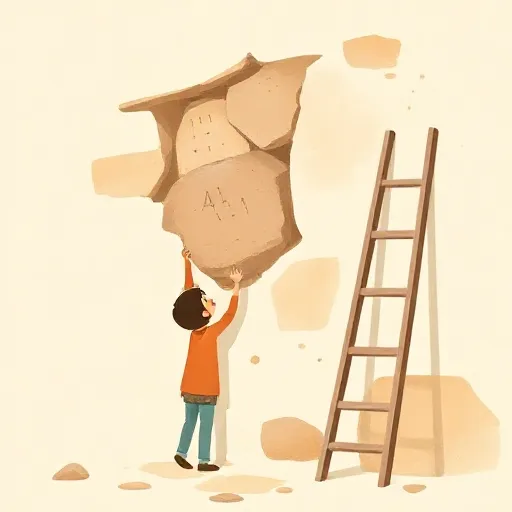
Derrida’s most famous term is deconstruction. Many people think it means “tearing things apart,” but Derrida meant something more precise. Western philosophy, he said, is built on pairs of opposites: good and evil, speech and writing, man and animal, essence and appearance. In each pair, one side is treated as pure, original, and superior, while the other is seen as a fallen copy or a secondary add-on. Derrida’s deconstruction first reverses the hierarchy, showing that the supposedly inferior side is actually necessary for the supposedly superior one to exist at all.
Take the opposition between speech and writing. For centuries, philosophers argued that spoken words connect you directly to your thoughts, while writing is a dead, external substitute. Derrida showed that speech itself works only because it uses repeatable sounds and patterns—exactly the kind of repeatable signs we usually associate with writing. In other words, speech is already a form of writing before any pen hits the page. The trace and différance are at work inside the voice. So the hierarchy flips: “writing” (understood as a system of repeatable marks) is not a degraded copy of speech; it is the condition that makes speech possible.
After the reversal, deconstruction does a second thing. Instead of just keeping the new hierarchy, it redefines the previously inferior term as the “resource” from which the whole opposition springs. Différance is one such resource. It is not another thing in the world, but the movement that made the cut between speech and writing possible in the first place. In this way, deconstruction uncovers what a binary opposition must exclude in order to look clean and natural.
The Worst: When We Try to Be Completely Safe
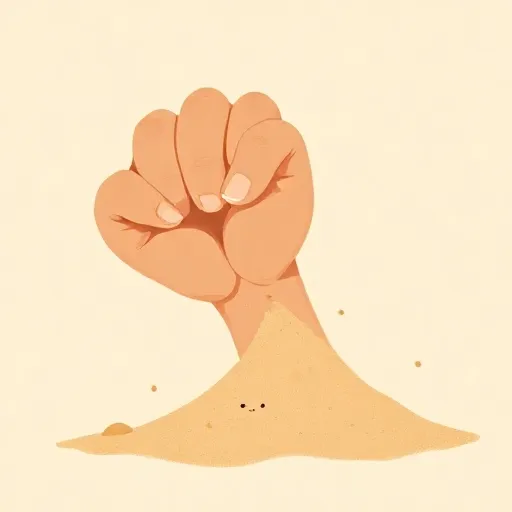
Derrida used these ideas to think about power, violence, and politics. He observed that every sovereignty—a state that wants to rule without sharing power—dreams of being an indivisible, pure “one.” A truly sovereign ruler would not have to give reasons or share decisions. But Derrida argues that this dream is impossible. As soon as a ruler speaks, the language itself is shared, repeatable, and open to others. So sovereignty is always already divided.
The attempt to deny this division leads to what Derrida called the worst. The worst is not just ordinary violence; it is a violence that tries to eliminate everything “other” once and for all. When a community imagines itself as perfectly unified, it must constantly find new enemies inside itself. Derrida called this an auto-immune reaction, like a body attacking its own cells. He saw this danger growing after the end of the Cold War, when enemies became harder to name and the line between “us” and “them” blurred. The result, he said, can be a limitless war against countless others—a tendency toward the worst.
Derrida did not believe this was inevitable. He believed that recognizing how split and shared everything already is can steer us away from the worst violence.
Radical Hospitality: The Door That Must Remain Open
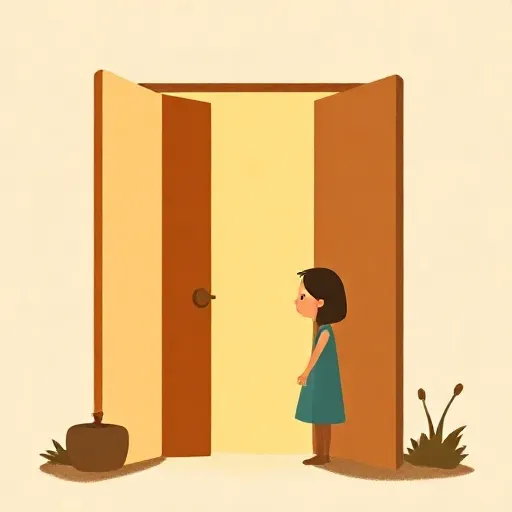
Instead of trying to seal borders completely, Derrida developed the idea of unconditional hospitality. This means welcoming the other without asking for identification, without judging, even when the other is uninvited. It means saying yes to every stranger because every other person is “wholly other”—utterly singular. This openness is, for Derrida, the opposite of the worst.
But unconditional hospitality is impossible. In real life, we have to make decisions: we ask for papers, we close doors, we judge. So hospitality always involves a conflict between the unconditional demand and the practical conditions. The same conflict appears in justice. Derrida described an aporia—a puzzle with no clean exit—at the heart of justice. A just decision must follow the law, but it must also be unique, responding to the singular case. If a judge just mechanically applies a rule, she is a calculating machine, not just. But if she ignores the rule, she is arbitrary. So every decision to be just must go through an impossible moment, a moment Derrida called “the ordeal of the undecidable.” Justice, he said, is never fully present; it is always “to come.”
Deconstruction, then, is not a method that gives you good conscience. It constantly reminds you that no decision is ever perfectly just, and that the work of opening toward others is never finished. Derrida liked to say that deconstruction is on the side of life—a life that accepts its own incompleteness and risk.
Why It Still Matters: The Lines We Draw

Every day, you draw lines. You decide who is your friend and who is a stranger, what is fair and what is not, what is clean and what is messy. These lines feel natural, but Derrida’s philosophy shows that they are never simply given. Every line excludes something, and every exclusion relies on a story about purity that doesn’t hold up. The trace of what you exclude is already inside what you keep.
This doesn’t mean you should erase all lines—that is impossible. But Derrida’s challenge is to keep questioning them. Why is this group treated as the “normal” one? What would happen if you welcomed someone you usually keep out? His thinking doesn’t hand you a neat answer; it hands you a responsibility. It asks you to stay open, to doubt your own certainties, and to remember that every pure “us” is already mixed with a “them.”
Think about it
- If you promise to keep a secret but you have to think about the secret to remember it, are you already sharing it with yourself? Does that mean no secret is ever completely private?
- Can a decision ever be perfectly just if you have to make it quickly, without knowing all the facts?
- Derrida warned that trying to keep a community “pure” often leads to violence. Can you think of a time when people at your school or in your town insisted on purity? What happened?