
If Horses Could Draw Gods, What Would They Look Like?
A Poet Who Dared to Laugh at the Gods
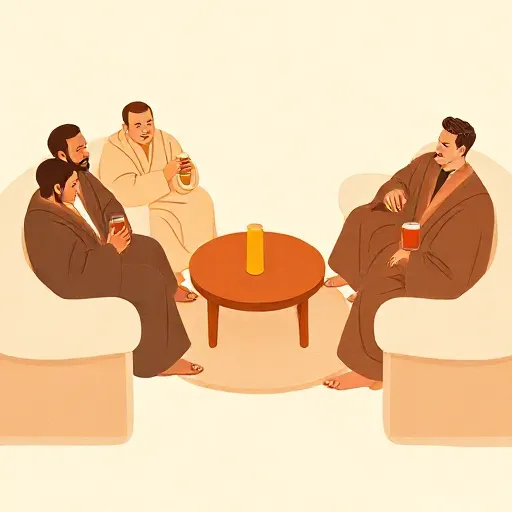
It is a late afternoon around 540 BCE in Colophon, a Greek city on the coast of what is now Turkey. Wealthy men lounge on couches, sipping wine mixed with water. A traveling poet stands to recite his latest work. He is tall, thin, and sun‑weathered from decades on the road. But the verses he begins to sing are not praise of heroes or the gods. Instead, he attacks the most famous poets in Greece, Homer and Hesiod, for telling shameful stories about the divine. The guests shift uncomfortably. This man is Xenophanes (born around 570 BCE, died around 480 BCE), and he is about to change the way people think about gods, nature, and what humans can ever know for certain.
Xenophanes had been thrown out of Colophon as a young man and spent the next 67 years wandering across the Greek world, reciting his own poems at festivals and private gatherings. His verses were often satires—sharp, critical, and designed to make people reconsider everything they took for granted. He especially loved to challenge the stories everyone had heard about the gods.
Gods Who Steal and Lie?
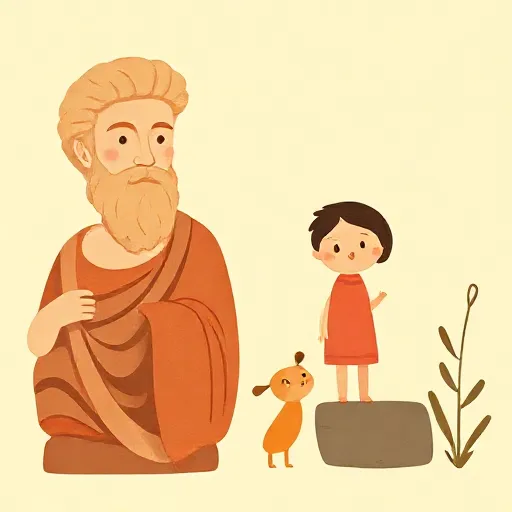
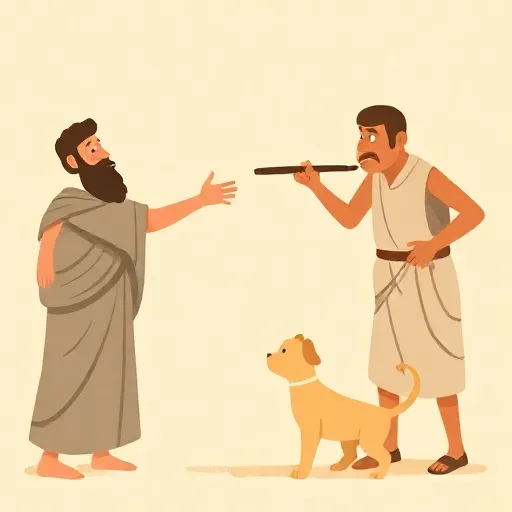
Xenophanes fixed his eye on Homer’s Iliad and Hesiod’s Theogony, the two great texts that shaped Greek religion. In them, gods steal, lie, cheat on their spouses, and trick one another. Xenophanes was blunt. He wrote:
Homer and Hesiod have attributed to the gods all sorts of things that are matters of reproach and censure among men: theft, adultery, and mutual deception. (Fragment B11)
His complaint was not just that these stories were embarrassing. He thought they were wrong because any being worthy of the title “god” must be perfect. A god who steals or betrays cannot be a perfect being. That idea itself was a huge move. Instead of simply repeating myths, Xenophanes used moral reasoning to judge what a god must be like.
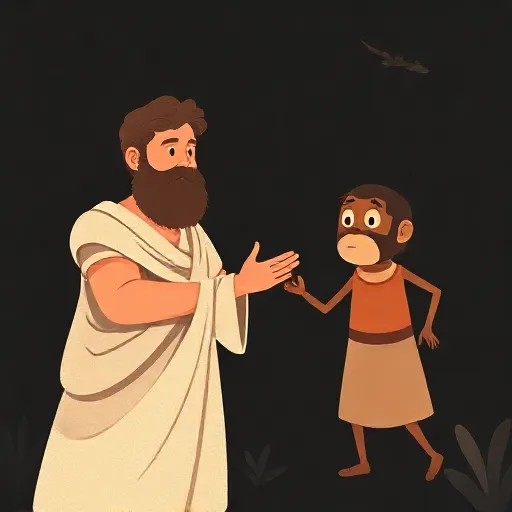
He pushed further. Look around the world, he said: different peoples picture the gods differently. The Ethiopians say their gods are snub‑nosed and black; the Thracians say theirs are blue‑eyed and red‑haired. Then came the line that has echoed for two and a half millennia:
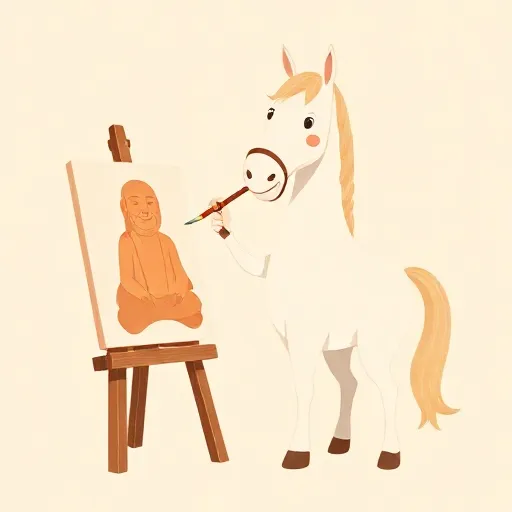
If horses and oxen had hands and could draw pictures, their gods would look remarkably like horses and oxen. (Fragment B15)
This is anthropomorphism—attributing human (or animal) form and behavior to non‑human beings. Xenophanes saw that we constantly remake the divine in our own image. A horse god would have four legs and a flowing mane. A lion god would prowl. It was a brilliant, almost funny observation, but it carried a serious message: our ideas about the gods tell us more about ourselves than about any real divine being.
One Greatest God
If the gods of Homer were hopelessly flawed, what kind of god did make sense? Xenophanes offered his own picture, and it was radically different from anything in Greek popular religion. The most compact statement is Fragment B23:
One god greatest among gods and men, not at all like mortals in body or in thought.
Scholars still argue whether this means only one god exists or simply that there is one greatest god above others. The Greek wording allows both readings. But what matters is the character of this being. It has no human‑shaped body and no human‑style mind. It does not walk, fight, or fall in love. It does not change. Instead, “always he remains in the same place, moving not at all” (B26). Yet somehow this unmoving god “shakes all things by the thought of his mind” (B25).
This is a picture of a god that is pure mind and power, not a character in a story. Xenophanes never wrote a systematic theology—the fragments don’t show him linking divine attributes with logical connectors like “therefore” or “because”—so we cannot be sure how much he connected the dots himself. But the portrait he left behind was completely new: a single, motionless, all‑thinking, all‑powerful being that you could never mistake for a mortal.
The Rainbow Is Just a Cloud

Xenophanes’ mind was not only on the gods. He was intensely curious about the physical world—the sea, the wind, the stars, fossils, and volcanoes. And here he did something just as radical as his theology: he explained natural events without invoking gods at all.
This is easiest to see in his treatment of the rainbow. For every Greek of his time, Iris was a goddess—a winged messenger who zipped between Olympus and the earth, often as a portent. Xenophanes simply erased her. He wrote:
And she whom they call Iris, this too is by nature a cloud. Purple, red, and greenish‑yellow to behold. (Fragment B32)
That little word “this” in Greek is a neuter touto—an it, not a she. The rainbow is just a colorful cloud, hanging there for you to “look at” (idesthai). No divine message. No omen. Just vapor and light.
Xenophanes built a whole physical theory around clouds as a basic substance shaped by the sun’s heat. In his view, the sea is the source of all water, wind, clouds, and rivers (Fragment B30). Moisture is drawn up from the sea by the sun, the sweet fresh part separates out, turns into mist, compresses into clouds, and eventually falls as rain. The sun and moon themselves are “compressed clouds” or “burning clouds.” Even shooting stars and St. Elmo’s fire are tiny glimmering clouds. No god needed.
This was one of the most complete naturalistic accounts of the world to emerge from the early Greek thinkers sometimes called pre‑Socratics—philosophers who lived before Socrates and sought physical explanations for natural phenomena. Without ever using the word “science,” Xenophanes practiced its core habit: explain things by looking at them, not by telling a story about a god.
The Truth No One Has Seen
If the gods are remote and incomprehensible, and if the universe is a vast system of physical processes, what can we humans actually know? Xenophanes’ most famous fragment (B34) lands on a startlingly modest answer:
…and of course the clear and certain truth no man has seen, nor will there be anyone who knows about the gods and what I say about all things. For even if, in the best case, one happened to speak just of what has been brought to pass, still he himself would not know. But opinion is allotted to all.
Let’s unpack this. The Greek word for “clear and certain truth” is saphes (literally “clear” or “manifest”). The historian Herodotus, a near‑contemporary, used saphes for knowledge you could confirm through your own eyes—by traveling to a temple and seeing it for yourself. Gods, however, live in a realm no human can visit. And if you claim to know the one fundamental substance behind all things (as earlier thinkers like Thales did), you cannot possibly observe all things everywhere and always to check your claim. So certain knowledge—epistēmē in later Greek philosophy—about gods and the cosmos is beyond mortal reach.
Xenophanes does not fall into total despair. In another fragment (B35), he says we should accept what we believe when it matches reality: “Let these things be believed as like the realities.” The world still gives us dokos—opinion, conjecture, well‑founded belief. We simply cannot upgrade that opinion to absolute certainty. Many later thinkers called this stance fallibilism: the view that any belief could, in principle, be mistaken.
He also seems to have valued inquiry itself. One fragment (B18) hints that not from the beginning did gods reveal all things to mortals, but in time, by searching, they discover better. The exact wording is debated, but the spirit is clear: humans improve their grip on the world by investigating, traveling, observing, and thinking—not by waiting for a sign from a god.
So Xenophanes stands with one foot in ancient piety (he holds the greatest god in awe) and the other foot in a new world of open‑ended inquiry and natural explanation. He does not dismiss the senses as totally deceptive, as some later philosophers would. Instead, he insists on their limits while trusting them enough to study fossils, volcanoes, and clouds.
Why a 2,500‑Year‑Old Skeptic Still Matters

Xenophanes never founded a school or wrote a single tidy book. Yet his fingerprints are all over later philosophy. Plato, in his Republic, picked up the call to censor shameful stories about the gods. The sharp distinction between knowledge and opinion, which Xenophanes first sketched, became the starting point of Greek epistemology and survives today as the belief‑and‑truth framework for analyzing knowledge. His unmoved divine mind influenced Anaxagoras’s cosmic nous (intelligence) and perhaps Aristotle’s vision of a god who moves the world by thought alone.
His naturalism also took a long time to find its audience. Plato and Aristotle largely ignored his cloud‑based science, preferring accounts of the cosmos that aimed at the “best” or a perfect order. Not until many centuries later did direct observation and purely physical causes become the norm. Xenophanes was, in that sense, a scientist born too early.
You live in a world where we routinely distinguish between what we know and what we merely believe, and where we treat rainbows as light refracting through water droplets, not as a goddess. Those habits started, in part, with a wandering poet who dared to laugh at the gods, imagine horses at an easel, and stare at the sea long enough to see it as the engine of wind and rain.
Think about it
- If you had no way to verify what a god is like, can your guess be better than someone else’s? How would you try to decide whose guess is more reasonable?
- Xenophanes believed that observing nature was the best way to understand the world. Can you think of a time your senses tricked you? Does that mean we can never fully trust what we see?
- Should we judge stories about gods (or any extremely powerful beings) by the same moral standards we use for people? Why or why not?