Why Did Timon Write Poems Making Fun of Every Famous Thinker?
When a Poet Met a Philosopher on a Road to Delphi
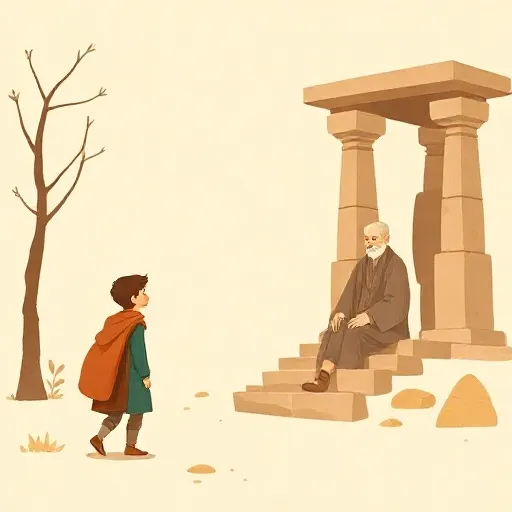
Sometime around 300 BCE, a young man named Timon of Phlius (c. 320–230 BCE) was walking toward the sacred region of Delphi. Near a temple he met Pyrrho of Elis (c. 365–275 BCE), a philosopher with a remarkable reputation: he never got worked up about anything. According to a dialogue Timon later wrote, that encounter turned his life upside down.
Timon had already studied with Stilpo, a thinker from Megara who praised a life of mild feelings and freedom from disturbance. But after meeting Pyrrho, Timon became his devoted follower. He eventually settled in Athens, the buzzing intellectual capital, and lived there for decades. He knew kings, collaborated with poets, and crossed paths with the leading philosophers of the day — Stoics, Epicureans, and the head of Plato’s Academy, Arcesilaus (c. 315–240 BCE). Unlike Pyrrho, who avoided arguments, Timon jumped right into the noisy world of ideas. His weapon was verse, and he aimed it at just about everyone.
The Poem That Turned Philosophy into a Battlefield

Timon’s blockbuster was a poem in three books called the Silloi. In the first book, he spoke in his own voice, mocking one philosopher after another. In the second and third books, he created a dialogue with the long-dead philosopher Xenophanes (c. 570–475 BCE). Timon questioned him about every thinker — the ancients in book two, the more recent ones in book three — and Xenophanes gave answers. The whole thing was a parade of abuse.
Timon lifted his style partly from Cynic diatribes. The Cynics loved to call out tuphos — a Greek word for vanity, the puffed-up nonsense of people who think they have everything figured out. Timon scattered that word and similar insults through his lines. He also borrowed scenes from Homer’s Odyssey, especially the part where Odysseus visits the underworld and meets the dead. Timon would write “I saw” or “I recognized” a long-dead philosopher, as if he were walking among ghosts. He even turned philosophical arguments into literal combat, echoing battle scenes from the Iliad.
Xenophanes got special treatment. Timon called him hupatuphos — “partly free from tuphos” — because Xenophanes had mocked Homer for picturing the gods as lying, cheating humans. But Timon didn’t fully approve; Xenophanes still put forward his own theological ideas, so he didn’t reach total freedom from vanity. Pyrrho alone was atuphos, entirely free.
Zeno of Elea was praised as “double-tongued” for arguing both sides of a question. Democritus was “two-minded.” Timon admired anyone who refused one-sided certainty. Arcesilaus, however, was pictured as an unoriginal fool, even though he was taking the Academy in a skeptical direction. We don’t know exactly why Timon ridiculed him — maybe small differences felt bigger because they shared so much common ground.
Why Did Timon Insult Everyone? The Calm at the Center

Behind all the mockery was a serious philosophy. Pyrrho believed that chasing after fixed truths — about how the universe really works, or what things are in their hidden nature — only creates anxiety. When you stop insisting that you know for sure, your mind quiets down. This state of tranquility was the whole point.
Timon’s few surviving lines about Pyrrho don’t give detailed arguments. Instead, they paint a picture of supreme calm. One fragment says that Pyrrho avoided getting tangled in disputes and speculation. In the Silloi, Timon’s main goal was to evoke an ideal attitude, not to lay out a step-by-step method. He celebrated the person who could let go of the need to win arguments.
To Timon, non-Pyrrhonists were everywhere — dogmatic teachers who puffed themselves up with tuphos, convinced their own system was the final word. The Silloi attacks them for their quarrelsomeness. Pyrrho, by contrast, is shown as someone who simply doesn’t join the fight. That refusal was the real target of admiration.
When “It Tastes Sweet” Is Enough

Even though Pyrrhonists refused to say how things really are, they still had to live in the world. They ate, drank, walked down streets, and made decisions. How? Timon’s answer shaped the whole later skeptical tradition.
In a prose work called On the Senses, Timon wrote, “that honey is sweet I do not posit, but that it appears so I agree.” He didn’t commit to the idea that honey is sweet in its hidden nature. He only accepted that it seems sweet to him. This was a practical solution: let appearances guide your actions, without signing up for any deep theory.
A line from another poem, the Indalmoi, underlined the point: “But the appearance is powerful everywhere, wherever it comes.” Whether the title Indalmoi means “appearances,” “images” of Pyrrho, or even the illusions that trick non-skeptics, the surviving snippets all circle the same idea — you can live normally by following how things strike you, even while you suspend judgment about what they really are.
Timon also insisted that he hadn’t “gone outside sunêtheia,” meaning ordinary experience. Critics had already begun saying that Pyrrhonism made life impossible, because you could never decide anything. Timon fired back: you don’t have to abandon everyday life; you just stop making final pronouncements about its underlying nature. This may have been Timon’s own contribution, prompted by hostile attacks.
Timon’s Own Brainstorms — and How He Didn’t Always Stay Calm

Timon wasn’t only a poet. In a work called Against the Physicists, he jumped into technical debates that Pyrrho would have avoided. He asked whether it’s ever legitimate to assume something “by hypothesis,” the way geometers do. The question suggests he thought accepting things without grounds was a suspicious move — a forerunner of the later Pyrrhonist “Mode from Hypothesis.”
He also made a claim about time: no process that can be divided into temporal parts — like coming into being or perishing — can happen in an indivisible instant. It’s a nearly tautological statement, but someone used it as an argument that the present cannot be indivisible. We don’t know Timon’s own purpose.
These interventions are striking because they show Timon doing exactly what he praised Pyrrho for avoiding: getting entangled in contentious philosophical arguments. He may have been Pyrrho’s most effective spokesman, but he didn’t perfectly embody the ideal himself. And that raises a bigger puzzle. Almost everything we know about Pyrrho comes through Timon. When Timon explains Pyrrho’s outlook, how much is faithful reporting and how much is his own creative extension? For instance, Timon glossed Pyrrho’s slogan “no more” (in Greek, ouden mallon) as meaning “determining nothing and withholding assent.” Was that Timon’s own spin? With so little evidence left, we can’t draw a sharp line.
Why Timon’s Mockery Still Matters

You’ve probably been in a shouting match where both sides are dead certain they’re right. Now imagine someone strolls by and, instead of jumping in, writes a hilarious poem about how ridiculous everyone looks. That’s Timon’s move.
His deep message is that certainty can be a trap. When you absolutely have to prove you know the truth, you often end up agitated, mean, or both. Pyrrho’s tranquillity came from giving up that need. Timon added laughter — a way to pop the balloons of pompous arguments without having to construct a counter-theory.
Today, we still wrestle with the same tension. Social media feeds are full of people stating final truths, and it’s exhausting. Timon’s strategy — treating appearances as enough for daily life, while refusing to claim final knowledge — offers a kind of freedom. You don’t have to decide the ultimate nature of things to get through your afternoon. You can like what tastes sweet without making it a cosmic law. And sometimes, a well-aimed joke is the sanest response to a room full of dogmatists.
Think about it
- If you could never be completely sure about anything, would your life feel more peaceful or more confusing?
- Timon mocked people who claimed to know big truths. When does making fun of someone’s certainty cross a line from helpful to harmful?
- Suppose a friend argues endlessly about the “best” video game. Would it be better to take Timon’s approach — laugh it off and follow appearances — or to search for real evidence?