Why Did a Philosopher Who Loved Logic Tell Wild Stories?
A Dying Man Tells a Strange Story
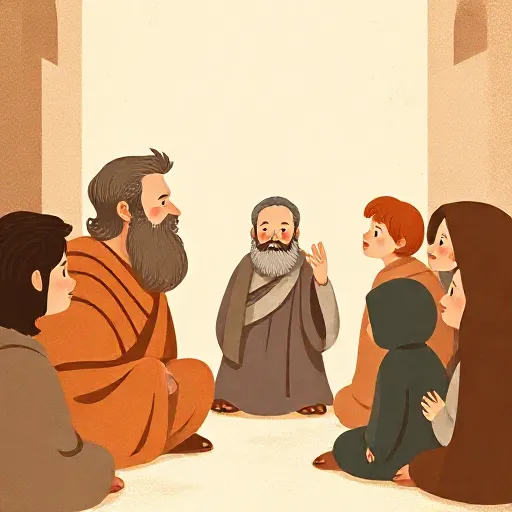
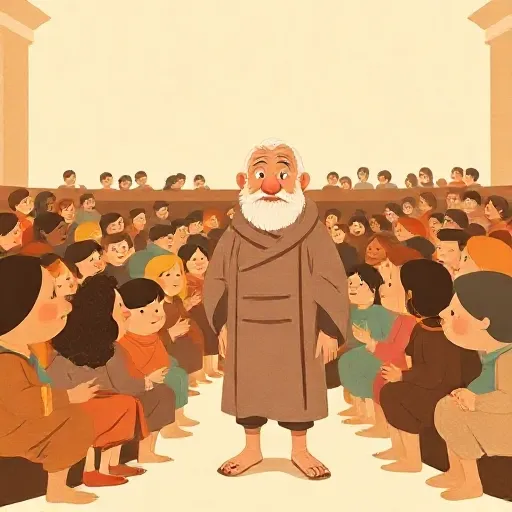
Socrates is about to die. He has just spent hours arguing, step by careful step, that the soul is immortal. His friends nod — the logic seems airtight. Then Socrates does something surprising: he tells a long, fantastical story. Souls travel to a shimmering meadow, face judges, and are sent either upward to rewards or downward into the earth to be punished. The tale is full of colorful geography and mythical rivers. Why would a philosopher who prizes pure reason end his most serious argument with a myth?
This is not an accident. Plato (c. 428–348 BCE) scattered myths throughout his dialogues. You’ll find winged souls, a cosmic spindle, a noble lie about citizens born from the earth, and a craftsman god shaping the universe. Plato even invented the story of Atlantis. If philosophy is about clear thinking, why would its champion fill his books with tales that can’t be checked against reality?
Why Plato Wrote for Everyone
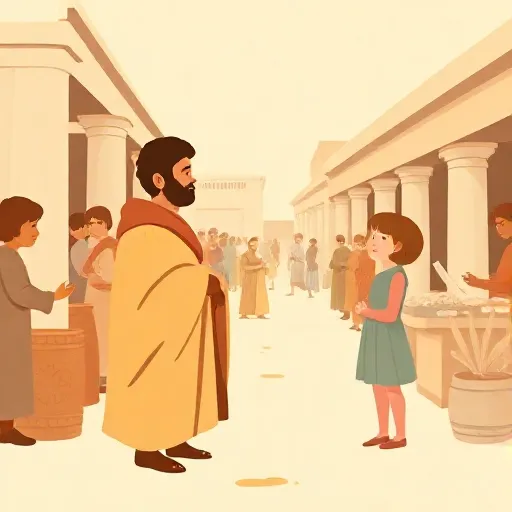
Before Plato, most philosophers wrote dense, technical treatises for small circles of experts. They dealt with “nature,” “being,” and “truth” — not with everyday worries about justice, courage, or how to live well. Plato broke that pattern. He wanted philosophy to reach a wider public, not just specialists. So he wrote dialogues — vivid conversations between historical or fictional characters — that open with a scene you can picture: a walk outside the city walls, a dinner party, a prison cell. The reader is drawn in before any argument begins.
Plato believed the philosopher has a duty to those who do not spend their lives thinking. In his famous cave image, the one who escapes into the sunlight should go back down to help the prisoners. But Plato did not follow Socrates’ habit of questioning strangers in the marketplace. Instead, he addressed the public through written dialogues that mixed reason with storytelling. His myths were one of the tools he used to make philosophy accessible — and convincing — to people who might never read a logical proof.
What Makes a Platonic Myth?
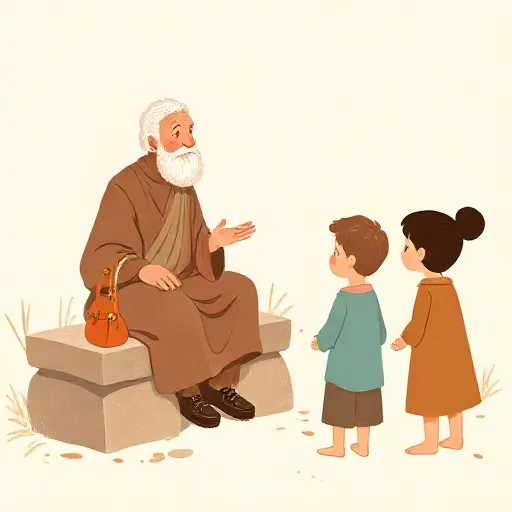
Plato called many of his stories muthoi — the Greek word that gives us “myth.” But not every imaginative story in the dialogues counts. Scholars have identified a core set of Platonic myths with a recognizable shape. They are monologues told by an older speaker to younger listeners. They claim to come from old oral sources, so you can’t test them by observing the world. They are set in the distant past, the afterlife, or among the gods — places beyond our ordinary experience. Their authority rests on tradition, not on rational proof. And they are designed to have a psychological effect: pleasure, comfort, or a motivating impulse that can sometimes move a person more powerfully than an argument.
The myth of Er at the end of the Republic, the story of the winged soul in the Phaedrus, the judgment of souls in the Gorgias — these follow the pattern. The famous Cave, by contrast, is an analogy, not a myth. It does not appeal to ancient tradition or describe the beyond; it simply paints a picture to map onto philosophical ideas. Recognizing the difference helps us see what Plato thought myths could do that analogies could not.
Myth as a Persuasion Backup Plan
Plato was realistic. Most people, he thought, will not build their lives on logical deductions. They need to be persuaded. And myth, he believed, can inculcate beliefs — it can make the non‑philosopher, and even children, believe noble things. In the Republic, the rulers of the ideal city are told a “Noble Lie” — a story that all citizens were born from the earth, with a certain metal mixed into their souls, so they should love their city like a mother. The aim is not to deceive for its own sake, but to create a devotion that pure argument might never spark.
The same pattern appears in the great eschatological myths — stories about the soul’s fate after death. In the Phaedo, after Socrates has finished proving immortality, one friend still admits a small doubt. Socrates immediately tells the myth of the afterlife judgment. He does not pretend the myth is evidence. He says it is “fitting for a man to risk the belief — for the risk is a noble one — that this, or something like this, is true about our souls.” If arguments fail to change your life, a good myth might still charm you into agreement. Myth is the backup; it works where logic leaves hesitation.
Myth as a Teaching Tool
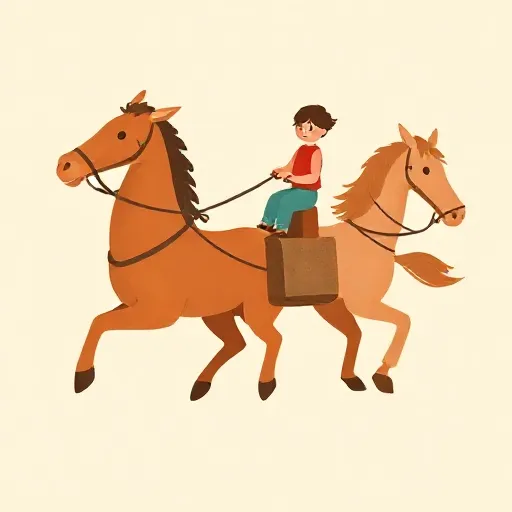
But Plato did not use myths only as a last resort for the unconvinced. Sometimes a myth can embody an abstract philosophical idea, making it graspable. In the Phaedo, Plato develops the theory of recollection — the idea that all learning is really remembering knowledge the soul had before birth. The argument is tight and abstract. Then, in the Phaedrus, he retells the same idea as a myth: souls once traveled through the heavens, glimpsed true reality, and then forgot it when they fell into bodies. Looking at beautiful things in this world triggers faint memories of what the soul saw up there.
The myth does not prove the theory. It assumes the theory is true and dramatizes it. For a reader who finds the logical version too dry, the story of the winged soul provides a handle — a moving picture that the mind can hold onto. The fantastical details (the charioteer, the struggling horses, the steep climb to the rim of heaven) are not meant as literal facts. They are designed to let someone who is not a philosopher grasp the main point: that knowledge is not something poured into you from outside; it is something you already carry, waiting to be awakened.
When Reason and Story Become One
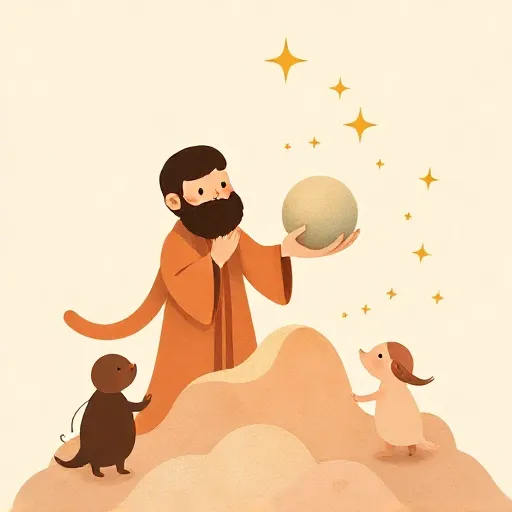
Nowhere does Plato blur the line between myth and argument more daringly than in the Timaeus. The dialogue offers a full account of how the cosmos was made — by a divine craftsman, working from an eternal model, with materials that have a stubborn tendency toward disorder. Plato calls this account an eikōs muthos, often translated as a “likely story” or “probable tale.” But the Greek word eikōs can also mean “reasonable” or “fitting.” So the cosmology is both a probable account — because no human can be certain of the creator’s reasons — and a reasonable one, because it shows the deep rationality of the universe.
This is not a myth told to persuade a non‑philosophical audience to behave better. It addresses experts, and the speaker even submits it to his friends as “judges.” Yet it is still called a muthos. Some scholars think that is because the world of becoming is always fluid and can’t be known precisely. Others think it is because human reason itself has limits, and when it reaches those limits, it has to rely on imagination — on story‑like conjectures that can’t be proved but can be tested and refined with others. On this reading, the Timaeus suggests that myth is not the opposite of philosophy; it is what philosophy does when it pushes beyond what strict logic can guarantee.
That idea opens a deeper possibility. Throughout the dialogues, Plato calls certain philosophical doctrines “myths” — not because they are false, but because they are presented without full step‑by‑step argumentation. Some interpreters argue that, at the deepest level, Plato treats all human reasoning as a kind of provisional story‑telling. Our conclusions are always colored by imagination, always a “likely account” rather than final certainty. Even the dialogue form itself — with its fictional scenes and dramatic twists — turns philosophy into a narrative. If so, it is not just that myth fills in the gaps reason leaves behind; it is that reason itself shares some of the features we associate with stories.
Why Plato’s Myth Trick Still Matters

You do not need to be a philosopher to use Plato’s insight. When you try to explain why something is unfair, a made‑up scenario often works better than a dictionary definition. A story about a stolen lunch can make the idea of justice stick when an abstract rule slides right out of someone’s head. Scientists, too, use thought‑experiments — Schrödinger’s cat, Einstein’s falling elevator — that work exactly like Platonic myths: they are vivid, impossible‑to‑check tales that dramatize a conceptual point.
Plato spent much of his life arguing that true knowledge should avoid images and stories. He even attacked poets in the Republic. And yet he could not — or would not — do without myths. That tension is not a flaw; it is a lesson. Sometimes a story reaches a part of the mind that a proof cannot touch. And sometimes, when you think you are building a perfect chain of reasoning, you are really, in part, telling yourself a story — one you hope is reasonable enough to be true.
Think about it
- If your friend refuses to listen to your logical reasons for sharing snacks, would telling them a story about a greedy squirrel work better? Why or why not?
- Can a made‑up myth about what happens after death teach you something true about how to live right now?
- Plato thought philosophers should use reason alone, but he kept using myths. Does that mean some truths are impossible to prove with logic alone?