Why Did Medieval Philosophers Hide Their Real Ideas?
A Boy, an Island, and a Secret Message
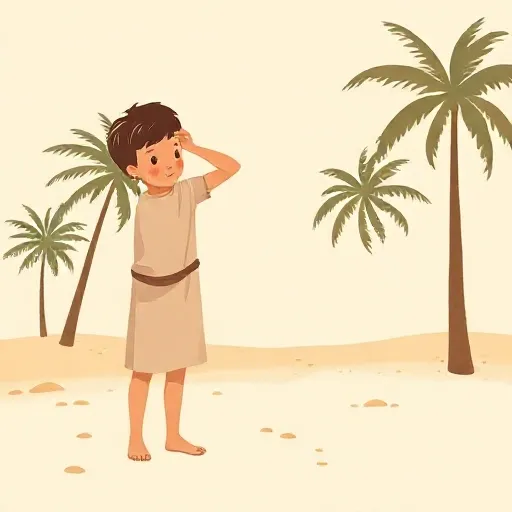
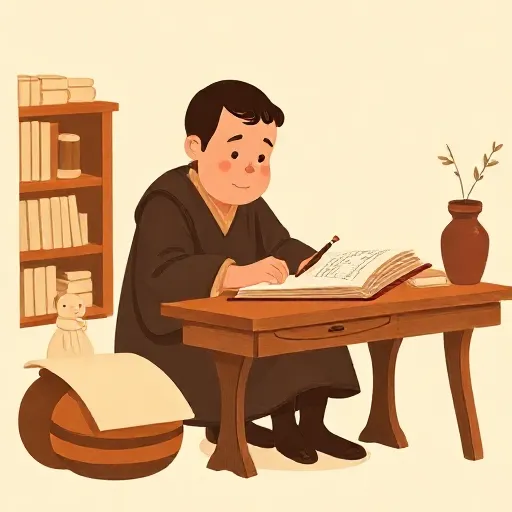
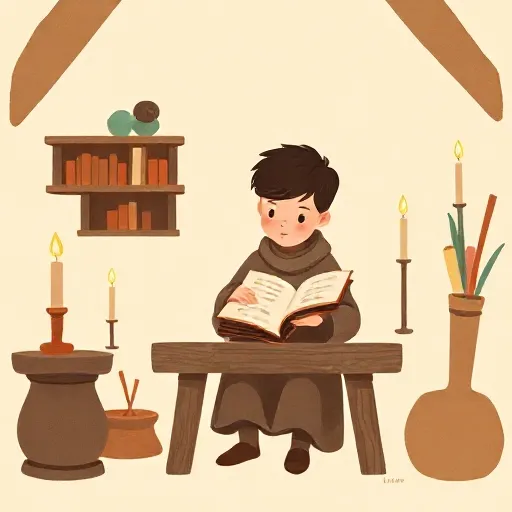
Around the year 1180, a Muslim philosopher in Spain named Ibn Tufayl (c. 1105–1185) wrote a strange book. It told the story of a boy abandoned on an island and raised by a gazelle. With no teachers or books, the boy figures out how to survive, then how the stars move, then what the universe must be made of — and finally, he seems to touch the divine. The book was called Hayy ibn Yaqzan, and Ibn Tufayl claimed it revealed the secrets of an even earlier philosopher, Avicenna. But why would anyone write philosophy as a made‑up adventure? Was the real philosophy hidden inside the tale?
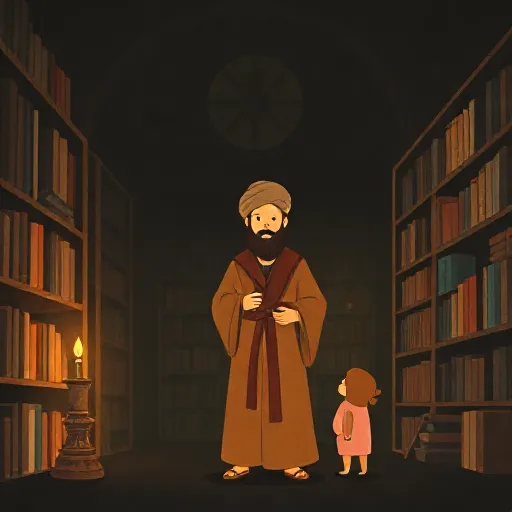
Ibn Tufayl was not alone. All through the Middle Ages, from Baghdad to Paris, thinkers poured their most serious ideas into stories, riddles, dialogues, and highly choreographed public debates. They did this deliberately, and the shape they chose — the literary form — was never just packaging. Understanding why a writer picked an allegory instead of a straightforward argument gets us closer to what they really meant, and sometimes to what they dared not say out loud.
From Cosmic Allegories to Hidden Truths
The most eye‑catching form is allegory. An allegory is a story where characters, objects, and events stand for something else — usually a moral or philosophical idea. Medieval allegory grew from Neoplatonist teachers who read Plato and Homer as if every detail pointed to a soul’s journey toward the One, the ultimate source of everything. Avicenna (980–1037) wrote two famous allegories on just that pattern. In his Treatise of the Bird, a flock of birds flies across nine mountain ranges, each one a dangerous temptation. The journey is really about the mind climbing through levels of knowledge and desire.
Christian Latin thinkers joined in. In the 12th century, Bernard Silvestris composed the Cosmographia, an allegory in which a figure named Natura begs a divine mind called Noys to bring order to chaotic matter. The poem tells the creation story as a vivid myth, yet it is packed with science and philosophy. Writers like Bernard didn’t see myth and science as opposites; they wove them together.
Why choose this form? There are at least three rival answers, and scholars still argue about them. One view says allegory is a teaching tool — a way to make hard, abstract ideas easier to picture. On this reading, you could strip away the birds and mountains and end up with the same philosophy. A second answer insists that some truths about God or mystical union are simply too big for literal language. Allegory gestures toward something that cannot be said plainly. The third answer is more uncomfortable: maybe allegory was a disguise. The famous 20th‑century thinker Leo Strauss argued that many medieval Jewish and Islamic philosophers hid their real views behind innocent‑looking stories so they would not be persecuted, or because they believed most people could not handle the truth.
The philosopher Maimonides (1138–1204), who wrote in the 12th century, explained in the introduction to his Guide for the Perplexed that he planted deliberate contradictions. A casual reader would see one message; a careful reader would find another. So when you encounter an allegory from this period, you are looking at a text that may have a public face and a private one — and there is no sharp consensus about which is the “real” one.
Talking It Out: Dialogue and Disputation
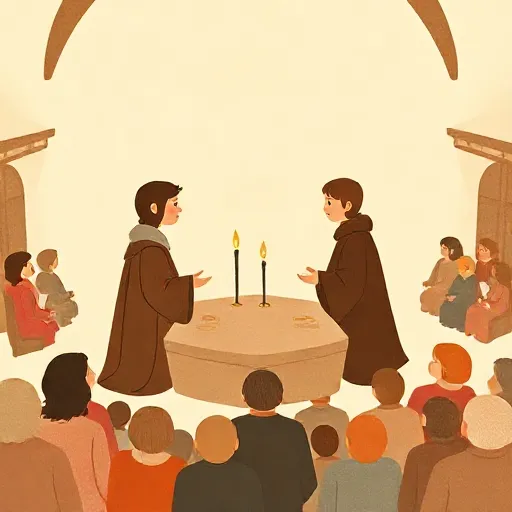
Allegory wasn’t the only form that put multiple voices on stage. Medieval writers also loved dialogue, a form that lets characters argue with each other directly. In the 12th century, Peter Abelard (1079–1142) wrote a dialogue among a philosopher, a Jew, and a Christian. He called it the Collationes. No single character is the teacher; all three are equals, and the judge who is supposed to settle the debate never actually speaks. Abelard leaves the quarrel hanging.
The dialogue was not just a way to play with ideas safely. In the Latin West, as the first universities took shape, dialogue evolved into the disputed question (or quaestio). This was a structured public debate: students marshaled arguments for and against a proposition, a master gave his determination, and then he answered every objection one by one. Even the most explosive topics — does God exist? can the world be eternal? — were examined out loud, with reasoning from both scripture and Aristotle.
The historian Alex Novikoff calls this the institutionalization of conflict. It was both daring and controlled. You could question almost anything, but only inside a tightly scripted format, under the eye of the Church. The form taught a habit: to think well, you must first build the strongest possible case against your own view and then respond to it. That habit still shapes philosophy classrooms today.
The Summa: Building a Cathedral of Ideas
By the 13th century, a new ambition took hold: to organize an entire field of knowledge into a single, logical order from first principles all the way to the last detail. The result was the summa, a comprehensive written work that no longer followed the order of the Bible or any other ancient book.
Thomas Aquinas (1225–1274) produced the most famous summa, the Summa Theologiae. He designed it for beginners, but it was anything but simple. Every topic became a question: whether God exists, whether human law binds in conscience. Then he listed objections, gave his own answer, and replied to the objections. The structure mirrors the movement of a disputation, but Aquinas arranged the questions not as a live debate but in a careful sequence that moves from God, to human nature, to Christ.
What mattered was the emancipation from textual authority. Earlier writers had often taken a book — Aristotle’s Physics, say, or the Book of Genesis — and commented on it line by line. Aquinas instead let the inner logic of the subject decide the order of topics. It was a quiet revolution: for the first time in the Latin tradition, a philosophical and theological work was organized purely according to reason’s own map.
Hiding in Plain Sight: The Puzzle of Esotericism

If forms could allow open debate, they could also allow silence. The question of esotericism — writing that deliberately hides a deeper meaning — runs through nearly every genre. Leo Strauss argued that philosophy in the medieval Islamic and Jewish worlds was a politically dangerous activity because revelation was law, not just belief. A philosopher who questioned the official understanding of the law risked everything. So, Strauss claimed, writers like Avicenna, Averroes (1126–1198), and Maimonides developed an “exoteric” surface for ordinary readers and an “esoteric” core for the few who could read between the lines.
Many scholars today push back. They point out that we are too quick to assume that statements that sound “Aristotelian” and ones that sound “more religious” are contradictory. Medieval thinkers often saw them as compatible. Moreover, after the famous Condemnation of 1277, when the bishop of Paris banned a long list of philosophical propositions, Latin authors learned to use careful phrases — such as dico recitative, “I am speaking in a reporting way” — to make clear they were describing a position, not endorsing it. The boundary between sincere belief, scholarly caution, and genuine disguise is hard to draw. That very difficulty is part of the philosophical interest: the form of a text forces us to ask not only what it says, but what it is doing.
What Medieval Forms Teach Us Today

You have probably never written an allegory about a flock of birds, or a disputed question with formal objections and replies. But you still face the same choice that confronted medieval thinkers every time you start to argue: what shape should your thinking take? A persuasive essay that moves straight from thesis to evidence? A story that lets a character live out a dilemma? A structured classroom debate where you must defend both sides?
Medieval philosophers teach us that form is never neutral. A summa can display the grand order of a whole science; a dialogue can leave a truth unstated and force you to wrestle with it. An allegory can protect a dangerous thought or express a mystery that plain sentences would flatten. The modern habit of treating “straightforward argument” as the only proper shape for philosophy is itself a choice — one that was shaped, in part, by the medieval university’s love of disputation and the eventual reception of Aristotle’s Posterior Analytics as the model for science.
The next time you try to explain a big idea, ask yourself: would this be clearer as a debate, a letter, a story, or even a careful diagram? The answer might change what you are able to say. And if you ever find yourself hiding an unpopular view inside a fictional world, remember — you are doing something very old, and very philosophical.
Think about it
- If you had a bold idea that might get you into trouble with your family or community, would you write it in a story or a code, or would you say it openly? What might you gain or lose?
- Can some truths only be expressed through a story, not a plain argument? Think of something you understand because of a tale, not because someone listed reasons.
- Most philosophy today is written as essays. Does that form limit what questions we ask or how we think? If you had to present a philosophical idea in a different form, what would you choose and why?